

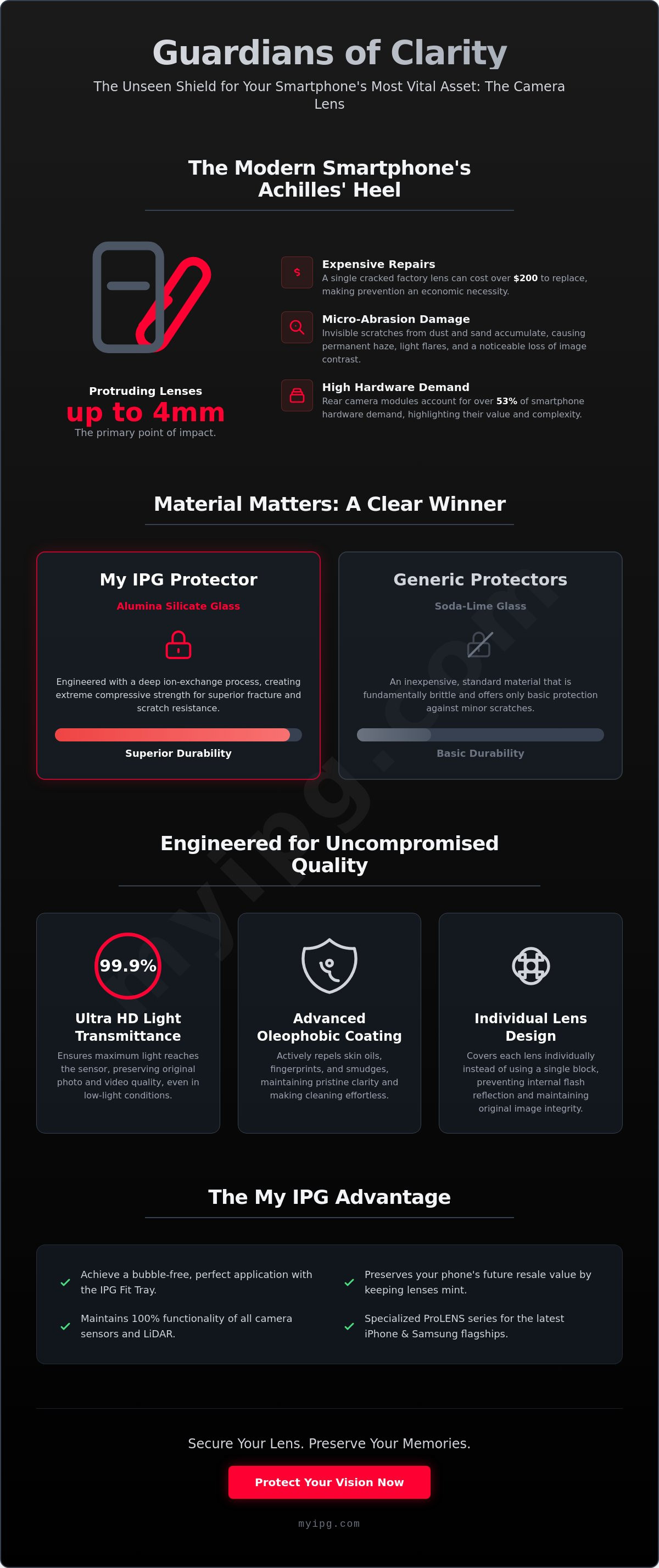
With rear-primary camera modules now accounting for over 53% of smartphone hardware demand, your lens is no longer just a feature; it's the most vulnerable asset you own. You've likely felt that sharp spike of anxiety when setting your phone down on a rough surface, fearing the inevitable scratch on those protruding optics. It's a valid concern. Modern camera bumps can protrude up to 4 millimeters, making them the primary point of impact during every drop or slide. Protecting this hardware is essential for anyone who values their device's longevity and performance.
Installing a My IPG phone camera lens protector ensures your high-end optics remain pristine without sacrificing a single pixel of quality. We understand the fear that a protector might cause blurriness or trap annoying air bubbles. This guide will show you how advanced Alumina Silicate tempered glass preserves 100% image clarity while acting as a dedicated guardian for your technology. You'll learn the technical differences between materials, the secrets to a flawless application, and how to maintain zero impact on your low-light photography while securing your phone's future resale value.
Key Takeaways
- Master the material science of Alumina Silicate to ensure maximum ion-exchange capacity and superior scratch resistance.
- Achieve a bubble-free, professional application of your IPG Phone camera lens protector using the IPG Fit Tray and specific dust-reduction techniques.
- Verify how 99.9% light transmittance maintains Ultra HD clarity and prevents sensor starvation in low-light environments.
- Evaluate the optical advantages of individual lens covers over full-block protectors to maintain original image integrity.
- Identify the specialized engineering behind the ProLENS and ProActive series designed for the newest flagship iPhone and Samsung devices.
The Vulnerability of Modern Multi-Lens Smartphone Arrays
Modern flagship devices are engineering marvels, but they possess a glaring structural vulnerability. The race for superior optical zoom and larger sensors has forced manufacturers to extend camera modules significantly beyond the phone's chassis. These protrusions, often reaching 3 to 4 millimeters, act as the primary contact point whenever you place your device on a surface. Without an IPG Phone camera lens protector, your high-value optics are essentially acting as the phone's "feet."
Every slide across a cafe table or drop into a pocket creates friction. This constant interaction is not just a cosmetic risk; it's a direct threat to your photographic integrity. A dedicated lens cover serves as a critical sacrificial layer. It's designed to absorb the kinetic energy of an impact and the abrasive force of surface contact so your factory glass doesn't have to. If the protector scratches or cracks, it has done its job. You simply replace the layer, not the lens.
The Physics of Protruding Camera Modules
The trend toward multi-lens arrays in devices like the iPhone 17 and Samsung Galaxy S25 has changed the physics of device safety. Gravity and surface friction now target the most expensive components first. When a phone falls flat, the protruding lenses endure the concentrated force of the impact. This design choice makes a protector an economic necessity. Repairing a cracked sapphire lens can exceed $200, while a precision-engineered protector costs a small fraction of that amount. Prevention is the only logical strategy for maintaining hardware integrity.
Micro-Abrasion: The Silent Killer of Image Sharpness
Don't be misled by marketing terms like "sapphire-coated glass." While these materials are durable, they aren't invincible. Common environmental elements like sand and household dust often contain quartz, which is harder than most smartphone glass. These microscopic particles create tiny scratches that accumulate over months of use. This damage is often invisible to the naked eye but devastating to your photos. Consider the following risks:
- Light Scattering: Small scratches catch incoming light, creating a permanent "haze" or flare in your images.
- Contrast Loss: Micro-abrasions reduce the lens's ability to resolve fine detail, leading to washed-out colors.
- Coating Degradation: The acidity in fingerprints and oils can slowly eat away at factory anti-reflective coatings.
An IPG Phone camera lens protector creates a barrier against these silent killers. By shielding the original glass from micro-abrasions, you ensure that every photon of light reaches your sensor exactly as intended. Protect your vision. Preserve your resale value. Stop the haze before it starts.
Material Science: Why Alumina Silicate Outperforms Standard Glass
Most generic protectors rely on soda-lime glass, a material that is inexpensive but fundamentally brittle. When you choose an IPG Phone camera lens protector, you are upgrading to Alumina Silicate. This advanced material is engineered for extreme environments where failure isn't an option. The difference isn't just surface-level; it's molecular. Aluminosilicate glasses possess a unique chemical structure that allows for deeper chemical strengthening. This results in a product that handles direct kinetic energy with far greater efficiency than standard alternatives. It provides a robust defense against the accidental impacts that often occur during daily use.
My IPG achieves 99.9% light transmittance, ensuring that your sensor never suffers from light starvation. This transparency is maintained through a sophisticated oleophobic coating. This layer repels skin oils and environmental moisture, preventing the smudges that typically degrade image contrast. By managing both physical durability and surface cleanliness, My IPG provides a protective barrier that remains invisible to your camera's high-resolution sensor. This stewardship over your device ensures that your photographic capabilities are never hindered by your choice of protection.
The Molecular Advantage of My IPG ProLENS
The strength of our glass comes from a rigorous ion-exchange process. During manufacturing, smaller sodium ions on the glass surface are replaced by larger potassium ions. This creates a state of deep compression. It's this internal tension that gives the glass its incredible fracture toughness. While generic competitors stop at basic 9H pencil hardness, My IPG focuses on impact dispersion. Our materials are designed to bend and absorb energy before a crack can even initiate. This specialized register of durability signals our expertise in the niche of high-end device preservation. It's a professional-grade solution for users who demand the highest level of security for their hardware. You can find these advanced materials in our My IPG Camera Lens Protector for iPhone Samsung Tempered glass collection.
Optical Clarity and Light Transmittance
Precision optics require a perfect refractive index. If a protector isn't engineered correctly, it can cause light to bounce between the glass layers, leading to ghosting or flare in your photos. My IPG utilizes anti-reflective (AR) treatments to eliminate these internal reflections. This ensures that features like LiDAR scanners and flash sensors function with 100% accuracy. We don't just cover the lens; we integrate with it. Every IPG Phone camera lens protector is cut to exact specifications to avoid interfering with the complex sensor arrays found in modern flagship devices. The result is HD clarity that looks exactly like the factory glass, only much stronger. By maintaining this level of transparency, My IPG remains a trustworthy partner in maintaining the integrity of your personal devices.
The Image Quality Debate: HD Clarity vs. Light Refraction
The primary concern for any mobile photographer is whether an extra layer of glass will degrade their work. It's a fair question. High-resolution sensors, often exceeding 48MP in modern flagships, are incredibly sensitive to optical interference. If the secondary glass isn't precision-engineered, the sensor essentially "starves" for clean data, resulting in muddy textures and flattened colors. When evaluating the impact on image quality, the data shows that material purity and fit are the only factors that matter. A high-quality IPG Phone camera lens protector uses Alumina Silicate to ensure that every photon reaches the sensor without deviation.
Optical integrity isn't just about the glass itself; it's about how that glass interacts with light. Cheap protectors often cause light refraction, which manifests as a loss of sharpness or strange color shifts. This is especially noticeable in night mode or low-light environments where the camera is struggling to pull in every bit of available light. By using optically neutral materials, IPG maintains the factory-standard light path. Your 48MP sensor remains a high-performance tool, not a compromised one.
Individual Lens Covers: The Precision Choice
There is a significant design divide between full-block protectors and individual lens covers. Full-block designs cover the entire camera island with a single sheet of material. This often leads to "flash bleed," where light from the LED flash travels through the protector material and leaks directly into the camera sensor. The result is a foggy, washed-out image. Individual rings for each lens solve this problem entirely. They maintain the phone's original aesthetic and prevent moisture from being trapped in the large gaps found in block designs. It's a more surgical, effective approach to protection.
Eliminating Lens Flare and Ghosting
Ghosting occurs when light bounces between the factory lens and the protector, creating a mirror image of bright light sources in your frame. This is a symptom of poor-quality adhesives or an air gap between the layers. IPG uses a specialized, optically clear adhesive layer that minimizes the refractive index change between the glass surfaces. This reduces internal reflections to near-zero levels. You can test your IPG Phone camera lens protector by taking a photo of a streetlamp at night. If you don't see a secondary "ghost" of the lamp, your protector is performing with professional-grade neutrality. We don't just protect the hardware; we protect the art you create with it.
Precision Fit and Zero-Dust Installation Strategies
Optical perfection depends entirely on the quality of the seal between your factory glass and the protector. Even a single microscopic particle can create an air pocket, leading to localized refraction and ruined shots. Your high-end optics deserve a laboratory-grade environment during application. Achieving a flawless, bubble-free result with an IPG Phone camera lens protector requires a methodical approach to environmental control and precision alignment.
The secret to a professional finish lies in managing static electricity. Dust particles are naturally attracted to the glass surfaces of your phone. By using the specialized IPG Fit Tray, you eliminate the guesswork of manual alignment while simultaneously neutralizing the static charge that pulls debris toward your lenses. This ensures the adhesive bonds instantly and purely to the surface, maintaining the optical neutrality we discussed in previous sections.
The "Zero Dust" Masterclass
Success begins with your environment. While the "steamy bathroom" trick is an old industry staple, it remains highly effective for modern installations. The high humidity grounds floating dust particles, preventing them from landing on your lenses during the critical seconds between cleaning and application. Follow this rigorous protocol for the best results:
- Sanitize: Use the provided high-purity alcohol wipe to remove all skin oils and factory coating residues.
- Dry: Buff the area with a lint-free microfiber cloth until the surface is completely streak-free.
- Static Sweep: Use the dust-removal sticker to lift any stubborn micro-fibers.
- Align and Press: Place the IPG Fit Tray over the camera module and apply firm, even pressure from the center outward.
If you discover a trapped speck after the tray is removed, don't panic. Our IPG Phone camera lens protector is designed for resilience. Use a thin plastic card to gently lift the edge of the protector. Insert a dust-removal sticker to "grab" the particle from the adhesive side, then let the protector settle back into place. Avoid using your fingernails, as this can deform the adhesive layer. For the ultimate clean-room experience, consider the IPG Zerodust Screen Protector system to prep your entire device.
Long-Term Maintenance and Removal
Once installed, your protector requires minimal but specific care. Clean the surface using only water or specialized lens cleaners. Avoid harsh household chemicals that can strip the oleophobic layer. This coating is what keeps your photos crisp by repelling oils. If you notice the coating wearing down or see a crack in the protector glass, it's time for a replacement. This "fatigue" in the sacrificial layer means it has absorbed all the energy it can. To remove it safely, apply gentle heat from a hairdryer for ten seconds to soften the adhesive, then lift from one corner. Your original lens will emerge in factory-fresh condition, preserved perfectly beneath the shield.
The IPG ProLENS Advantage: Guardian of Your Vision
Since 2011, My IPG has operated as a dedicated specialist in device preservation. We don't just manufacture accessories; we provide stewardship over the technology you value most. The IPG Phone camera lens protector is the result of over a decade of material innovation. It represents a commitment to protecting your vision without compromising the sophisticated engineering of your smartphone's optics. We understand the financial and emotional value of your hardware, and our products reflect that meticulous care.
Our ProActive technology sets a new benchmark in the industry. It utilizes a hybrid construction that combines the impact-absorbing flexibility of our My IPG Original (Hydrogel) Screen Protector with the high-density scratch resistance of Alumina Silicate tempered glass. This dual-layer approach ensures that your lens is protected against both sharp micro-abrasions and high-velocity kinetic impacts. While we've discussed the molecular strength of these materials in previous sections, the ProActive difference is about how these materials work in harmony to provide a resilient, invisible barrier.
We recognize that a lens protector is part of a larger protective ecosystem. Our designs undergo rigorous testing to ensure 100% compatibility with leading third-party cases. The precision-cut edges are tapered to prevent the "pop-off" effect often seen with generic, oversized covers. Your shield stays locked to your lens, regardless of the armor you choose for your phone. This focus on functional clarity ensures your device remains slim, protected, and fully operational.
Tailored Protection for Flagship Devices
We synchronize our manufacturing cycles with global hardware launches to ensure Day 1 availability for flagship devices. Whether you're upgrading to the iPhone 17 Pro Max or the latest Samsung Galaxy S series, our IPG Phone camera lens protector is engineered to match the exact specifications of your new sensors. By designing our protectors alongside the latest hardware releases, we achieve a level of fit and finish that generic brands cannot match. This allows us to account for the specific light filtration requirements and sensor placements of the newest high-resolution arrays.
Sustainable and Reliable: The My IPG Commitment
Durability is the ultimate form of sustainability. A protector that lasts the entire lifespan of your device reduces environmental waste and saves you from the cycle of constant replacement. The My IPG "We Protect What We Love" philosophy is more than a slogan; it's a methodical approach to engineering. We build products that are resilient, reliable, and optically neutral. Don't leave your most valuable tool vulnerable to the elements. Secure your device today and experience the peace of mind that comes with professional-grade protection and a global reputation for excellence.
Secure Your Photographic Future
Your smartphone's optical array is a precision instrument that demands professional stewardship. By choosing an IPG Phone camera lens protector, you've invested in a sophisticated barrier that balances 9H Hardness Alumina Silicate Glass with 99.9% light transmission. You now understand how individual lens covers prevent flash bleed and how our Zero Dust Auto-Alignment Technology removes the anxiety of a messy installation. This isn't just about avoiding a scratch. It's about preserving the absolute clarity of every memory you capture.
Trusted by over 1 million users worldwide, My IPG remains the dedicated specialist for those who refuse to compromise on performance. You don't have to choose between security and image quality when the right material science is at your fingertips. Take the final step in safeguarding your device's most vulnerable hardware and maintain your phone's resale value for years to come.
Shop the IPG ProLENS Collection for Invisible Protection
Keep your vision sharp and your lenses pristine.
Frequently Asked Questions
Do IPG camera lens protectors affect the quality of my photos?
IPG protectors maintain 100% of your camera's original optical performance. We utilize Alumina Silicate glass with 99.9% light transmission to ensure no sensor starvation or color shifting occurs. Your high-resolution 48MP+ photos will look exactly as they did before installation. The optical neutrality of our materials ensures that your sensor receives clean, undistorted data in every frame.
Can I use a lens protector with my existing phone case?
Yes, our protectors are engineered with a precision-fit design that remains compatible with the majority of third-party cases. We taper the edges of the IPG Phone camera lens protector to prevent interference with case lips. This ensures your camera shield stays securely bonded without being pushed off by your phone's armor. It's a seamless integration designed for total device security.
What is the difference between tempered glass and hydrogel for camera lenses?
Tempered glass provides rigid 9H hardness for maximum impact dispersion and scratch resistance. Hydrogel, like our IPG Original (Hydrogel) Screen Protector, offers superior flexibility and self-healing properties for curved surfaces. For lenses, we recommend the ProActive series. It combines the strengths of both materials to provide a resilient, invisible barrier for your hardware.
How do I remove a camera lens protector without damaging the phone?
Removal is safe and straightforward when done correctly. Apply gentle heat from a hairdryer for about ten seconds to soften the adhesive layer. Use a thin plastic tool or your fingernail to lift one corner carefully. The protector will peel away without leaving any permanent residue on your factory lens housing. Your lenses will emerge in the same condition they were in on the day of installation.
Will the lens protector interfere with my phone’s flash or LiDAR sensor?
No, our individual lens designs include precision cutouts for sensors and flash modules. This prevents "flash bleed" where light reflects into the camera lens and ruins the shot. Every IPG Phone camera lens protector is tested to ensure LiDAR scanners and autofocus systems maintain full operational accuracy. We don't just cover the lens; we integrate with the device's sensor array.
Why should I choose Alumina Silicate glass over standard tempered glass?
Alumina Silicate offers significantly higher ion-exchange capacity than standard soda-lime glass. This molecular strengthening creates a deeper compression layer that is far more resistant to fractures and deep scratches. It handles direct kinetic energy with much greater efficiency. It is the professional choice for protecting high-value smartphone optics from real-world impacts and surface friction.
How does the Zero Dust installation tray work?
The IPG Fit Tray utilizes static-neutralizing technology to ground floating dust particles before they can land on your lens. It provides a physical guide that aligns the protector perfectly with your camera module. This system eliminates the human error often associated with manual application. It's a methodical, fast-paced solution that ensures a crystal-clear seal every time you apply a new protector.
What should I do if I see bubbles under my lens protector after installation?
Most small air pockets can be removed by applying firm pressure with a microfiber cloth and pushing them toward the nearest edge. If a bubble is caused by a trapped dust speck, you can gently lift the edge and use a dust-removal sticker to grab the particle. The adhesive is designed to re-settle once you release the protector. This allows for quick troubleshooting without wasting the product.