
Imagine tracking a school of trophy fish when the afternoon sun hits the water. Suddenly, your high-definition display becomes a blinding reflection of the sky. It's more than an annoyance. It is a direct barrier to your success. Installing a high-quality anti glare fish finder screen protector is the most effective way to reclaim your visibility. Keep your focus on the fish, not the glare.
We understand your marine electronics are a significant investment. You shouldn't have to choose between protecting your screen from salt spray and maintaining sonar clarity. It's a common fear that adding a layer of film will make the image fuzzy or unresponsive. We're here to show you that the right material, originally engineered for the U.S. Air Force, can actually enhance your experience. Learn how to eliminate sun glare and safeguard your expensive glass without sacrificing technical precision.
This 2026 visibility guide breaks down the performance of hydrogel versus tempered glass. We examine light filtration properties, impact resistance, and the specific benefits of oleophobic coatings for easier cleaning. This guide provides the technical insights needed to secure your gear and optimize your performance on the water.
Key Takeaways
- Understand how matte finishes neutralize the mirror effect on high-gloss marine displays to ensure sonar data remains visible at any sun angle.
- Compare the structural integrity of hydrogel versus tempered glass to find the ultimate defense against lead sinker strikes and salt abrasion.
- Select the ideal anti glare fish finder screen protector by balancing light diffusion with optical clarity to prevent image haze.
- Master the field-installation process to achieve a bubble-free, Zero Dust finish even in challenging, windy environments on the water.
- Discover how custom-fit marine-grade shielding manages heat and UV exposure to extend the operational lifespan of your 2026 electronics.
Why Your Fish Finder Screen is Unreadable in Direct Sunlight
Your fish finder is a high-performance computer designed for precision. In the retail showroom, that glossy screen looks premium and sharp. On the open water, it becomes a liability. High-gloss marine displays suffer from specular reflection, commonly known as the mirror effect. This occurs when light bounces off the smooth surface at the same angle it strikes. Instead of seeing your side-scan data or bottom contours, you see a perfect reflection of the sky and clouds. It's a fundamental physics problem that turns your most valuable tool into a blank mirror.
Direct UV exposure adds another layer of risk. Intense sunlight doesn't just cause blinding glare; it generates significant heat. Without a specialized anti glare fish finder screen protector, your device absorbs excessive thermal energy. This heat can eventually degrade the bonding agents within the display and shorten the lifespan of internal components. Furthermore, the conflict with polarized fishing sunglasses is a constant struggle. Many factory coatings aren't optimized for polarization, leading to "blackout" spots or distorted rainbow patterns when you tilt your head.
Standard phone protectors are not the solution. They are engineered for controlled, indoor environments. In a high-moisture marine setting, standard adhesives fail. Constant temperature swings and salt-heavy humidity cause generic films to bubble, peel, and trap moisture against your expensive glass. You need a solution built for the elements. Understanding The Science of Anti-Glare is the first step in protecting your investment and your vision.
The Cost of Poor Visibility on the Water
Invisibility has a price. Missing a subtle sonar arch because of a surface reflection can be the difference between a successful tournament and a total bust. Poor visibility also takes a physical toll. Squinting at a washed-out screen for an eight-hour day causes severe eye strain and "screen fatigue." Most importantly, safety is at stake. When navigation charts are obscured by glare, identifying depth contours or submerged hazards becomes a dangerous guessing game.
Factory Screen Limitations
Manufacturers often prioritize "showroom" gloss because it makes colors look vibrant in a controlled environment. This prioritizes aesthetics over on-water utility. Unprotected factory glass is also highly vulnerable to the marine environment. Consider these risks:
- Salt Abrasions: Salt spray dries into sharp, microscopic crystals.
- Sand Friction: Swiping a touchscreen with grit on your fingers acts like sandpaper on the glass.
- Micro-Scratches: Over time, repeated cleaning of unprotected screens creates a haze that permanently reduces clarity.
A dedicated anti glare fish finder screen protector acts as a sacrificial barrier. It preserves the integrity of the factory glass while diffusing harsh light to ensure your data remains actionable.
The Science of Anti-Glare: Diffusion vs. Reflection
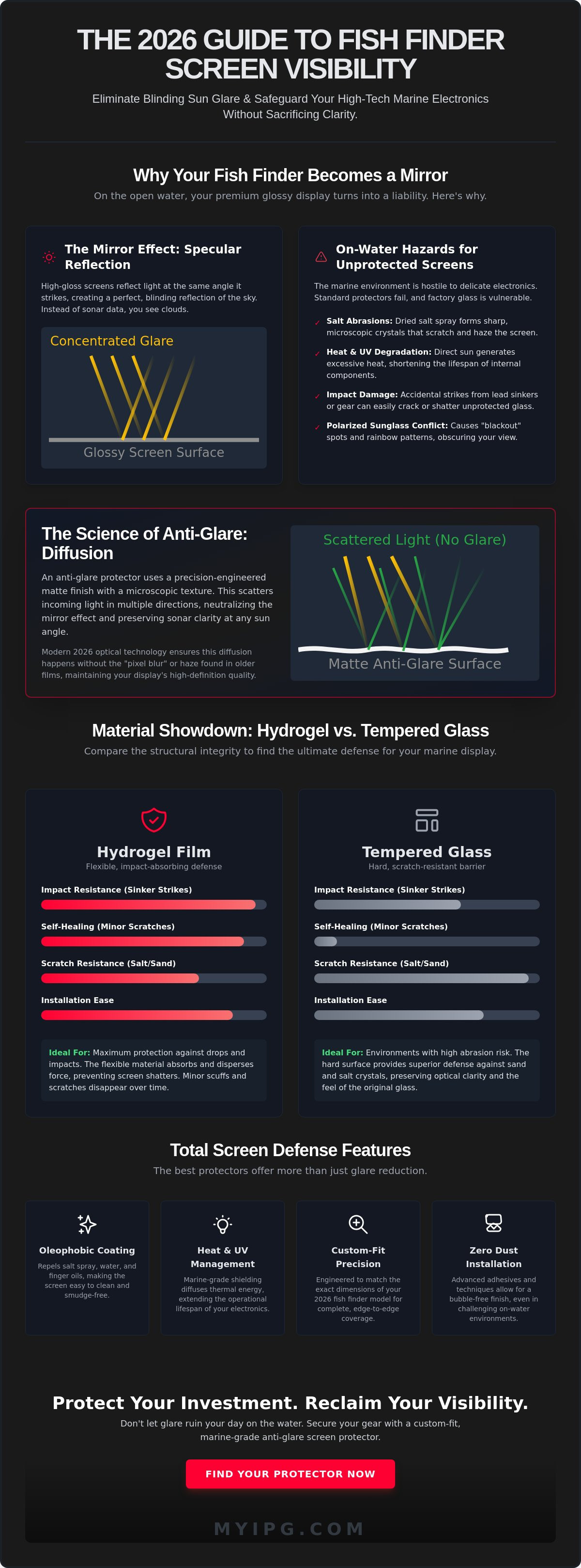
Visibility on the water starts with the physics of light. Most marine displays feature a high-gloss finish that creates specular reflection. This occurs when light hits a smooth surface and bounces back in a concentrated, parallel beam. It effectively turns your fish finder into a mirror. An anti glare fish finder screen protector solves this by introducing a precision-engineered matte finish. This surface utilizes microscopic etching to scatter incoming light rays in multiple directions. This process, known as diffuse reflection, ensures that harsh sunlight is neutralized before it can obscure your sonar returns.
2026 optical technology has solved the "pixel blur" issues of the past. Older matte films often made high-resolution displays look grainy or fuzzy. Modern manufacturing now allows for much finer surface textures. These microscopic patterns are small enough to allow individual pixels to shine through with perfect clarity while still being large enough to break up light waves. This results in actionable sonar data and vivid map colors without the distracting haze. This advanced light management is built on the same principles as thin-film anti-reflection coatings, which use interference to minimize surface bounce.
Polarized glasses are essential for spotting fish. However, they often clash with factory screen coatings, creating a distracting rainbow shimmer or "oil slick" effect. A high-quality protector realigns the light. It eliminates that prismatic distortion. This ensures you can transition your gaze from the horizon to your sonar without removing your glasses or struggling with visual artifacts.
Specular vs. Diffuse Reflection
A flat, unprotected glass surface is a magnet for glare. It creates a high-intensity reflection of the sky that overpowers the backlight of your unit. By scattering those rays, you maintain readable contrast even when the sun is directly overhead. While there is a minor trade-off in absolute peak brightness, the gain in usable visibility is massive. You don't need to crank your backlight to 100%, which saves battery and reduces unit heat. If you want to experience this clarity firsthand, consider the IPG Original (Hydrogel) Screen Protector for a professional-grade matte finish.
UV Filtration and Heat Reduction
Protection goes deeper than just visibility. Constant exposure to the marine sun causes screen yellowing and internal heat buildup. Protective films act as a critical barrier against these environmental stressors. They reflect infrared energy to keep the unit's surface temperature lower during tournament days. UV inhibitors within the protective film significantly extend the functional life of liquid crystal displays by preventing chemical breakdown from solar radiation. This stewardship over your electronics ensures your investment lasts for seasons, not just months.
Comparing Screen Shield Materials: Hydrogel vs. Tempered Glass
Choosing the right anti glare fish finder screen protector requires a balance between optical performance and physical defense. Your decision impacts how your unit survives a lead sinker strike or a high-speed run across choppy water. Two primary materials dominate the market: tempered glass and hydrogel. Each offers distinct advantages based on your specific marine electronics setup. Understanding these material properties is essential for Protecting Your Marine Investment over the long term.
Durability is the first priority. A lead sinker traveling at high velocity can shatter factory glass instantly. Tempered glass provides a rigid, sacrificial layer that absorbs impact by cracking itself instead of your display. However, hydrogel takes a different approach. It uses elastic polymers to disperse energy. While it may not offer the same "crush" protection as 9H glass, it is virtually indestructible in terms of shattering. It won't crack, chip, or send glass shards into your boat cockpit. This makes it a safer choice for aggressive fishing environments.
Optical clarity and "haze" are also critical factors. Any matte finish introduces some diffusion. Tempered glass is typically thicker, which can occasionally create a slight distance between the touch sensor and your finger. Hydrogel is ultra-thin. It maintains a lower profile, reducing the "tunnel" effect and keeping the image closer to the surface. For saltwater anglers, adhesion is the final hurdle. High-speed boat vibrations and salt spray can cause rigid glass edges to lift over time. Hydrogel utilizes a more aggressive, flexible adhesive that contours to the screen, preventing saltwater creep and edge-lifting during 70 mph runs.
Tempered Glass: The Rigid Guardian
Tempered glass is defined by its 9H hardness rating. It offers the highest level of scratch resistance against sand and grit. It feels exactly like your factory screen. This material is ideal for non-touch navigation units or flush-mounted displays where impact from loose gear is a primary concern. The trade-off is the risk of shattering. If a heavy lure hits the edge, the protector can spiderweb, requiring immediate replacement to maintain visibility.
Hydrogel (My IPG Original): The Flexible Shield
The My IPG Original (Hydrogel) Screen Protector represents the next generation of marine shielding. It features unique self-healing properties. Minor scratches from hooks or pliers literally disappear as the polymer settles back into place. This material is the superior choice for modern "Live" sonar units that require constant touch interaction. My IPG provides:
- Perfect Touch Sensitivity: No lag or missed swipes during critical moments.
- Edge-to-Edge Fit: Its flexible nature allows it to bond perfectly to curved or recessed bezels.
- Zero Shatter Risk: It stays intact regardless of the impact force.
By choosing a material that matches your unit's interface, you ensure your anti glare fish finder screen protector enhances your fishing rather than hindering it.
How to Choose and Install a Marine-Grade Screen Cover
Installation is the final step in securing your marine optics. While previous sections detailed the physics of light and material durability, the actual application determines if your anti glare fish finder screen protector performs as intended. On a boat, environmental variables like wind and humidity replace the controlled conditions of a home office. You must approach the process with technical precision to avoid trapping salt or grit against the factory glass.
Step 1 requires deep decontamination. Salt spray leaves microscopic crystals that act like sandpaper if trapped. Use 70% isopropyl alcohol and a fresh microfiber cloth. Step 2 is environmental control. If you're docked, close the console to block the wind. Even a light breeze carries dust that ruins the adhesive bond. Step 3 is alignment. For large 12-inch or 16-inch displays, use the hinge method with painter's tape to lock the position before peeling the backing. Step 4 is the squeegee phase. Work from the center outward to push out air. Step 5 is the curing period. Allow 12 to 24 hours for the moisture to evaporate and the seal to set before hitting the water. For a masterclass on these steps, check out how to put a screen guard on like a pro for expert precision.
Sizing Your Protector for Lowrance, Garmin, and Humminbird
Generic kits often fail because they ignore the unique bezel geometry of marine units. A "trim-to-fit" film leaves gaps where saltwater can seep in and corrode the screen edges. You need a precision-cut anti glare fish finder screen protector designed for your specific hardware. Whether you are outfitting a My IPG Lowrance Eagle 4" Elite hds poroFishFinder screen protector or a large Garmin unit, the fit must be exact to maintain button access and sensor responsiveness.
The 'Wet' vs. 'Dry' Install Debate
Repositioning large films is nearly impossible with a dry application. We advocate for the wet method on marine displays. Using a specialized application fluid allows you to slide the film into the perfect position without it grabbing prematurely. This is critical in high-humidity coastal areas where adhesives react faster. Once aligned, the fluid is squeegeed out to create a seamless bond. To start your installation with the right gear, view our custom-fit My IPG screen protectors and ensure your display is ready for the elements.
Protecting Your Investment: Why My IPG Leads in Marine Shielding
Your marine electronics are the eyes of your vessel. They represent a significant financial commitment and a critical tool for your success on the water. My IPG operates as a dedicated specialist and a guardian of this technology. We don't just provide a layer of film; we offer a precision-engineered defense system. Choosing an anti glare fish finder screen protector from a brand that understands the molecular properties of light and durability ensures your gear remains in showroom condition for years.
The My IPG Zero Dust advantage is essential for the 2026 angler. Marine environments are notoriously difficult for standard adhesives. Salt crystals, wind-blown grit, and high humidity usually compromise the bond of generic protectors. Our specialized application process and advanced adhesives are designed to stay clear and secure in these harsh conditions. By maintaining a perfect, debris-free seal, we prevent the microscopic abrasions that eventually cloud your view and ruin your factory glass. It's about security and the preservation of what you value most.
Long-term value is often overlooked until it's too late. A single lure strike or a day of cleaning salt with a rough towel can cause permanent damage. This doesn't just hurt your visibility; it destroys your unit's resale value. When it's time to upgrade your boat's tech, a pristine, protected screen commands a much higher price. Our anti-glare technology preserves every sonar detail, ensuring that your investment pays dividends both in fish caught and in equity retained.
Precision Engineering for Anglers
We test our films in extreme high-UV and high-salinity conditions to simulate years of tournament use. This meticulousness ensures that our anti glare fish finder screen protector won't yellow or peel when you need it most. We provide custom-fit solutions for the latest 2026 hardware, including the Lowrance Eagle, Elite, and HDS Pro series. For a broader look at how we secure all your high-value devices, explore the definitive guide to screen protection.
The My IPG Promise of Stewardship
We are invested in your experience on the water. Protecting the gear that finds the fish requires a specialist's perspective and a commitment to high-performance light filtration. We understand the emotional and financial value of your marine electronics. Our role is to provide the reliability and peace of mind you need to focus on the bite. Don't leave your display vulnerable to the elements. Protect your Lowrance or Garmin screen today with a shield designed for the professional angler.
Reclaim Your View on the Water
Success on the water requires absolute visual clarity. You have learned how light diffusion eliminates the mirror effect and why material science dictates the longevity of your marine electronics. Don't let the sun dictate your ability to track fish or navigate safely. A high-performance anti glare fish finder screen protector is more than an accessory. It is a critical layer of defense for your most valuable technology.
Our specialized shields are custom-cut for Lowrance, Garmin, and Humminbird units to ensure a precision fit. We utilize shatterproof hydrogel technology to absorb impacts that would destroy factory glass. With advanced UV and saltwater resistance, your display remains clear and responsive in the harshest environments. Stewardship over your gear means choosing a partner that values your investment as much as you do.
Secure Your Marine Electronics with IPG Anti-Glare Shields and experience the technical advantage of a professional-grade finish. It's time to stop squinting and start catching. Get back to what matters most with the confidence that your screens are protected for the seasons ahead.
Frequently Asked Questions
Will an anti-glare protector make my fish finder screen look dark?
No, it won't make your screen dark. While an anti glare fish finder screen protector uses a matte finish that slightly diffuses light, the gain in readable contrast is massive. Instead of fighting a mirror-like reflection of the sky, you see clear sonar data. You may need to adjust your backlight brightness slightly, but the overall visibility in direct sunlight is significantly improved compared to an unprotected factory screen.
Can I use a regular iPad screen protector on my fish finder?
You shouldn't use consumer-grade protectors on marine electronics. iPad protectors aren't engineered for high-UV exposure or constant saltwater contact. The adhesives used in home electronics will fail quickly when exposed to humidity and temperature swings. This leads to bubbling and peeling within weeks. Marine-specific shields use specialized polymers designed to withstand the harsh conditions of an open cockpit without degrading or losing adhesion.
How do I remove salt spray from an anti-glare screen cover without scratching it?
Always rinse the screen with fresh water first to remove abrasive salt crystals. Once the salt is dissolved, use a clean microfiber cloth and a dedicated marine screen cleaner. Avoid using paper towels or old rags, as these can trap grit and cause micro-scratches. Gently wipe the surface in a circular motion. This process keeps your anti glare fish finder screen protector clear and prevents the buildup of salt haze that obscures sonar returns.
Do anti-glare protectors work with polarized sunglasses?
Yes, they are specifically designed to improve compatibility with polarized lenses. Unprotected factory screens often create a distracting rainbow shimmer or dark spots when viewed through polarized sunglasses. A high-quality anti-glare film realigns the light waves. This eliminates prismatic distortion and allows you to see your maps and side-scan imaging clearly without having to tilt your head or remove your glasses.
Will the screen protector peel off if my fish finder gets wet?
Marine-grade protectors won't peel off when wet if they are installed and cured correctly. These shields utilize advanced, moisture-resistant adhesives that create a permanent bond with the glass. Whether you are dealing with heavy rain, salt spray, or high-pressure cleaning, the protector stays secure. It is essential to allow the film to cure for 24 hours before your next trip to ensure the bond is fully set.
What is the difference between matte and clear screen protectors for fishing?
Clear protectors offer physical defense against scratches but do nothing to stop sun glare. Matte protectors, also known as anti-glare, feature microscopic surface etching that scatters incoming light. This prevents the mirror effect common on high-gloss marine displays. For most anglers, the matte finish is superior because it provides both scratch protection and the ability to read the screen in the middle of a bright tournament day.
How often should I replace my marine screen protector?
You should consider replacing your protector every two to three seasons or when it shows visible signs of deep scratching. While the material is durable, constant exposure to salt and UV rays will eventually take a toll. Specialized hydrogel films like the IPG Original are designed for long-term stewardship. These often come with a lifetime replacement warranty, allowing you to refresh your screen's clarity whenever the physical barrier becomes compromised.
Does the protector interfere with the touchscreen functionality of my Lowrance HDS?
It won't interfere with your touchscreen performance. Modern hydrogel films are ultra-thin and engineered for capacitive touch sensitivity. Whether you are using a Lowrance HDS Pro or an Elite FS, you will maintain 100% responsiveness for swiping, pinching, and zooming. The material acts as a second skin. It provides a smooth surface that actually feels better than factory glass when your fingers are wet or covered in fish slime.