
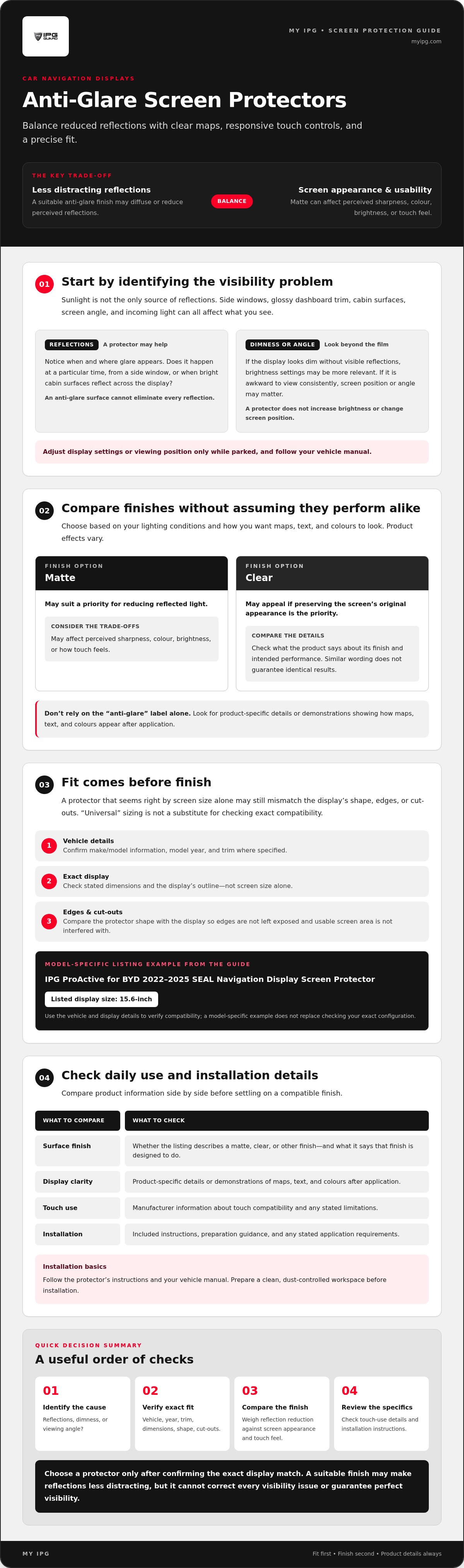
The most matte screen isn’t automatically the easiest navigation display to read. An anti-glare screen protector for car navigation can help diffuse distracting light, but the finish may also change how sharp the screen looks. The right choice balances reduced reflections with clear maps, responsive touch controls, and a precise fit.
Sunlight and cabin reflections can make directions harder to check, so wanting a clearer view is understandable. But a protector made for the wrong vehicle or display can leave edges exposed or interfere with the screen’s usable area. “Universal” sizing isn’t a substitute for checking exact compatibility.
This guide explains what to compare before you choose: vehicle and display fit, matte versus clear finishes, screen clarity, touch use, and installation requirements. It also explains how to assess product details without assuming that a finish or fit claim applies to every model. The goal is a protector that suits your specific navigation display and helps keep essential information easy to see.
Key Takeaways
- Choose an anti-glare screen protector for car navigation by weighing reflection reduction against the clarity and usability you want.
- Check vehicle, model year, trim, and exact display details. Screen size alone may not confirm a precise fit.
- Compare matte and clear finishes, then review product information for touch use and installation requirements.
- Follow the protector’s instructions and your vehicle manual. Prepare a clean, dust-controlled workspace before installation.
- If glare persists, consider whether screen brightness or display positioning is contributing before choosing a protector.
Why choose an anti-glare screen protector for car navigation?
Sunlight through the windshield is only one source of distraction on a navigation display. Light can also reflect from side windows, glossy dashboard trim, or other cabin surfaces. The screen’s angle and the direction of incoming light affect what appears on its surface. A display that’s readable in a shaded driveway may be difficult to see on a bright road.
An anti-glare protector is a screen covering designed to reduce the appearance of reflected light. It may make reflections less distracting, but it can’t eliminate every reflection or correct every visibility problem. It changes how light interacts with the screen surface. It doesn’t increase display brightness, change the screen’s position, or adjust the vehicle’s settings.
What makes a car navigation screen difficult to read in bright conditions?
Before comparing finishes, notice when and where reflections appear. Does the problem happen at a particular time of day, when sunlight enters through a side window, or when bright cabin surfaces reflect across the display? Does changing your viewing position affect the reflection? These observations help you decide whether reflected light is the main issue.
If the screen looks dim even without visible reflections, brightness settings may be more relevant. If the display is consistently awkward to view, its position or angle may be a factor. A screen covering shouldn’t be treated as a fix for either issue. Make adjustments only while parked, and follow your vehicle manual.
What can an anti-glare protector realistically change?
A surface treatment may diffuse or reduce perceived reflections, depending on its design and the lighting conditions. For background on how anti-reflective coatings work, see this overview of the optical principles behind reducing reflected light. Anti-glare and anti-reflective approaches aren’t necessarily identical, so check the specific finish described for any protector you’re considering.
There may be trade-offs. A matte surface can make reflections less sharp, but it may also affect perceived screen sharpness, colour, or brightness. It may change how touch feels, too. Effects vary by product, so look for product-specific details rather than assuming every film performs the same way.
An anti-glare screen protector for car navigation is worth considering when reflections are a persistent problem and the finish of a compatible protector suits your preferences. It isn’t a promise of perfect visibility or safer driving. Keep navigation information easy to read, and don’t rely on a protector to remove every source of glare.
How to compare anti-glare car navigation screen protectors
Start with compatibility, then compare optical qualities and daily use. Check exact display compatibility before choosing a finish. A protector may appear suitable based on screen size alone and still mismatch the display’s shape, edges, or cut-outs.
Use this checklist to compare product information side by side. The Society for Information Display discusses topics such as sunlight readability and legibility, useful reminders that screen visibility involves more than a product’s “anti-glare” label.
| What to compare | What to check |
|---|---|
| Fit | Vehicle model year, display dimensions, shape, edges, and cut-outs. |
| Surface finish | Whether the listing describes a matte, clear, or other finish, and what it says that finish is designed to do. |
| Display clarity | Product-specific details or demonstrations showing how maps, text, and colours appear after application. |
| Touch use | Manufacturer information about touch compatibility and any limitations. |
| Installation | Included instructions, preparation guidance, and any stated application requirements. |
Matte versus clear: which finish suits your driving conditions?
A matte finish may suit drivers whose main concern is reflected light. A clear protector may appeal if preserving the screen’s original appearance is the priority. Neither is automatically best. Your lighting conditions and preference for image appearance matter. Look for product demonstrations or verified specifications, and don’t assume two finishes described with similar words perform identically.
Which specifications matter beyond glare reduction?
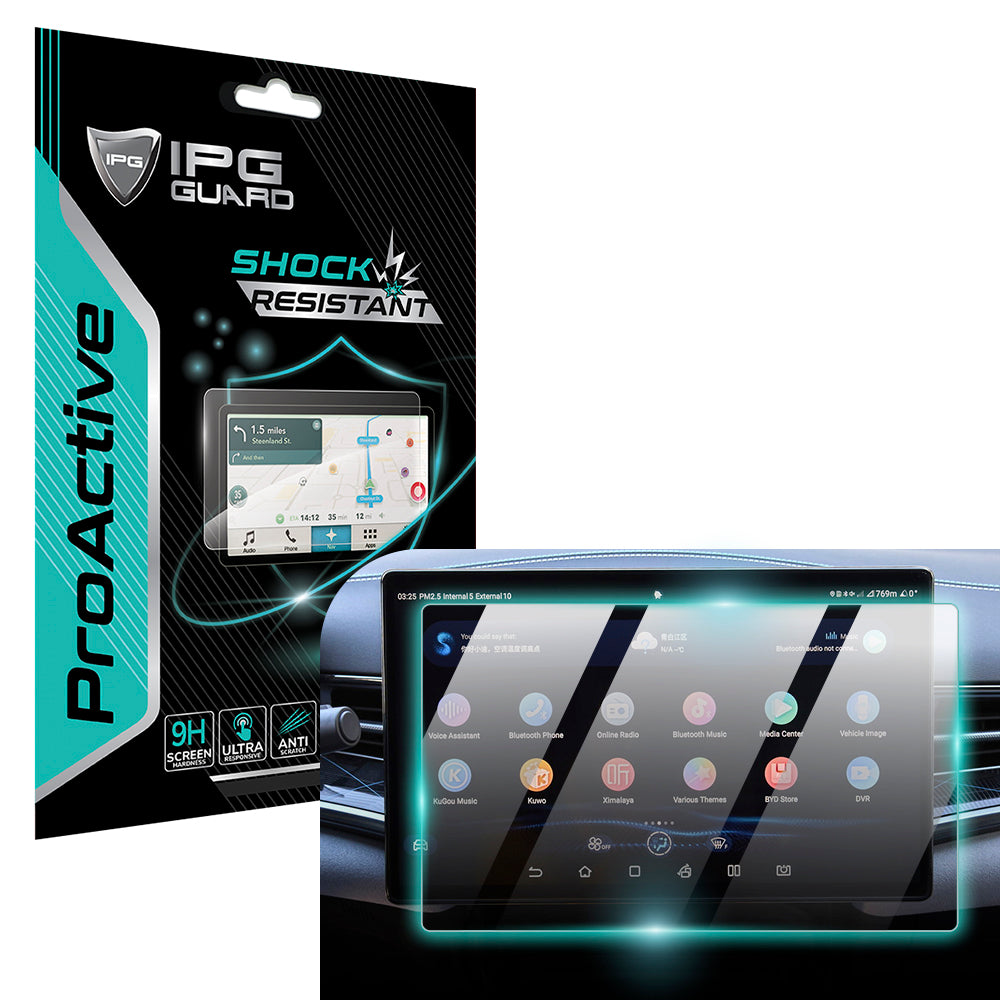
Match the exact vehicle and model year, then confirm the display’s stated dimensions, outline, and cut-outs. For example, My IPG lists the IPG ProActive for BYD 2022‑2025 SEAL Navigation Display Screen Protector (15.6" inch) as a model-specific item. Check current availability and exact compatibility against your vehicle and display before purchase. This example is not a universal fit.
Also review the manufacturer’s details for touch use, cleaning guidance, and installation. Treat claims about scratch resistance or fingerprint reduction as specific to the product, not as standard features of every protector. If a listing doesn’t explain its finish or usage requirements, don’t fill in the gaps with assumptions. Compare the available details for automotive display screen protectors as part of your research, and verify that any item matches your exact screen.
Will an anti-glare protector fit your car navigation display?
Fit depends on more than the screen’s diagonal measurement. A protector must match the display’s shape and usable area, including any curves, borders, or openings. Before buying an anti-glare screen protector for car navigation, check these details in order:
- Vehicle: Confirm the make and model.
- Model year: Match the year listed for the product.
- Trim: Check whether the trim level affects the installed display.
- Exact display: Compare the navigation screen’s dimensions, outline, and relevant cut-outs with the product listing.
A stated screen size is a useful clue, but it doesn’t confirm a precise fit. Two displays with the same diagonal measurement may have different proportions, curved edges, borders, or openings. A mismatch could leave part of the screen uncovered or place the protector over an area it wasn’t designed for.
How do you confirm the exact screen size and shape?
Start with your vehicle manual, manufacturer specifications, or the protector’s fitment listing. Compare the listed vehicle and display details, not just the size. Look closely at the screen outline and any buttons, sensors, or camera or light openings that apply to your display.
Measure only if the seller provides a compatible method and specifies which dimensions to compare. Measuring the diagonal alone may not capture the shape or edge profile. Don’t guess at cut-outs or assume a photograph represents your exact display version.
What should you do when vehicle compatibility is unclear?
Pause before ordering. Ask the seller to confirm the protector against your exact vehicle, model year, trim, and display version. Don’t assume different trims or adjacent model years use identical screens. The detail that resolves uncertainty may be the display version, not the vehicle name alone.
For example, My IPG lists the IPG ProActive for BYD 2022‑2025 SEAL Navigation Display Screen Protector (15.6" inch) for the stated BYD SEAL model years and display size. This is a model-specific example, not evidence of compatibility with another vehicle or screen. Verify current availability and exact fitment before purchase.
If you need broader vehicle-screen selection advice, consult the Car Screen Protector Buying Guide 2026. Matching every fitment detail first helps you avoid relying on assumptions.
How to install and care for a navigation screen protector
Careful preparation helps protect the display and the fit of your anti-glare screen protector for car navigation. Installation steps vary by product, so use the protector’s instructions and your vehicle manual as the authority. Don’t assume a method that worked for another screen is appropriate for yours.
What should you check before applying the protector?
Set up in a clean, dust-controlled space and handle the protector gently. Before starting:
- Confirm the package is intended for your exact vehicle display, not just a similar screen size.
- Inspect the protector for visible damage before applying it.
- Read the full product instructions and relevant vehicle guidance first.
- Turn off the display only if the protector instructions or vehicle guidance recommend it.
- Keep liquids and cleaning products away unless the manufacturer explicitly permits their use.
Dust trapped beneath the surface can create a visible speck or uneven contact. Misalignment may leave edges uncovered or interfere with openings, while bubbles can distract from map details. If something looks wrong during application, pause and consult the product instructions rather than forcing the protector into place or improvising a removal method.
How can you maintain visibility after installation?
Follow the cleaning and care method specified by both the vehicle and protector manufacturers. Avoid abrasive materials and unapproved cleaners. Either could damage the display or alter the protector’s surface. Don’t assume a cleaning product safe for another screen is suitable for your navigation display.
After installation, check the screen while parked and in ordinary lighting conditions. Look for lifting edges, visible dust, bubbles, or a position that appears to obstruct part of the display. Assess readability during normal use without adjusting or inspecting the screen while driving. If the protector seems incorrectly sized or placed, contact the seller for guidance before attempting corrective steps.
Good care starts with product-specific instructions, not guesswork. To review automotive screen protector options, check the listing details and confirm compatibility with your exact display before choosing. A precise fit and approved care routine help keep the screen clear and usable.
Choose a model-matched protector and take the next step
Choose based on the problem you’re trying to solve, not the word “anti-glare” alone. If reflections repeatedly make your navigation screen difficult to read, an anti-glare screen protector for car navigation may be worth considering. If glare is occasional, compare the finish and expected screen appearance before deciding whether a protector suits your needs.
Which buyer should prioritize an anti-glare finish?
Prioritize an anti-glare finish when reflections are a frequent, identifiable issue. Compare the product’s finish, exact fit, touch information, and care instructions. Performance depends on the protector, display, viewing angle, and surrounding light, so don’t assume a result based on the finish name alone.
If the display appears dim even when reflections aren’t present, review its brightness settings and vehicle guidance. If the screen is consistently difficult to view from the driver’s position, positioning may also need attention. A protector changes the screen surface; it doesn’t correct every cause of poor visibility.
How can you make a confident, model-specific choice?
Before selecting a product, confirm your vehicle, model year, trim, and exact screen. Compare those details with the product listing, including the stated dimensions and display shape. If anything is unclear, pause and ask the seller to confirm the fit for your specific display.
My IPG lists the IPG ProActive for BYD 2022‑2025 SEAL Navigation Display Screen Protector (15.6" inch) for the stated BYD SEAL model years and screen size. Verify current availability and exact compatibility before relying on that listing. It isn’t a general fit recommendation for other vehicles or displays.
- Identify when and where reflections affect readability.
- Choose a finish based on your preference for reflection reduction or original screen appearance.
- Confirm exact vehicle and display compatibility.
- Check touch-use details and care instructions.
For wider context on protector materials and protecting different devices, see the Ultimate Screen Protector Guide. Then explore My IPG’s automotive screen protection options and check each listing against your vehicle and display before choosing.
Make your next screen-protection choice with confidence
The right anti-glare screen protector for car navigation should suit your actual glare conditions without compromising the display’s clarity or touch use. Compare matte and clear finishes, check product-specific details, and confirm the exact vehicle, model year, trim, and screen before ordering. A protector may help with reflections, but brightness settings or screen positioning may deserve attention if the display is hard to read for other reasons.
My IPG’s catalog includes a navigation-display protector specified for the BYD SEAL, model years 2022 to 2025, with a 15.6-inch display. Verify current availability and exact compatibility before purchase. This model-specific listing isn’t a universal fit. My IPG also offers screen protectors for other automotive displays and electronic devices.
Ready to compare options? Explore My IPG screen protection options and check each listing against your vehicle and display. A careful match helps you protect the screen while keeping its everyday usability in view.
Frequently Asked Questions
Does an anti-glare screen protector completely eliminate reflections on a car navigation screen?
No. An anti-glare protector is designed to reduce reflected light or make reflections less distracting, not remove every reflection. Results depend on the protector’s finish, sunlight direction, cabin lighting, and screen angle. If you’re considering an anti-glare screen protector for car navigation, check product-specific information. Remember, it won’t increase display brightness or correct a screen position that’s difficult to view.
Can an anti-glare protector make a car navigation screen look less clear?
It can affect perceived clarity, depending on the protector’s surface and the display. A matte finish may soften the appearance of fine text or map details, and could change how colours or brightness look. These effects aren’t identical across products. Check verified specifications or demonstrations for the specific protector, and consider whether reducing reflections or preserving the screen’s original appearance matters more to you.
How do I know whether a screen protector fits my car navigation display?
Compare the product listing with your exact vehicle, model year, trim, and navigation display. Check stated dimensions, screen shape, and any relevant openings or cut-outs. Diagonal size alone doesn’t confirm fit because displays with the same measurement may have different outlines. Use your vehicle manual or manufacturer specifications to verify details, and ask the seller to confirm compatibility if the listing leaves room for doubt.
Are matte and clear navigation screen protectors different?
Yes. Matte finishes are often considered by buyers seeking to reduce the appearance of reflections, while clear finishes may better suit those who want to preserve the screen’s original look. Neither is automatically the better choice. The result depends on the product and viewing conditions. Review product-specific information or demonstrations rather than assuming protectors described with similar finish terms will look or perform the same.
Can a screen protector affect touch response on a car display?
It may, but the effect depends on the protector and the display. Don’t assume touch performance is unchanged or impaired based only on the product category. Check the manufacturer’s information for touch compatibility and any stated limitations before purchase. After installation, test the screen while the vehicle is parked. If touch response seems different, consult the protector instructions and vehicle manual before taking further action.
How should I clean a car navigation screen with a protector installed?
Follow the care instructions from both the vehicle and protector manufacturers. Use only cleaning methods and products they approve for the display and its covering. Avoid abrasive materials and unapproved cleaners, which could affect the screen or protector surface. If the product listing doesn’t explain care, check with the seller or vehicle manufacturer before cleaning. Don’t apply liquids directly unless the instructions explicitly allow it.
Does My IPG make an anti-glare protector for every car navigation system?
No. My IPG offers screen protection for automotive displays and other electronic devices, but that doesn’t mean every vehicle or display has a matching protector or an anti-glare finish. Its catalog lists the IPG ProActive for BYD 2022-2025 SEAL Navigation Display Screen Protector (15.6" inch) as a model-specific example. Verify current availability and exact compatibility, and don’t assume it fits other vehicles or screens.