
The most expensive way to restore your Honda's wheels is often the least effective. You take pride in your vehicle's appearance, but watching OEM center caps succumb to corrosion and UV damage is a common frustration. You might think the only solution is to pay for overpriced replacement parts. It's time to reconsider. High-performance honda wheel center cap decals are not simple stickers. They are precision-engineered protective overlays designed to revive your rims and maintain their integrity against harsh road environments.
We understand you want a result that looks authentic and stands up to high-pressure washes and road grime. You deserve a cost-effective restoration that doesn't sacrifice quality or professional aesthetics. This article busts five common myths about wheel restoration to reveal the truth about modern material durability. You'll discover how to achieve a factory-fresh look and long-lasting UV protection without the high cost of genuine Honda parts. We will show you why these specialized overlays are the ultimate guardian for your wheel's visual integrity.
Key Takeaways
- Understand the material properties of high-performance vinyl and how it functions as a durable protective barrier for your rims.
- Debunk the myths surrounding decal longevity by exploring the performance of pressure-sensitive automotive adhesives in extreme conditions.
- Learn how to measure and select honda wheel center cap decals with precision-cut edges to eliminate unsightly border gaps and dirt collection.
- Master professional installation workflows, including the crucial cleaning steps that ensure maximum bond strength and long-term security.
- Discover how to maintain a factory-fresh appearance using advanced overlays that bridge the gap between technical protection and high-end automotive style.
Rethinking the Honda Wheel Center Cap: Restoration vs. Replacement
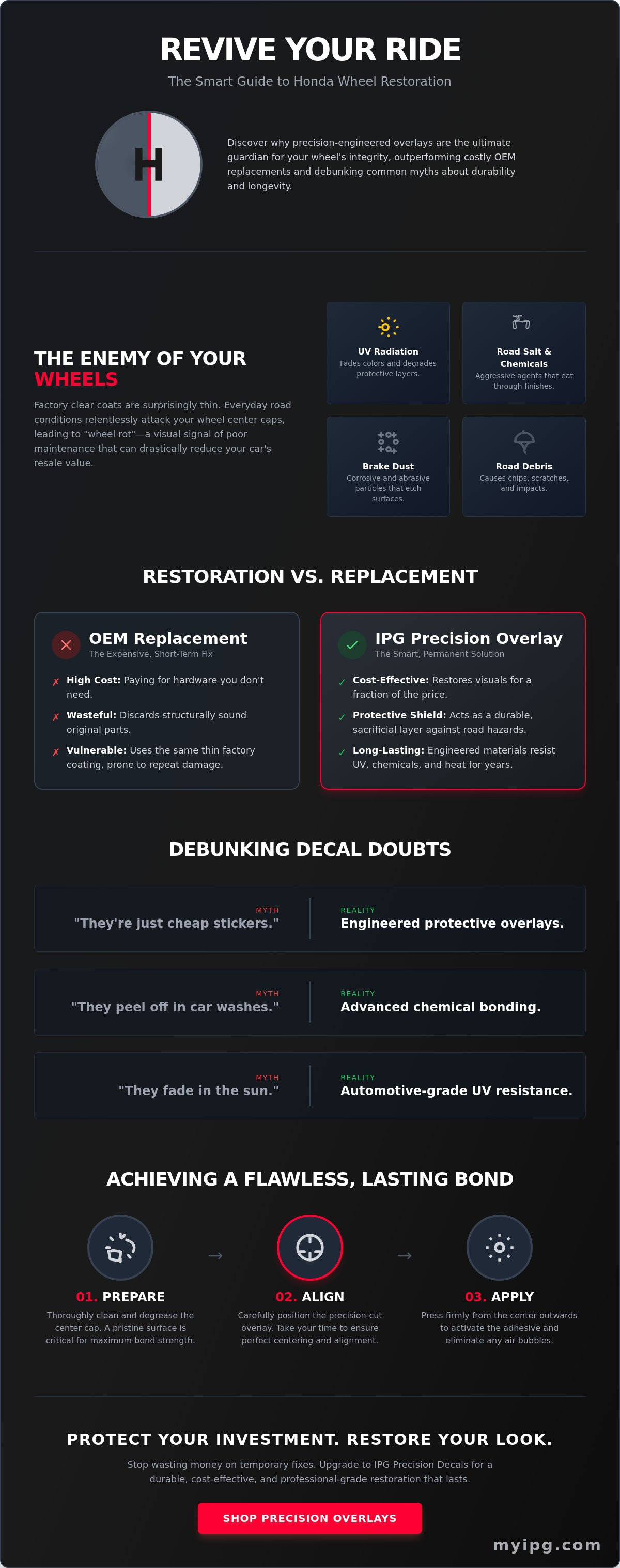
Restoration is a precision task. It isn't just about color; it's about structural preservation. honda wheel center cap decals represent a paradigm shift in how we maintain vehicle aesthetics. These aren't simple stickers. They are high-performance vinyl overlays engineered to bond with the existing substrate of your Alloy Wheels. While many dismiss these as flimsy additions, high-grade vinyl actually functions as a protective shield. It resists chemicals, blocks UV radiation, and handles the high thermal loads generated by your braking system.
The "cheap sticker" myth persists because of low-quality alternatives found on auction sites. Professional-grade overlays are different. They utilize automotive-grade cast vinyl that conforms to the slight dome of the cap. Choosing a decal kit over four new genuine Honda center cap assemblies is a strategic move. You're opting for a surgical solution. Often, the plastic housing of your cap is structurally sound; only the finish has failed. By using an overlay, you restore the visual impact without paying for hardware you don't actually need.
The Problem with Faded Hub Caps
Factory clear coats are surprisingly thin. They are designed for showroom floors, not for years of salted highways and aggressive brake dust. Road salt is chemically aggressive. Brake dust is corrosive and abrasive. Together, they eat through the protective layer, leading to "wheel rot." This isn't just an aesthetic annoyance. Faded, corroded caps have a negative psychological impact on potential buyers. They signal a lack of meticulous maintenance, which can slash your car's resale value. Simply cleaning the caps won't help; once the pigment and clear coat are gone, the surface requires a new layer of protection.
Decals as a Protective Barrier
Think of an overlay as a sacrificial layer. It takes the hit from road debris and environmental contaminants so your underlying plastic doesn't have to. This "Invisible Shield" philosophy allows you to protect the logo you love while maintaining a seamless look. The IPG Decal Honda Center Cap Overlay Wheel Tire Decals are designed with this stewardship in mind. We use a precision-cut manufacturing process to ensure a perfect fit. This eliminates the "border gaps" where dirt usually collects. By applying a high-performance barrier, you halt further degradation and return your wheels to a factory-fresh state with minimal effort and maximum security.
The Durability Myth: Do Vinyl Decals Really Peel and Fade?
Skepticism regarding the longevity of automotive overlays is understandable. Most people have seen "stickers" curl at the edges or turn into a sun-bleached mess within months. However, professional-grade honda wheel center cap decals operate on an entirely different level of material science. The fear that a pressure washer or a standard car wash will blast them off is a myth rooted in experiences with low-quality adhesives. High-performance decals utilize pressure-sensitive adhesives (PSA) that create a chemical bond with the cap surface. Instead of a simple glue that dries out, these adhesives actually strengthen their grip over time as they cure, resisting the high-velocity water used in modern detailing.
UV resistance is another critical factor. Cheap pigments quickly succumb to solar radiation, leading to the dreaded "pink logo" syndrome where vibrant reds fade into a pale, washed-out hue. Specialized automotive pigments are designed to block specific light wavelengths, maintaining color density for years. This level of performance is often reflected in state-mandated decal durability standards, which require vehicle identifiers to remain legible and bonded for at least six years. Your wheel decals should meet these same rigorous expectations, surviving the intense heat generated by your brake rotors during heavy driving without warping or losing adhesion.
Material Science: Cast Vinyl vs. Cheap Stickers
Cast vinyl is the gold standard for a reason. Unlike calendered vinyl, which is stretched into shape and wants to shrink back, cast vinyl is poured as a liquid. This manufacturing process ensures the material has no "memory" pull-back, allowing it to stay perfectly flat on your center caps. A secondary protective top layer acts as a barrier against aggressive chemical wheel cleaners and road grime. Cast vinyl conforms to curved surfaces with absolute precision and stays there permanently without edge lifting.
Surviving the Elements
Real-world testing involves more than just sunlight. Decals must endure road salt, slush, and the thermal shock of driving through a cold puddle after a long highway stint. At IPG, our background in marine screen protection and high-tech device shields informs every automotive product we develop. We approach wheel aesthetics with a "Guardian" mindset. Your vehicle's appearance is an investment that requires meticulous protection from environmental degradation. If you are ready to restore your Honda's signature look, choosing materials engineered for extreme durability is the only way to ensure your factory-fresh aesthetic lasts for the long haul.
Fitment Fallacies: Are All Center Cap Overlays Created Equal?
The "one size fits all" claim is a dangerous oversimplification that often leads to buyer's remorse. Most generic retailers insist that a standard 56mm circle will accommodate every vehicle in the Honda lineup. This is false. honda wheel center cap decals must account for the subtle geometry of specific rim series to achieve a truly professional result. For example, the original Honda 44732 series caps feature distinct curvatures and edge profiles that a flat, universal sticker cannot match. We utilize digital scanning technology to map these surfaces with extreme accuracy. This ensures our overlays don't just sit on top of the cap; they integrate with the existing hardware. Precision-cut edges are vital for long-term success. Without them, you end up with "border gaps" where the original faded plastic peeks through. These gaps quickly become magnets for brake dust and road grime, eventually compromising the adhesive bond and ruining the factory look.
Choosing between "universal" decals and brand-specific precision cuts is a choice between a temporary fix and a permanent restoration. Universal decals are often cheaper because they require no specialized tooling or model-specific research. However, they almost always result in a high failure rate and an obvious aftermarket appearance. Maintaining the visual standards of your vehicle shouldn't be a guessing game. Much like how FMCSA regulations dictate strict legibility and maintenance standards for commercial decals to ensure safety and professional identity, we believe your Honda's branding deserves the same level of technical scrutiny. A precision-cut overlay provides a seamless look and better adhesion, securing your investment for the long haul.
Why Precision Matters for OEM Looks
A measurement error as small as 0.5mm is enough to make a decal look like a cheap add-on. This gap isn't just a visual flaw; it creates a physical ledge. When your wheels spin at highway speeds, centrifugal force pulls at any unbonded edge. If the decal isn't a flush fit, this force leads to edge lift-off. Dirt and moisture then migrate under the vinyl, causing it to peel. At IPG, we apply the same precision engineering to our vinyl cuts as we do to high-end tech protection. We don't settle for "close enough." Our goal is a seamless transition that defies detection even under close inspection.
Identifying Your Honda Center Cap Size
Don't guess your dimensions. Take a moment to measure the outer diameter of your existing cap with a digital caliper for the most accurate results. If the wheels are off the car, check the back of the cap for a molded part number. While 56mm and 69mm are common across the Accord and Civic lines, modern wheels on newer hybrids and EVs often feature unique dimensions. You should never trust a "one size fits most" listing. These products are designed for the seller's convenience, not for your car's specific requirements. Secure the integrity of your wheel's aesthetic by choosing a product cut specifically for your Honda model.
Maximizing Adhesion: The Professional Way to Install Hub Cap Decals
Precision engineering is only half the battle. Even the highest-grade honda wheel center cap decals will fail if the bond is compromised by poor installation. Industry data suggests that 90% of decal failures stem from inadequate surface preparation rather than product defects. You are the guardian of your car's aesthetic. Success requires a methodical approach and a controlled chemical environment for the adhesive to cure. For small-diameter overlays like these, the "dry" application method is significantly better than the "wet" method. It provides immediate tack and prevents the decal from floating out of alignment during the critical first seconds of contact.
You don't need a professional workshop to achieve a factory result. You do need the right tools. Gather 70% isopropyl alcohol, a fresh lint-free microfiber cloth, and a standard hair dryer. Avoid using any window cleaners or household detergents. It's vital to remember that ammonia-based cleaners leave a residual chemical film that actively prevents automotive adhesives from reaching their full bond strength. This invisible barrier is the primary cause of edge lifting and premature peeling. By following a strict cleaning protocol, you ensure your investment stays secure through thousands of wheel rotations.
Surface Preparation: The Secret to Longevity
Your center caps live in a hostile environment. They are constantly coated in road wax, silicone-based tire shines, and metallic brake dust. These contaminants create a slippery layer that standard car soap cannot fully remove. Use your isopropyl alcohol to strip these residues down to the bare plastic substrate. Perform the "squeaky clean" test: drag a clean, dry finger across the cap. If it glides smoothly, contaminants remain. If it drags with a distinct squeak, the surface is ready for a permanent bond. Ensure the ambient temperature is between 60°F and 80°F for optimal adhesive flow.
Step-by-Step Application Guide
- Leveling: Use a rim spoke or the tire valve stem as a visual reference point to ensure the logo is perfectly level before the first touch.
- Initial Tack: Lightly place the center of the decal on the cap. Don't press down until you're satisfied with the alignment.
- Pressure Application: Use your thumb to apply firm pressure, moving from the dead center outward to the edges. This action drives out microscopic air pockets and activates the pressure-sensitive adhesive.
- Post-Heating: Apply low heat with a hair dryer for 30 seconds. This softens the vinyl slightly, allowing it to conform to the micro-texture of the plastic cap for a seamless, "molded" look.
Patience is the final ingredient. The adhesive requires a full 24-hour cure time to reach maximum structural integrity. Resist the urge to drive immediately after installation; centrifugal forces can shift a fresh decal before it has fully bonded. If you're ready to upgrade your vehicle's appearance with a kit designed for maximum durability, order your precision-cut Honda decal set today and follow these steps for a result that defies the elements.
Protecting Your Aesthetic Investment with IPG Precision Decals
IPG doesn't just produce automotive accessories; we engineer high-performance protective layers. We've spent years perfecting the material science behind the world's most sensitive device shields. Bringing that same level of technical scrutiny to honda wheel center cap decals ensures your vehicle receives the same stewardship as a flagship smartphone. Unlike generic marketplace sellers who prioritize volume over verification, we act as a dedicated specialist. We understand that your Honda's branding is a high-value asset that requires meticulous defense against environmental degradation. When you choose a specialized provider, you're opting for a product backed by a legacy of performance and precision engineering.
Our "Zero-Dust" philosophy is central to our manufacturing success. We know that a single microscopic particle can compromise an adhesive bond. This mindset, originally developed for our camera lens protection systems, is applied to every automotive overlay we produce. It's about more than just a clean look; it's about structural integrity. When you apply our overlays, you aren't just performing a visual upgrade. You are investing in a precision-engineered barrier that resists chemical cleaners, road salt, and intense UV radiation. Our goal is to provide security and preservation for the items you value most.
The IPG Difference: From Screens to Rims
We leverage deep expertise in material properties across our entire catalog. Whether it's the IPG Original (Hydrogel) Screen Protector or our IPG Decal Honda Center Cap Overlay Wheel Tire Decals, the objective remains the same: preservation without compromise. Our automotive vinyl is selected specifically for its ability to withstand road-specific stressors like intense brake heat and abrasive dust. This results in a "set it and forget it" solution. You install the overlay once, and it performs for years without edge lifting or pigment loss. We back our products with professional-grade customer support and a guarantee of a perfect, model-specific fit.
Taking the Next Step for Your Honda
Your vehicle deserves a restoration that defies the elements. Don't settle for generic, "one size fits most" stickers that fail after the first car wash. Our full range of Honda-specific aesthetic enhancements is designed for enthusiasts who demand perfection and long-term durability. Ordering is rapid, efficient, and results-oriented. We deliver a complete, precision-cut restoration kit directly to your door, giving you the tools to revive your car's look in minutes. Browse our Honda Center Cap Overlay Collection and secure the factory-fresh aesthetic your wheels deserve.
Revive Your Rims with Professional-Grade Restoration
Restoring your vehicle's aesthetic doesn't require expensive OEM replacements. You've discovered that modern honda wheel center cap decals are high-performance defensive layers engineered for extreme environments. Demand better for your car. By choosing specialized automotive-grade vinyl and UV-resistant pigments, you ensure your rims remain vibrant. Protect your investment against road salt, slush, and intense brake heat. Precision-cut digital templates eliminate the unsightly gaps found in universal alternatives. This ensures a seamless finish that defies detection even under close inspection. Our commitment to material science means you get a guardian for your wheels that won't peel or fade.
A methodical installation process turns a simple upgrade into a permanent solution. Your Honda represents a significant investment. Protect its visual integrity with materials designed specifically for the task. Take pride in every detail of your vehicle's appearance. It's time to enjoy that factory-fresh look on every drive.
Upgrade Your Honda with Precision-Cut Center Cap Decals
Frequently Asked Questions
Will these decals fit my Honda Civic or Accord stock wheels?
Yes, our overlays are designed to fit the standard 56mm and 69mm center caps commonly found on most Honda Civic and Accord stock wheels. Because we utilize digital scanning for our templates, the fit is precise to the rim's specific geometry. You should always measure your specific cap diameter before ordering to ensure a seamless, gap-free restoration that mirrors the factory look perfectly.
How long do the center cap decals typically last in harsh weather?
High-performance honda wheel center cap decals typically last between 5 and 8 years depending on your local environmental exposure. They are engineered to survive extreme summer heat and freezing winter slush without edge lifting or material degradation. The specialized cast vinyl construction ensures the material doesn't shrink or warp over time, which maintains its structural integrity through thousands of intense thermal cycles.
Can I take my car through an automatic car wash with these decals on?
You can safely use automatic car washes once the pressure-sensitive adhesive has fully cured for at least 24 hours. The adhesive creates a durable chemical bond that easily resists high-velocity water jets and standard cleaning agents. We simply recommend avoiding direct, high-pressure spray at the very edge of the decal from just inches away to help preserve the bond's long-term security and finish.
Do I need to remove my wheel center caps to install the decals?
You don't need to remove the center caps from the wheels for a successful installation process. These overlays are specifically designed for a "dry" application while the wheels remain mounted on the vehicle. As long as you have clear access to the cap surface and follow the meticulous cleaning protocol mentioned in our guide, you can achieve a factory-fresh look right in your driveway.
What happens if I don't get the decal perfectly centered on the first try?
The adhesive allows for very slight repositioning during the initial "tack" phase if you haven't applied firm pressure yet. If you notice the decal is off-center, gently lift the edge before pressing it down. Once you apply firm pressure from the center outward, the bond becomes permanent. At that point, repositioning is no longer possible without stretching the vinyl or damaging the adhesive layer.
Will the red 'H' logo fade to pink over time like the cheap ones?
Our decals utilize automotive-grade pigments that are specifically formulated to block UV radiation and prevent color degradation over time. Unlike cheap marketplace stickers that use standard inks, these specialized overlays won't turn pink or wash out. They maintain their deep, vibrant red or black tones even after years of direct sunlight exposure, ensuring your car's branding stays sharp and professional for the long haul.
Are these decals compatible with aftermarket wheels or only OEM Honda rims?
Our honda wheel center cap decals are primarily engineered for OEM Honda rims, but they are compatible with aftermarket wheels that feature a flat, smooth center cap surface. You must verify that the diameter of your aftermarket cap matches our precision-cut sizes exactly. If the aftermarket cap is heavily textured or deeply recessed, the adhesive may not achieve the required surface contact for a permanent bond.
How do I remove the decals if I want to go back to the original look?
Removal is a straightforward process that won't damage the underlying plastic cap or the original logo. Apply low heat with a hair dryer for 30 seconds to soften the adhesive, then lift a corner with a fingernail or a plastic tool. Slowly peel the decal back at a 180-degree angle. Any minimal residue can be easily wiped away with a microfiber cloth dampened with isopropyl alcohol.