
Individual camera lens protector rings need to align with each lens, not just the overall camera bump. A poor fit may leave part of a lens exposed or cover a nearby camera component. If you’re comparing separate rings with a full camera-module cover, consider coverage, reflections, case clearance, and how each design is applied.
Start with your exact phone model and camera layout, then consider how you use your camera and how much coverage you want. My IPG sells phone camera lens protectors for people looking to add protection to their camera lenses. The right choice depends on a precise fit and careful application, not simply on a protector that looks close.
This guide explains how individual rings differ from full-coverage protectors, what fit and optical details to compare, and how to apply protection carefully. Use the checklist to assess model compatibility, intended coverage, and your photography needs before choosing.
Key Takeaways
- Individual camera lens protector rings cover lenses separately, while a full cover spans more of the camera module. Compare the coverage you want before choosing a format.
- Match the protector to your exact phone model and generation. Similar-looking camera layouts can differ in lens spacing and nearby components.
- Compare fit, coverage, stated material information, and application method before selecting individual camera lens protector rings.
- Consider how you use your camera. Photo results can vary with the protector and phone, so no design guarantees unchanged image quality.
- Prepare the camera surface and apply the protector carefully to help achieve accurate placement and avoid covering nearby components.
What Are Individual Camera Lens Protector Rings, and What Do They Cover?
Individual camera lens protector rings are separate pieces positioned over the phone’s camera lenses. A set has a piece for each intended lens rather than one cover across the entire camera island. This design protects the covered areas while leaving spaces between the lenses open. Coverage depends on the protector’s dimensions and construction, so the word “ring” alone doesn’t tell you exactly which surfaces it shields.
Phone camera systems vary in lens arrangement and nearby components. A quick overview of smartphone camera technology puts those small, precisely positioned parts in context. Before choosing a protector, decide what you want covered: individual lens surfaces, a broader area of the camera module, or no additional protector. My IPG sells phone camera lens protectors for people considering added lens-surface protection. Choose a design that matches your specific phone.
Individual Lens Rings vs. a Full Camera Cover
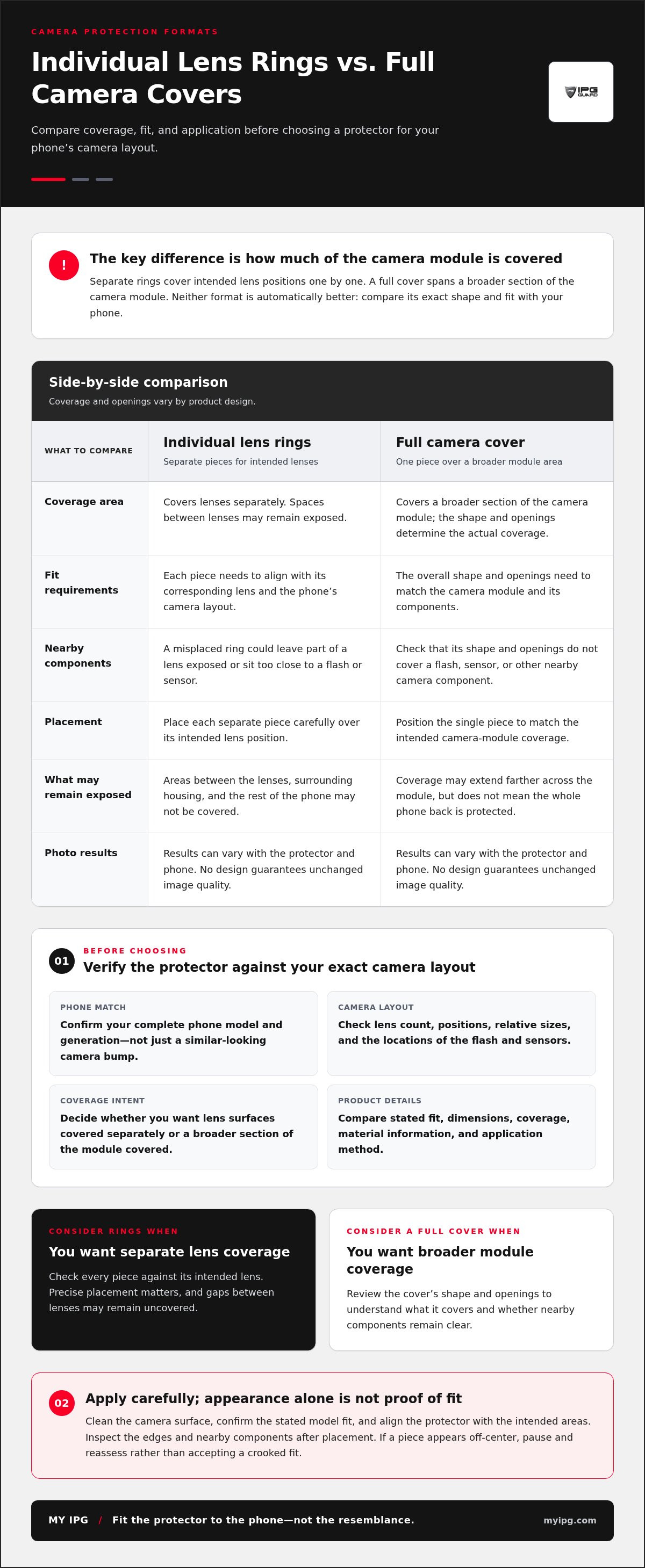
Individual rings cover lenses separately, so a multi-lens phone may need several pieces placed according to the camera layout. A full camera cover uses one piece over a broader section of the camera module. Depending on its shape and openings, it may also cover some of the area between lenses.
The two formats don’t cover the same area by default. Compare the product’s design and dimensions with your phone’s camera layout. A protector that appears close to the right size could still leave part of a lens exposed or extend over a flash or sensor.
What Camera Lens Rings Can, and Cannot, Protect
These protectors add a layer over the lens surfaces they cover. That layer can help shield those areas during ordinary handling, but it doesn’t guarantee the lens will avoid damage in every situation. Protection depends on the design, fit, coverage, and circumstances.
A piece over a lens doesn’t necessarily cover the entire camera island, surrounding housing, or phone body. A full-module cover may extend farther, but it still shouldn’t be treated as protection for the whole back of the phone. Don’t assume either style is waterproof, drop-proof, or impact-proof without evidence for that specific product.
For a suitable fit, identify your exact phone model and generation, then compare the protector’s intended coverage with the camera layout. Individual camera lens protector rings are one format to assess, not a universal fit. Check that the pieces cover the surfaces you want protected without blocking nearby camera components.
How Fit, Coverage, and Camera Design Affect Ring Protector Performance
A camera module is a compact arrangement of components, not a set of interchangeable openings. Phone models can differ in lens count, lens spacing, and the positions of the flash and nearby sensors. Even phones with similar-looking camera bumps may have different dimensions. Match the protector to your exact model and generation, not just to a resemblance in photos.
Smartphone camera optics are carefully designed. SPIE’s overview of optics in smartphone cameras explains the complexity of these systems. A protector needs to align with the intended lens area and leave nearby components unobstructed. A visual match alone can’t establish compatibility.
How to Check Whether Rings Fit Your Phone
First, identify your complete phone model and generation in device settings or manufacturer documentation. Then compare the product’s fit information with your camera module. Count the lenses, note their positions and relative sizes, and locate the flash and sensors. Check that each opening aligns with its intended lens without overlapping neighboring components.
Illustrative camera-module layout, not to scale:
[Lens A] [Lens B] [Flash]
[Lens C] [Sensor]
Actual positions and component count vary by phone.
Use the diagram as a reminder to check each opening, not as a template for another model. Before application, confirm that the stated model fit matches your phone.
Why Camera Layout Matters for Coverage
Individual camera lens protector rings need to sit in the right position around each intended lens. If a ring is misaligned, it may leave part of an edge uncovered or sit too close to a flash or sensor. A neat appearance doesn’t prove compatibility. Compare the stated fit details with your phone’s camera layout.
Apply each piece to a clean camera surface and check its position before pressing it down. Inspect the edges and nearby components once it’s in place. If a ring appears off-center, pause and reassess rather than accepting a crooked fit.
Compare your phone’s model and camera layout with My IPG phone camera lens protectors. Careful selection and placement help keep coverage focused on the intended areas while leaving nearby components clear.
Individual Camera Lens Rings vs. Full Covers: Which Design Suits You?
Choose based on the coverage you want, the camera layout you need to match, and the look you prefer. Individual rings place separate pieces over the lenses. A full cover spans a broader part of the camera module, though its cutouts and coverage vary by design. Neither format is automatically the better choice.
| Comparison | Individual lens rings | Full camera cover |
|---|---|---|
| Coverage area | Separate coverage over intended lens positions; spaces between lenses may remain exposed. | One piece covers a broader section of the module, depending on its shape and openings. |
| Fit needs | Each piece must align with its corresponding lens and match the spacing. | The cover’s overall outline and cutouts must match the module and nearby components. |
| Appearance | Leaves more of the camera area visible; the finished look depends on ring design and layout. | Creates a more unified covered area; its appearance depends on its finish and shape. |
| Application | Requires positioning each separate piece carefully. | Requires aligning one larger piece and its openings carefully. |
When Individual Rings May Be the Better Match
Consider individual camera lens protector rings if you prefer separate pieces over a single cover spanning more of the camera module. Accurate placement matters: each ring needs to correspond to its intended lens. The finished appearance depends on the ring design and how the pieces sit within your phone’s camera layout. Check the model-specific fit details before choosing.
When a Full Camera Cover May Make More Sense
A full cover may suit you if you want one piece over a broader area of the camera module. It means positioning one piece instead of several, but doesn’t guarantee an easier application. Its outline and openings still need to align with your phone’s lenses and surrounding components. Compare the stated coverage with the camera module before choosing this format.
Think of installation as a different alignment task, not a contest with one universal winner. Separate rings require positioning each piece; a full cover requires aligning one larger piece and its openings. Follow the product’s application instructions for either style.
Materials and photo effects vary by product and phone. Don’t assume individual rings always preserve image quality better or that a full cover will affect it more. Weigh your coverage and appearance preferences against the exact fit and your camera-use needs. My IPG sells phone camera lens protectors for people comparing ways to protect their phone camera lenses. Review the fit and design details for the option you choose.
How to Choose and Apply Individual Camera Lens Protector Rings
A careful fit starts before you open the package. Compare the protector’s model-specific details with your phone, then review its coverage, stated material information, and application method. Individual camera lens protector rings are designed around a particular camera layout, so don’t rely on a product photo or a similar-looking phone as proof of compatibility.
A Simple Pre-Purchase Compatibility Checklist
Before choosing a protector, work through these checks:
- Phone model: Confirm the complete model name and generation in your device settings or manufacturer documentation. Check that the product’s fit details name your model.
- Camera layout: Compare the number, positions, and relative sizes of the lenses. Check that every opening corresponds to its intended lens and doesn’t overlap the flash, sensors, or neighboring components.
- Coverage: Identify which surfaces the set covers and which areas remain exposed. Separate rings don’t necessarily cover the entire camera module.
- Material information: Review the material stated for the protector. Don’t infer scratch resistance, optical properties, or other features if they aren’t specified.
- Application method: Read the installation instructions in advance. Note any stated alignment or placement process, and follow the product’s guidance.
If the model or camera arrangement doesn’t match the fit information, pause before applying the protector. A close visual resemblance isn’t a substitute for a model-specific match.
Applying Rings Without Misalignment
Prepare a clean, dry camera area and follow the product’s cleaning and application instructions. Dust or residue can interfere with neat placement. Work in good light so you can see each lens edge and nearby component clearly.
Align each ring over its intended lens before pressing it into place. Work carefully, one piece at a time, and check each position against the camera layout as you go. Don’t rush or press down while a ring appears off-center. When you’ve placed the pieces, inspect their edges and check that none have shifted over a neighboring component.
Finish with a practical camera check. Open the camera and review its available views, then try the flash during ordinary use. Compare the results with your usual camera experience. If you notice an obstruction or an unexpected change, consult the protector’s instructions instead of assuming every design behaves the same.
My IPG sells phone camera lens protectors for shoppers considering added lens-surface protection. Explore My IPG phone camera lens protectors and use the model-specific fit details to guide your selection.
Choose Camera Lens Protection That Fits Your Phone and Photography
Use three filters to narrow your choice: exact phone fit, preferred coverage format, and how you use your camera. Check the model and camera layout first. Then decide whether separate lens pieces or broader module coverage better suits your preference. Finally, consider the photos you take, including whether you often use flash or shoot in low light. A protector’s effect on photos can vary with its design and the phone, so no format guarantees unchanged results.
Make the Final Choice With Confidence
Prioritize model-specific compatibility over broad claims that a protector fits multiple phones. Camera layouts can differ between generations even when devices look similar. For individual camera lens protector rings, check that the product details match your phone’s lens positions and surrounding components. Don’t treat a close visual match as proof of fit.
Next, choose your preferred coverage. Separate pieces cover individual lens positions, while a full cover spans more of the camera module, depending on its design. Consider how each option will look on your phone and whether you’re comfortable aligning multiple pieces or one larger cover.
Before deciding, review the product’s stated material information and application instructions. Don’t assume features that aren’t specified. If camera clarity is a priority, test the camera and flash after application under ordinary use. This gives you a practical check with your own phone and photography habits.
Explore My IPG Camera Lens Protection
My IPG sells phone camera lens protectors for people looking to add protection to their camera lenses. Focus on the details that matter: model fit, intended coverage, and careful application. Choosing with those details in mind helps you select a protector that suits your device and keeps your camera use in consideration.
Use those three filters to make a considered choice. Explore My IPG’s phone camera lens protectors and find an option suited to your camera and everyday use.
Protect Your Camera With a Fit That Makes Sense
Choosing camera protection comes down to three checks: an exact match for your phone model, coverage that suits your camera layout, and a design that fits the way you use your camera. Individual camera lens protector rings cover lenses separately, while a full cover spans more of the camera module. Neither format suits every phone or preference.
Before applying protection, read the model-specific fit details and follow the product’s instructions. Photo results can vary with the protector design and phone, so check camera views and flash use after installation rather than relying on an absolute quality claim.
My IPG sells phone camera lens protectors as part of its specialized protection products for phones and other electronic devices. Choose carefully, apply with care, and keep your everyday camera use in mind.
Explore My IPG phone camera lens protection and take a thoughtful next step in caring for your phone.
Frequently Asked Questions
What is an individual camera lens protector ring?
An individual camera lens protector ring is a separate piece positioned over one phone camera lens. A set uses multiple pieces, with each ring placed over its intended lens, rather than one cover spanning the camera module. Coverage depends on the product’s design, so check whether it protects only the lens surface or extends around it. Match the protector to your phone’s exact model and camera layout.
Do individual camera lens protector rings affect photo quality?
They can affect photo results, but the outcome depends on the protector’s design and the phone’s camera system. Fit, material, and how the protector sits over a lens may all matter. Don’t assume every ring has the same optical effect. After installation, test the camera’s available views and take photos in different lighting, including with flash if you use it. Look for unexpected glare, haze, or obstruction.
How do I know what size camera lens protector rings to buy?
Choose a protector whose fit information names your exact phone model and generation. Then compare the number, positions, and relative sizes of the lens openings with your camera module. Check the flash and sensors, too. Don’t rely on a similar-looking phone or a general size description alone. Individual camera lens protector rings need a model-specific fit, and a close visual match doesn’t establish compatibility.
Can camera lens protector rings cover the flash?
Some designs may extend over part of the camera module, while others leave spaces around individual lenses. The flash should remain unobstructed unless the product is specifically designed with a suitable opening for it. Before applying a protector, compare its layout with your phone and check that it doesn’t cover the flash or nearby sensors. After installation, test flash use under ordinary conditions.
Are individual camera lens rings better than a full camera cover?
Neither format is always better. Individual rings place separate pieces over lens positions, while a full cover spans a broader area of the camera module, depending on its design. Rings require careful placement for each lens; a full cover requires alignment of its overall shape and openings. Choose based on your phone’s layout, preferred coverage, and appearance. Materials and photo effects vary by product.
How do you install individual camera lens protector rings?
Start with a clean, dry camera surface and follow the protector’s preparation instructions. Align each ring over its intended lens before pressing it into place. Apply the pieces carefully and check that none sit over the flash or sensors. Inspect the edges when finished, then test camera views and flash use. If placement seems wrong, consult the product instructions before adjusting or removing the protector.
Can I remove camera lens protector rings without damaging my phone?
Removal depends on the protector and its adhesive, so damage-free removal can’t be guaranteed in every situation. Follow the manufacturer’s removal guidance and work slowly. Don’t force a piece or use a sharp tool against the phone’s camera area. If the ring resists, stop rather than risk scratching the lens or surrounding housing. After removal, inspect the camera surface and clean it only as directed by the phone or protector instructions.