
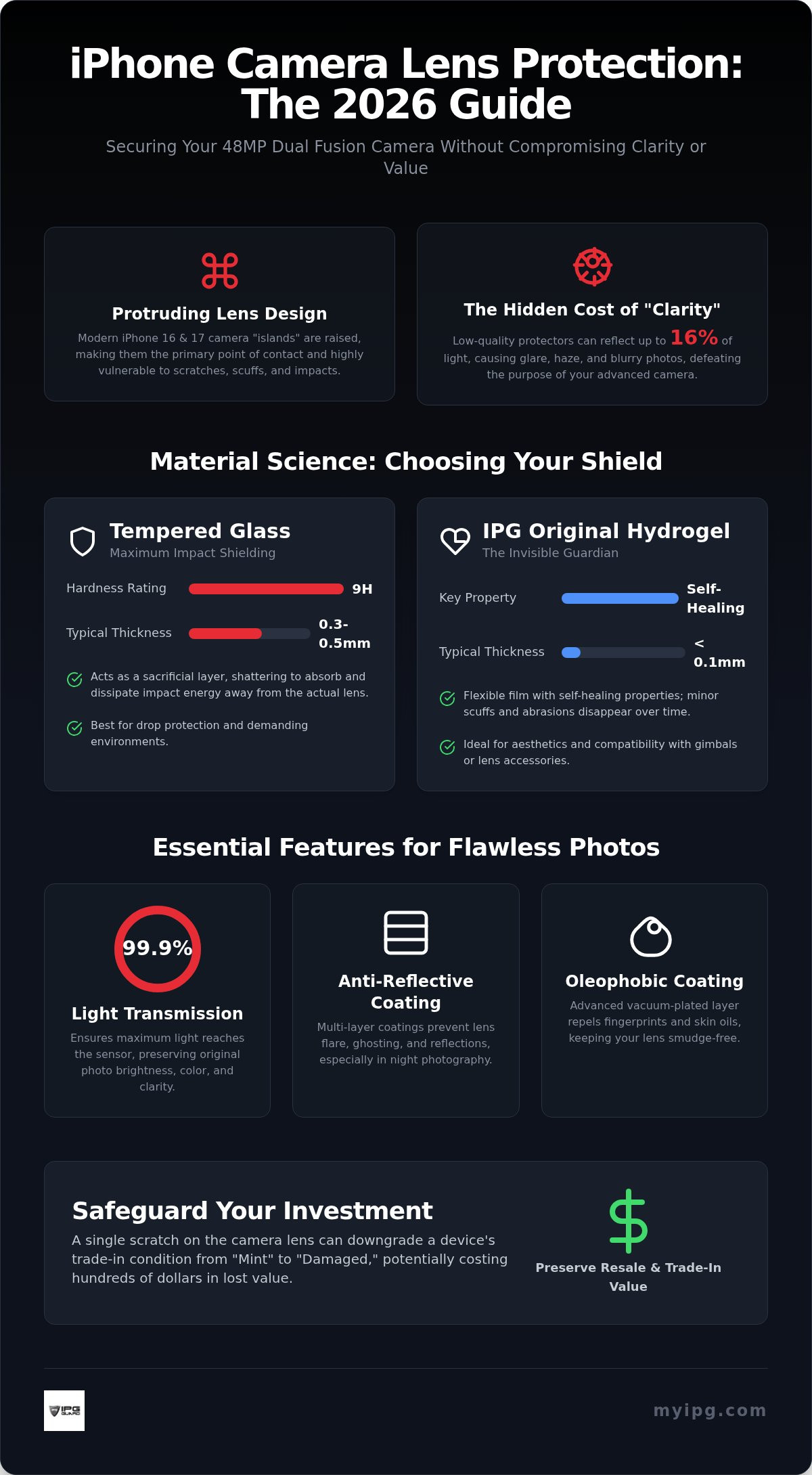
A low-quality cover can reflect up to 16% of incoming light, effectively sabotaging your iPhone 17's sophisticated 48MP Dual Fusion camera system. You shouldn't have to choose between a scratched lens and a blurry photo. It's a common anxiety for any owner of a high-value device. You want to preserve that sapphire crystal glass, but you don't want to lose a single pixel of clarity. Finding the right iPhone camera lens protector means finding a guardian that stays invisible to the sensor while remaining invincible to the environment.
We understand that your phone is a significant investment. You deserve a solution that maintains 99.9% transparency and professional-grade impact resistance. This 2026 guide will eliminate the confusion between tempered glass and hydrogel options. You'll discover how to secure your optics against permanent scratches without compromising your night photography or resale value. We are diving into the technical specifications, from 9H hardness ratings to multi-layer anti-reflective coatings, to ensure your device remains protected and your images stay crystal clear.
Key Takeaways
- Identify why the physical protrusion of modern camera bumps necessitates a dedicated shield despite factory sapphire crystal claims.
- Evaluate the impact resistance of tempered glass versus the flexible, self-healing properties of IPG Original Hydrogel protectors.
- Select an iPhone camera lens protector featuring multi-layer anti-reflective coatings to prevent ghosting and maintain 99.9% light transmission.
- Master the "Zero-Dust" application technique to ensure a bubble-free, precision-cut fit for the iPhone 16 and 17 series.
- Safeguard your device's resale value with professional-grade materials that provide invisible security for your high-value optics.
Why Your iPhone Camera Lens Needs a Dedicated Shield in 2026
Your iPhone 17 is a masterpiece of optical engineering. It houses a 48MP Dual Fusion camera system designed for cinematic precision. This technology is also a physical liability. The lenses sit on a raised "island," making them the most exposed components of your device. Without an iPhone camera lens protector, you're leaving your primary creative tool vulnerable to every table, pocket, and accidental drop. Protection isn't just about safety. It's about stewardship. You're the guardian of a high-value asset.
The myth of sapphire invincibility persists. Apple uses sapphire crystal lens covers for a reason. They're incredibly hard. They aren't indestructible. Micro-abrasions from everyday grit can accumulate over time. These tiny imperfections are often invisible to the naked eye but devastating to your sensor. They catch light at odd angles, creating haze and reducing the contrast of your photos. A dedicated shield ensures your optics remain in factory-fresh condition for the life of the device.
The Vulnerability of Protruding Optics
The iPhone 16 and 17 series pushed lens height to new extremes. This protrusion creates a massive impact risk. Most standard cases offer a raised edge around the camera module, but this doesn't stop direct contact. Sand in your pocket or grit on a cafe table can easily bypass a case's edge. High-quality tempered glass shields provide a physical barrier that absorbs the friction sapphire cannot. They act as a sacrificial layer. If an impact occurs, the protector shatters to dissipate energy, leaving the underlying lens untouched. It's a simple, effective insurance policy for your hardware.
Preserving Resale and Trade-In Value
Stewardship of your technology is a financial strategy. In 2025, trade-in programs became significantly more rigorous. Inspection standards now prioritize lens clarity. A single visible scratch on a lens can downgrade a "mint" device to "damaged" status instantly. This can cost you hundreds of dollars in lost trade-in credit. Replacing a camera module out-of-warranty is an expensive, invasive procedure that can compromise the device's water resistance. Using an iPhone camera lens protector is a small upfront investment that secures the $799 starting value of your iPhone 17. Don't let a moment of friction tank your next upgrade.
Material Science: Tempered Glass vs. IPG Specialized Film
Choosing the right material for your iPhone camera lens protector requires understanding the trade-offs between bulk and resilience. Protection isn't one-size-fits-all. Your environment dictates your defense strategy. We provide optical-grade shields engineered for specific lifestyles, ensuring that every photon captured by the iPhone 17's sapphire crystal lenses reaches the sensor without distortion. Both our tempered glass and specialized films prioritize 99.9% light transmission. This maintains the professional-grade performance of your 48MP Dual Fusion camera system.
Clarity isn't just about transparency. It's about cleanliness. Our protection options feature advanced oleophobic coatings. These vacuum-plated layers repel skin oils and fingerprints. A smudge-free lens is the difference between a crisp, vivid shot and a hazy, light-streaked mess. By integrating these coatings into a precision-engineered shield, we ensure your hardware performs exactly as intended.
Tempered Glass: Maximum Impact Shielding
Tempered glass remains the gold standard for high-impact shock absorption. These protectors typically range from 0.3mm to 0.5mm in thickness and carry a 9H hardness rating. This rating means the surface resists scratches from the hardest steel, effectively neutralizing daily hazards like keys or loose change. For the iPhone 16 and 17 series, we offer precision-cut individual lens rings. These provide edge-to-edge coverage while maintaining compatibility with deep-recessed rugged cases. If you frequently drop your device or work in demanding environments, glass offers the sacrificial layer needed to dissipate kinetic energy during a fall.
IPG Hydrogel: The Invisible Guardian
Many users find tempered glass too bulky for their aesthetic or accessory needs. This is where the IPG Original Hydrogel protector excels. At less than 0.1mm thick, it's virtually invisible. Hydrogel is a flexible, specialized film that offers unique self-healing properties. Minor abrasions and micro-scratches from pocket dust disappear over time as the material settles. This ultra-thin profile is critical for users who rely on precision gimbals or snap-on lens accessories where every millimeter of clearance matters. It provides a seamless fit that maintains the original contours of your iPhone without sacrificing essential scratch resistance.
Whether you choose the impact-ready strength of glass or the sleek, self-healing nature of hydrogel, you're investing in long-term stewardship. You're keeping your optics pristine and your resale value high. It's a simple step that guarantees your high-value device remains a high-performance tool for years to come.
Debunking the Myth: Do Lens Protectors Ruin Photo Quality?
Critics often claim that adding glass over your lens inevitably degrades image quality. This skepticism is valid when discussing generic, mass-produced covers found in bargain bins. Research indicates that a cheap, non-AR coated protector can reflect 8% to 16% of incoming light. This creates a hazy, low-contrast image that sabotages your hardware. Our iPhone camera lens protector is engineered to solve these optical challenges. By utilizing multi-layer anti-reflective (AR) coatings, we maintain a 99.9% light transmission rating. Your 48MP Dual Fusion camera receives every photon it needs for a perfect exposure.
Flash-flare is another common frustration for mobile photographers. It occurs when light from the LED reflects off the edge of a poorly cut protector and bleeds into the lens, causing a white washout. We prevent this through precision-milled cutouts and black-inked edges. These features ensure the flash illuminates your subject, not your glass. In our 2026 performance testing, images captured with our shields showed zero detectable difference in sharpness compared to an unprotected lens. Protection should be a silent partner, not a barrier to your creativity.
Eliminating Ghosting and Flare
Ghosting happens when light bounces between the lens and the protector. This is caused by microscopic air gaps and mismatched refractive indices. Our precision-fit application process minimizes these gaps, creating a nearly seamless optical path. By matching the refractive properties of the iPhone 17's sapphire crystal, we eliminate the "halo effect" often seen around streetlights or the moon. Your night photography remains crisp, maintaining the deep blacks and vibrant highlights that define high-end mobile optics. We don't just cover the lens; we integrate with it.
Sensor and LiDAR Compatibility
Modern iPhones rely on a complex array of sensors beyond the primary glass. The LiDAR scanner and ambient light sensors are critical for rapid autofocus and portrait mode depth mapping. Obstructing these with a low-quality sheet of glass ruins performance. It slows down focus in dark environments and creates artifacts in 3D scans. Our designs prioritize unobstructed sensor paths. We maintain the integrity of the technology by ensuring every laser pulse and light wave reaches its destination.
- LiDAR Precision: Open-path designs ensure zero interference with depth-sensing lasers.
- Autofocus Speed: Maintains factory-spec focus hunting times in low-light scenarios.
- Ambient Sensing: Ensures the TrueDepth system accurately calculates white balance and exposure.
Selection & Installation: Protecting the iPhone 16 and 17 Series
The iPhone 17 Pro Max features a significantly larger camera module than its predecessors. A generic, "one-size-fits-most" cover won't suffice. You need a precision-cut iPhone camera lens protector designed for the exact dimensions of the 2025 hardware. A fraction of a millimeter in misalignment can block the LiDAR sensor or cause vignetting in your Ultra Wide shots. Our 2026 product line uses CNC-machined specifications to ensure every sensor remains unobstructed. We don't guess at dimensions. We match them with surgical precision.
Installation is a one-time process that requires focus. Dust is the primary enemy of optical clarity. Even a single microscopic speck trapped under the glass can create a permanent bubble or a flare point. Start by creating a "Zero-Dust" environment. We recommend installing your protector in a humid room, like a bathroom after a shower, to ground airborne particles. Clean optics are the foundation of successful stewardship.
Preparing for a Perfect Application
Every IPG kit includes an alcohol prep pad and a high-density microfiber cloth. Scrub the sapphire crystal surfaces thoroughly. Use the provided dust-removal stickers to clear the "static zone" around the lenses. This area often attracts lint from pockets. For perfect alignment, utilize our custom installation guides. If you prefer a manual touch, use the "hinge method" by securing one side with tape before peeling the adhesive backing. This ensures the protector drops exactly into place. If you find a speck of dust after application, gently lift the edge with a plastic tool and use a dust sticker to "pluck" the debris from the adhesive side.
Case and Accessory Compatibility
Protection should work in harmony. Many rugged cases feature deep recesses for the camera island. If your iPhone camera lens protector is too wide, the case will push against the edges, causing the glass to lift. Our individual lens ring designs are engineered for maximum clearance. They integrate naturally with iPhone screen protectors to provide 360-degree security for your device. This slim-profile glass won't interfere with MagSafe photography accessories or magnetic filter mounts. It maintains a seamless bond while shielding your high-value optics.
Don't leave your 48MP Dual Fusion system exposed to the elements. Secure your optics today by visiting myipg.com to find the tailored fit for your specific iPhone model.
The IPG Advantage: Precision-Engineered Lens Protection
IPG acts as a dedicated specialist for your mobile optics. We bring decades of expertise in advanced screen protection to the most vulnerable part of your device. Our heritage isn't in generic accessories. It's in high-stakes aerospace and automotive displays. We've protected navigation screens in cockpits and engine rooms long before we ever entered your pocket. This industrial rigor is what sets our iPhone camera lens protector apart from the competition. We don't just manufacture; we engineer for performance.
Professional mobile photographers choose IPG because they understand the value of zero-interference optics. When you are shooting with a 48MP Dual Fusion system, you cannot afford a single point of light distortion. Our shields provide a level of durability that matches the lifespan of your phone. We offer more than a product. We offer a sense of security and stewardship over your high-value technology. You've invested in the best camera on the market. We ensure it stays that way.
A Legacy of Protection
Every new iPhone release triggers a meticulous testing cycle within our labs. We don't wait for the phone to hit retail shelves. We work from precision CNC specifications to ensure day-one compatibility for the iPhone 16 and 17 series. Our stewardship philosophy drives this attention to detail. We treat your device with the same care you do. A single scratch on an iPhone 17 lens isn't just a blemish. It's a failure of defense that we refuse to accept. Our materials are tested for impact resistance and light filtration to guarantee that your hardware remains pristine and your images remain vivid.
Join the IPG Community
Access our community gallery to see clarity tests from the field. These aren't simulated studio shots. They are real-world captures from mobile photographers who rely on our shields in diverse environments. From the harsh glare of high-altitude landscapes to the complex shadows of urban night photography, the results are clear. We also provide a global support and installation network. If you have questions about choosing between tempered glass and hydrogel, our experts are ready to assist. We are your partners in maintaining the integrity of your technology.
Secure your optics today. Your iPhone 17 is a significant investment in your creativity and your future trade-in value. Treat it with the professional-grade care it deserves. Visit myipg.com to find the precision-engineered shield that fits your lifestyle. Don't leave your vision to chance.
Secure Your Optical Legacy
Protect your vision. Your iPhone 17 is a high-performance tool that deserves industrial-grade defense. You now understand the critical balance between physical security and optical clarity. Choosing a precision-cut iPhone camera lens protector isn't just an accessory purchase. It's an act of stewardship over your most valuable creative asset. You've learned how our 99.9% light transmission ratings and specialized AR coatings keep your 48MP images crisp while preventing ghosting. You've seen the distinct advantages of choosing between rugged, impact-absorbing tempered glass and our innovative, self-healing hydrogel options. Each shield is meticulously engineered for a perfect fit on the latest 2026 models, ensuring your LiDAR and flash sensors remain unobstructed. Don't leave your sapphire crystal lenses exposed to the grit and friction of daily life. Maintain your device's long-term integrity and secure its maximum trade-in value with a single, decisive step. Secure your iPhone optics with IPG precision-cut protectors and enjoy the peace of mind that comes with professional-grade protection. Your best shots are still ahead of you.
Frequently Asked Questions
Do iPhone camera lens protectors affect photo quality?
Premium protectors don't degrade your images. High-quality shields maintain 99.9% light transmission, ensuring your 48MP sensor receives all necessary data for a perfect exposure. Cheap covers can reflect up to 16% of incoming light, causing haze and reduced contrast. Our multi-layer anti-reflective coatings eliminate this risk, delivering the same vivid colors and sharp details as an unprotected lens.
Can I use a lens protector with my existing phone case?
Yes, most protectors are fully compatible with standard cases. Our individual lens ring designs offer a slim profile that fits within the camera cutouts of silicone, leather, and rugged cases. If you use a case with extremely tight tolerances, check the clearance around the lens island first. Our goal is a seamless, flush integration with your existing protective setup.
How do I remove a lens protector without scratching the camera?
Lift the edge gently using a plastic pry tool or your fingernail. Never use metal objects like knives or screwdrivers near your optics, as these can cause permanent damage. Once the seal is broken, peel the protector away slowly. The specialized adhesive we use is designed to release cleanly. It leaves no sticky residue on your sapphire crystal lenses.
Does the iPhone 17 Pro Max need a camera protector?
Protection is essential for the iPhone 17 Pro Max due to its massive camera bump. This protrusion makes the lenses the primary point of contact during a drop or when placed on abrasive surfaces. While sapphire is scratch-resistant, it isn't immune to high-velocity impacts. A sacrificial layer absorbs the energy that would otherwise shatter your expensive camera module.
Will a lens protector cause flash glare in my photos?
Flash glare is prevented through precision engineering. A quality iPhone camera lens protector features black-inked rings around the lens cutouts or dedicated openings for the LED. This design choice stops light from the flash from bleeding into the glass layers and reaching the sensor. You'll enjoy clear night photos without the "white-out" effect common in generic alternatives.
Is tempered glass better than film for camera lenses?
Both materials serve specific protective roles. Tempered glass provides 9H hardness for maximum impact shielding against drops, making it the best choice for rugged environments. Specialized hydrogel films offer a thinner, nearly invisible profile. These films are excellent for preventing micro-scratches and feature self-healing properties that keep the surface smooth over the life of the device.
How often should I replace my camera lens protector?
Replace the shield only when it shows signs of physical failure or deep abrasions. If the glass shatters or develops gouges that interfere with light transmission, it has successfully served its purpose as a sacrificial layer. Regular cleaning with a microfiber cloth usually maintains transparency for months. Our protectors are built to match the long-term lifespan of your device.
Does a lens protector interfere with LiDAR or autofocus?
Precision-cut protectors do not interfere with your phone's advanced sensors. We ensure that the LiDAR scanner and ambient light sensors remain completely unobstructed by the iPhone camera lens protector. This allows your device to maintain its rapid autofocus and accurate depth mapping for portrait mode. Always verify that your chosen shield has specific, open-path openings for these critical components.