

Your sapphire crystal screen is tough, but it isn't invincible against the abrasive reality of a dive boat. One accidental strike against a steel tank or a rub in the sand can leave permanent scars on your expensive investment. You need a garmin descent screen protector that functions as a critical sacrificial layer, absorbing impacts and managing glare before they reach your display.
We understand that your dive computer is more than a gadget; it's a vital piece of life-support equipment. You rely on it for crystal-clear visibility during decompression stops and precise data tracking. This guide explores the latest in high-stakes defense for models like the Descent Mk3i and the eco-friendly G2. You'll learn how to safeguard your tech against salt, sand, and extreme pressure using advanced materials that won't fail when you're thirty meters down.
We'll break down the technical differences between self-healing hydrogel and traditional tempered glass. We'll also explain why a precision-cut fit is the only way to prevent adhesive failure in saltwater. Let's ensure your gear remains as resilient as your dive plan.
Key Takeaways
- Understand the vital role of a sacrificial layer in shielding high-value sapphire displays from abrasive saltwater and sand.
- Compare material performance to see why flexible hydrogel offers superior pressure resistance and adhesion over brittle tempered glass at depth.
- Ensure uncompromised visibility during decompression stops with specialized HD clear films and innovative self-healing surface technology.
- Follow our professional guide to achieve a bubble-free, waterproof application of your garmin descent screen protector in any environment.
- Secure the long-term integrity and resale value of your Mk1, Mk2, or Mk3 series with precision-cut guardian technology.
Why Your Garmin Descent Needs Dedicated Screen Protection
Your Garmin Descent is a high-stakes instrument. It's a lifeline at 100 feet. While the housing is rugged, the display is the most vulnerable component. Scuba diving environments are inherently hostile. You deal with abrasive sand, corrosive salt, and heavy metal tanks. A specialized garmin descent screen protector acts as a critical sacrificial layer. It takes the abuse so your factory glass doesn't have to.
Think about the financial reality. These units often cost well over $1,000. When you decide to upgrade from an older model to the latest Mk3i, resale value is everything. A single deep scratch from a wreck dive can slash hundreds off the trade-in price. It's a small investment to protect a significant asset. Beyond the money, a damaged screen can compromise the structural integrity of the device under pressure.
The Sapphire Myth: Why "Scratch-Resistant" Isn’t Enough
Many divers believe sapphire glass is invincible. It's a common misconception. Sapphire is exceptionally hard, sitting just below diamond on the Mohs scale, but this hardness comes with a trade-off. It's brittle. A direct impact against a boat ladder or a steel cylinder can cause the crystal to chip or shatter completely. Researching various screen protector materials reveals that flexible layers offer better energy dispersion than rigid glass. While sapphire resists scratches from metal, fine silt and pressurized sand particles can still mar the surface over time. Replacing a film is simple. Replacing a factory-sealed sapphire display is a logistical and financial nightmare.
Preserving Visibility in the Marine Environment
Legibility isn't just about aesthetics; it's a core safety requirement. Underwater, your ability to read decompression limits and gas pressures is non-negotiable. Saltwater dries quickly on the surface, leaving behind crusty deposits that scatter light and blur data. A high-quality garmin descent screen protector maintains a smooth surface that helps shed water. This repels skin oils and sunscreen, preventing smudges that become visible in low-light conditions. Clear, HD film ensures that your AMOLED display remains vivid. You need to see your stops clearly when the visibility drops. Protecting the screen ensures your data remains accessible in every environment, from tropical reefs to dark quarries.
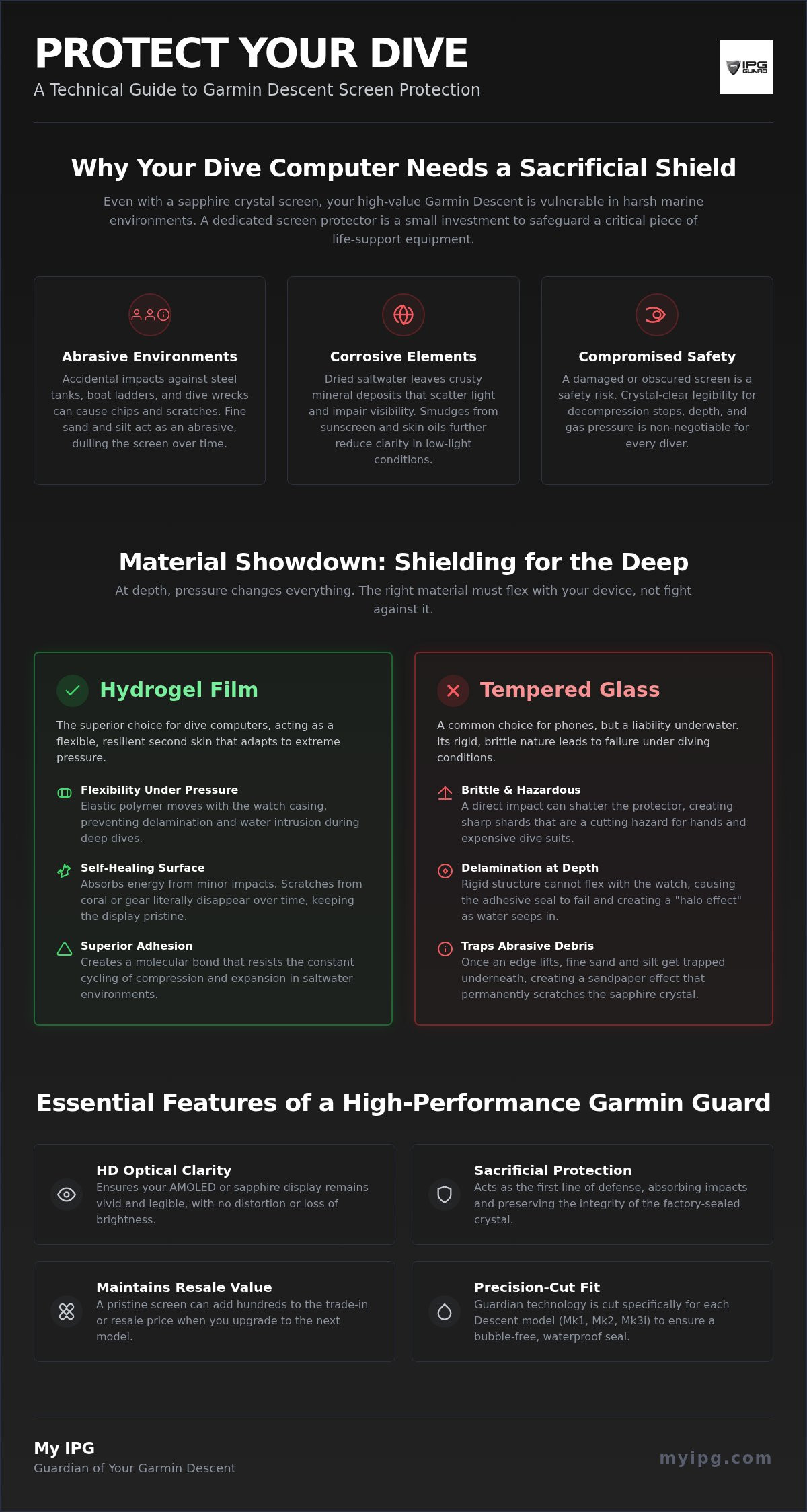
Hydrogel vs. Tempered Glass: Choosing the Right Shield for the Deep
Depth changes everything. On land, a rigid glass sheet works fine for a smartphone. Underwater, increasing pressure exerts uniform force on every square millimeter of your equipment. A garmin descent screen protector must handle these atmospheric shifts without losing its vacuum seal. Rigid materials like tempered glass don't flex. When the watch casing and screen compress slightly under extreme depth, rigid protectors often delaminate. This creates a "halo" effect where water and salt creep under the edges, eventually causing total failure.
Hydrogel is fundamentally different. It's a flexible, elastic polymer that moves with the device. It creates a molecular bond that resists the constant cycling of compression and expansion during a dive. This is why specialized films are the preferred choice for high-stakes dive tech. They act more like a second skin than a separate plate, ensuring the seal remains intact regardless of the depth gauge reading.
The Benefits of Hydrogel for Wearable Dive Tech
Hydrogel technology offers a unique self-healing capability that glass simply cannot match. If you brush against a coral head or a rusty wreck, the film absorbs the energy. Minor indentations and surface scratches literally disappear over time as the material returns to its original state. This keeps your display looking pristine dive after dive. Because the material is thin and pliable, it allows for true edge-to-edge coverage. This is vital for the specific geometries of the Mk1, Mk2, and Mk3i series. For Mk3i users, the film ensures full touch sensitivity remains intact. You won't struggle with unresponsive menus or delayed inputs while wearing 5mm gloves.
Why Tempered Glass Often Fails Divers
Tempered glass is inherently brittle. While it's great for impact protection in a pocket, it's a liability on a dive boat. If a glass protector cracks, it becomes an immediate safety hazard. Sharp shards can cut your hands or, worse, snag and tear an expensive drysuit seal. Saltwater also tends to degrade the rigid adhesives used on glass protectors faster than the flexible bonds used in hydrogel. Once a corner lifts, fine silt and sand get trapped underneath. This creates a permanent abrasive layer held directly against your sapphire crystal. This is the exact opposite of what you want from your protection.
Glass protectors also add significant height to the watch face. This creates a snag point for BCD straps, reel lines, or computer consoles. A streamlined profile is essential for underwater safety and efficiency. Choosing an IPG Garmin DESCENT Screen Protector provides the high-performance defense you need without the bulk or the risk of shattering at depth. It's about maintaining the integrity of your gear without introducing new points of failure.
Essential Features of a High-Performance Garmin Guard
A high-performance shield does more than stop scratches. It manages the physics of light and the chemistry of the marine environment. When you're tracking your nitrogen loading at depth, you can't afford a display that's clouded by salt or obscured by surface reflections. A premium garmin descent screen protector must be invisible to the eye but invincible to the elements. It serves as a sophisticated optical filter that ensures your data remains the priority.
Precision fitment is the foundation of this protection. Unlike universal round protectors that leave gaps at the bezel edge, a custom-engineered guard follows the exact CNC-machined specifications of your device. This eliminates the "dirt ring" that typically forms around the perimeter of generic films. By sealing the entire crystal surface, you prevent pressurized saltwater from finding a weak point in the adhesive. This level of meticulousness is what separates a true dive-grade guard from a standard fitness tracker film.
Self-Healing and Smoothness: The IPG Advantage
Modern protection relies on molecular realignment. Our IPG ProActive technology uses a specialized polymer chain that remembers its original shape. When a piece of dive gear rubs against the screen, the material absorbs the impact and slowly closes the gap. This self-healing property ensures that minor abrasions from wreck penetrations or gear bags don't become permanent eyesores. Beyond durability, the finish remains smooth to the touch. This is essential for daily wear and ensures that touch-sensitive models like the Mk3i respond instantly to every swipe. You get the protection of a rugged shield with the tactile feel of factory glass.
Optical Performance and Light Filtration
Maintaining the integrity of Garmin’s high-resolution AMOLED displays is a technical challenge. Our garmin descent screen protector is engineered for 99% light transmission. This ensures that the deep blacks and vibrant colors of your dive computer remain vivid even in low-visibility conditions. We focus on reducing the "mirror effect" that often plagues divers at the surface in bright tropical sun. By managing light filtration, the film allows you to read critical decompression data without fighting distracting reflections. It’s a safety-first approach to display management that keeps your focus on the dive, not on struggling to see your screen.
- 99% light transmission for maximum AMOLED clarity
- Molecular self-healing technology for surface restoration
- CNC precision-cut fitment for Mk1, Mk2, and Mk3 series
- Oleophobic coating to repel salt, oils, and smudges
Installation Guide: Achieving a Bubble-Free Waterproof Seal
Achieving a professional-grade seal on your Garmin Descent requires more than just steady hands. It requires a controlled environment. Saltwater and high-pressure depths will find any weakness in a poorly applied film. A flawless installation of your garmin descent screen protector ensures that no silt, sand, or corrosive salt can migrate under the edges during your dive. Follow these steps to secure your tech.
- Step 1: Deep Cleaning. Strip away skin oils, sunscreen, and factory residues. Use a 70% isopropyl alcohol wipe to prep the sapphire surface. Don't skip this. A clean base is the only way to ensure a permanent bond.
- Step 2: Environment Control. Create a "Zero Dust" zone. Use the steam trick mentioned below to clear the air of floating contaminants.
- Step 3: Precision Alignment. Line up the film with the bezel markers. Start from one edge and slowly lower the protector. The CNC-cut dimensions leave zero room for error.
- Step 4: Bubble Extraction. Use a firm squeegee or a credit card wrapped in a lint-free cloth. Work from the center toward the edges. Use overlapping strokes to push all air out.
- Step 5: The Curing Phase. Be patient. Allow the adhesive to set for at least 24 hours before submerged use. The molecular bond needs time to stabilize against pressure.
Preparation: The Key to Long-Term Adhesion
Cleanliness is the foundation of performance. Use isopropyl alcohol to strip factory oils without damaging the rugged bezel finish. To manage airborne dust, run a hot shower in your bathroom for a few minutes. The rising steam binds to dust particles and pulls them to the floor, creating a temporary clean-room environment. A truly lint-free environment is the foundation of hydrogel performance, preventing microscopic fibers from compromising the adhesive's vacuum seal.
Troubleshooting Common Application Issues
If you spot a stray hair or dust speck mid-installation, don't panic. Gently lift the nearest corner and use a piece of adhesive tape to "dab" the particle off the film. For curved models like the Descent Mk2, edge lifting usually indicates a slight misalignment. Press the edges down firmly with your thumb for sixty seconds to activate the pressure-sensitive adhesive. If you see tiny micro-bubbles immediately after application, wait. These typically breathe out through the semi-permeable hydrogel material within 24 to 48 hours. Don't try to force them out, as you might stretch the film.
Secure your dive computer with a specialist guardian that won't fail when the pressure rises. Get your precision-cut IPG Garmin DESCENT Screen Protector today and dive with total confidence.
The IPG Specialization: Guardian of Your Garmin Descent
IPG isn't just a retailer. We are dedicated specialists. Our mission is to act as the ultimate guardian for your high-stakes technology. From high-performance automotive displays to the extreme pressure requirements of dive computers, we provide a level of defense that generic brands simply can't match. Choosing an garmin descent screen protector from IPG means investing in precision-engineered film that respects the technical integrity of your device. We don't just sell covers; we provide stewardship over the instruments you rely on for safety.
We understand the emotional and financial value of your gear. That's why our cutting technology is calibrated to the micron. Whether you're diving the Great Barrier Reef or exploring the Red Sea, our global presence ensures that high-tier protection is always within reach. We handle your items with care. We deliver a product that feels like a factory component rather than an aftermarket add-on. It's about maintaining the purity of your user experience while ensuring maximum durability.
Tailored Protection for Every Descent Model
We don't believe in "one size fits all" solutions. Our catalog offers specific, precision-cut films for the entire Garmin lineage. This includes the rugged legacy of the original Descent Mk1 and the sophisticated 43mm and 51mm variants of the Mk3i. We move quickly to support new releases. By using advanced ProActive films, we ensure that your next-generation AMOLED display is protected the moment it leaves the box. Our commitment is to stay ahead of the technology curve. Your gear should never face the elements unprotected. We provide the invisible shield that keeps your focus on the dive plan.
Beyond the Watch: A Complete Protection Ecosystem
Our expertise extends far beyond the wrist. We apply the same meticulous standards to all high-value displays in your marine kit. If you're a professional mariner or a dedicated enthusiast, explore our specialized defense for Lowrance fishfinders and other critical navigation tech. We understand that your entire electronic ecosystem needs a guardian. For those looking to secure every device in their professional or personal life, we've compiled The Ultimate Screen Protector Guide. It's a comprehensive resource for safeguarding every display in 2026.
Don't leave your life-support equipment to chance. Secure your dive tech today with a guardian that understands the stakes. Trust IPG to preserve the clarity, value, and performance of your Garmin Descent through every atmospheric cycle. Your adventure deserves nothing less than precision-engineered security.
Secure Your Dive Tech for Every Environment
Your Garmin Descent is a precision instrument designed for the most demanding conditions on earth. Protecting it shouldn't be an afterthought. By choosing a specialized garmin descent screen protector, you ensure that abrasive sand, corrosive salt, and accidental impacts never reach your sapphire display. You've learned how flexible hydrogel technology outperforms brittle glass under pressure and why a precision fit is essential for maintaining a waterproof seal.
Our films are precision-cut for Mk1, Mk2, and Mk3i models, featuring self-healing technology that repairs minor surface abrasions automatically. It's the same trusted defense used by professional divers worldwide to maintain visibility and resale value. Don't wait for the first scratch to compromise your gear. Protect Your Gear: Shop Garmin Descent Screen Protectors Now
Dive with the confidence that your technology is shielded by a dedicated guardian. We're here to help you preserve the integrity of your gear through every descent and decompression stop.
Frequently Asked Questions
Does a screen protector affect the depth rating of my Garmin Descent?
No, a garmin descent screen protector does not impact the factory depth rating of your device. The film is a surface-level application that sits entirely outside the watch's sealed pressure chamber. It doesn't exert force on the O-rings or the casing's structural seals. Your Mk2 or Mk3i remains rated for its original depth; the film simply provides a secondary layer of defense against abrasive silt and sand particles at pressure.
Will a hydrogel protector stay on in saltwater?
Yes, our specialized hydrogel films are engineered for permanent adhesion in marine environments. The key is the 24-hour curing phase. This allows the adhesive to form a vacuum seal that resists saltwater intrusion and the expansion cycles of deep diving. Unlike rigid glass that can lift at the edges, the flexible polymer moves with the watch face to maintain its bond dive after dive.
Is it worth putting a protector on a sapphire crystal screen?
Absolutely. While sapphire is highly scratch-resistant, it is fundamentally brittle and prone to chipping upon impact with steel tanks or boat ladders. A garmin descent screen protector serves as a sacrificial barrier. It absorbs the kinetic energy of a strike that might otherwise shatter the sapphire crystal. It also guards against the fine sand abrasion that can eventually dull even the hardest factory finishes over time.
Can I still use the touch screen on my Garmin Descent Mk3i with a protector?
Yes, the touch interface remains fully functional. Our HD hydrogel is ultra-thin, ensuring that capacitive signals pass through to the sensor without delay. You'll experience the same responsiveness on your Mk3i menus as you would with the bare glass. The smooth, oleophobic finish actually improves the experience by reducing friction and repelling the skin oils and salt crust that can sometimes cause unresponsiveness or ghost touches.
How do I remove an old or damaged screen protector from my watch?
Removal is straightforward and safe for your watch. Simply lift one edge of the film using your fingernail or a thin plastic card. Peel the protector back slowly across the face of the display. Our adhesives are designed to leave zero permanent residue. If any slight tackiness remains, a quick wipe with a 70% isopropyl alcohol pad will restore the sapphire crystal to its original, factory-clean state.
Does the screen protector interfere with charging or heart rate sensors?
No, the protection is localized to the front display. Garmin's charging pins and Elevate heart rate sensors are located on the case back and sides. Because our protectors are precision-cut to the exact diameter of the crystal, they don't overlap with the bezel buttons or the underside of the watch. Your biometrics and power connection remain completely unobstructed, allowing for seamless data tracking and charging between dives.
What happens if I get bubbles under the film during installation?
Micro-bubbles typically vanish on their own within 24 to 48 hours. Hydrogel is a semi-permeable material that allows trapped air to breathe out naturally as the adhesive settles. If you see tiny imperfections immediately after installation, avoid the urge to press them out with excessive force. Larger bubbles should be moved to the edge with a squeegee during the initial application to ensure a perfect, invisible finish before the film cures.
How often should I replace my Garmin Descent screen protector?
We recommend replacing the film every 6 to 12 months, depending on your dive frequency. While the self-healing technology handles minor abrasions, the sacrificial layer will eventually accumulate deep impacts from heavy gear or wreck contact. If you notice the edges starting to lift or the surface losing its HD clarity due to extreme abuse, it's time for a fresh guard. Regular replacement ensures your primary display always looks brand new.