

Your high-value diagnostic scanner is the heartbeat of your shop. It's a precision instrument, yet it's often one dropped wrench or a splash of brake fluid away from a total failure. Investing in a specialized screen protector for industrial diagnostic tools isn't just about scratch prevention. It's an insurance policy for your uptime. You've worked hard to build your professional kit. We're here to help you protect it with the same level of meticulous care you give your customers' vehicles.
We know the frustration of a cracked display or a screen so clouded by grease that you can't read the live data. It's a struggle to maintain touch sensitivity with thick, generic protectors, and the high cost of OEM repairs is a drain on your bottom line. This 2026 guide promises to show you how to safeguard your gear against shop chemicals and heavy impacts. You'll learn to maintain 100% touch accuracy and crystal-clear visibility, even in the harshest garage environments.
We'll dive into the technical properties of 9H nano-glass and the self-healing capabilities of modern hydrogel films. From preserving resale value to finding the perfect precision-cut fit for brands like Snap-on and Autel, we've mapped out the essential criteria for professional-grade protection. Let's ensure your tools stay as sharp as your diagnostic skills.
Key Takeaways
- Calculate the financial advantage of preventative protection by comparing the low cost of film against expensive OEM display replacements and lost billable hours.
- Select the optimal material for your workflow by weighing the high-impact shield of 9H nano-glass against the self-healing properties of hydrogel.
- Eliminate edge-peeling and touch sensitivity issues by choosing a precision-cut screen protector for industrial diagnostic tools designed for Snap-on and Autel hardware.
- Master the "Clean Zone" installation protocol to ensure a bubble-free, professional application even in grease-heavy automotive environments.
- Discover how aerospace-grade materials and ZeroDust technology provide a specialized, technician-approved barrier against shop chemicals and debris.
Why Your Diagnostic Scanner Needs More Than a Standard Screen Guard
Your diagnostic scanner is the nerve center of your bay. It's a high-precision instrument that lives in a high-impact environment. Standard consumer-grade guards fail here because they aren't built for the chemical reality of a professional shop. A specialized screen protector for industrial diagnostic tools acts as a dedicated barrier between your livelihood and the daily hazards of automotive repair. It's a calculated investment in your tool's longevity and your shop's daily output.
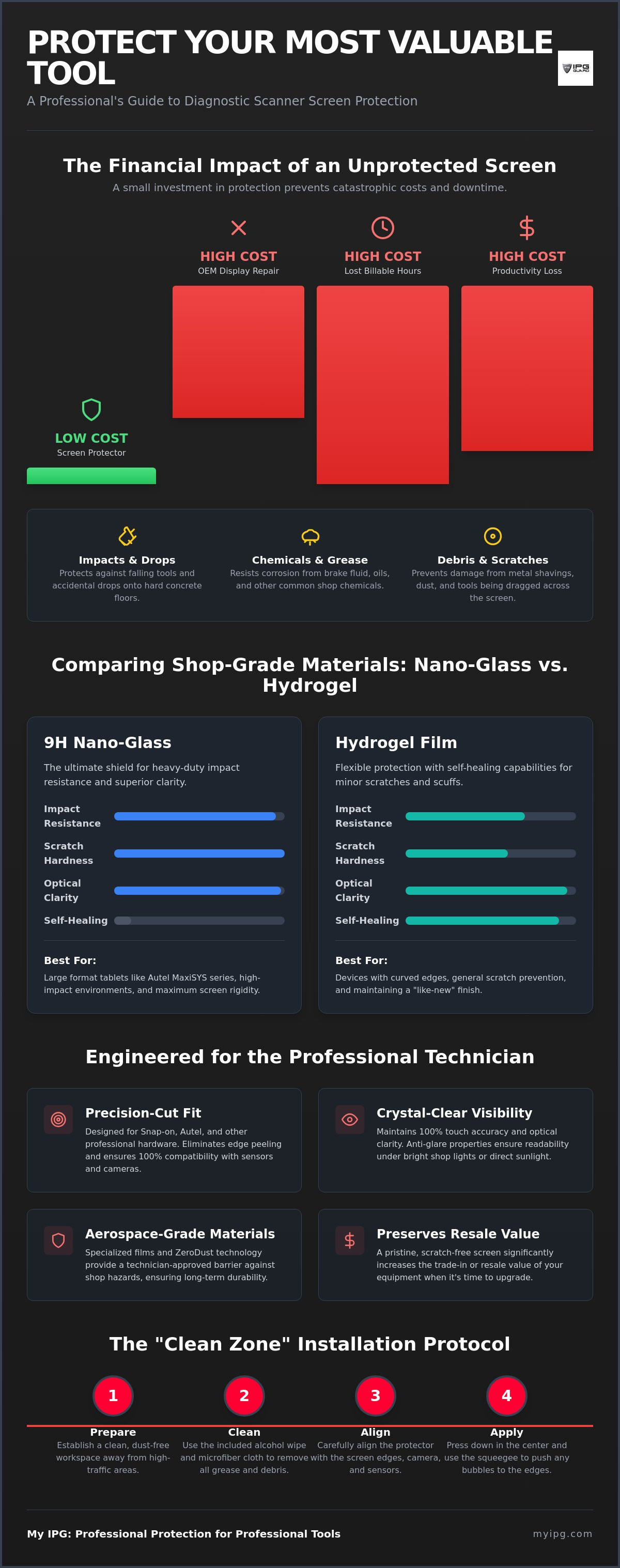
The financial math is simple. Replacing an OEM display assembly on a premium scanner often costs hundreds, or even thousands, of dollars. When you factor in the shipping time and the labor involved in a hardware swap, the true cost of an unprotected screen is staggering. A professional-grade shield is an insurance policy that pays for itself the first time a heavy diagnostic lead swings into the glass. It ensures that your high-value equipment remains in service, not in a box heading back to the manufacturer.
Diagnostic uptime is the metric that defines your profitability. A cracked screen isn't just a cosmetic flaw; it's a workflow killer. If your scanner is down, you aren't performing ADAS calibrations, deep system scans, or bi-directional tests. Those lost billable hours can never be recovered. By prioritizing screen integrity, you protect the steady flow of vehicles through your shop and keep your technicians productive.
The Hidden Costs of Unprotected Displays
Modern diagnostic tools rely on sensitive capacitive touch technology. Even a minor hairline fracture can create a "dead zone" where the tool no longer recognizes your input. This effectively bricks the device. Beyond the hardware failure, a shattered screen damages customer trust. Clients look for professionalism in every corner of your shop. A beat-up, cracked scanner suggests a lack of care, while a pristine, protected tool signals a technician who values precision and high standards.
Beyond Scratches: Impact and Pressure Protection
Mobile diagnostic tablets are constantly at risk of drops and localized pressure. Whether it's a falling wrench or a heavy object leaning against the screen in a tool drawer, the display is vulnerable. Professional protectors utilize common screen protector materials like 9H nano-glass or high-density hydrogel to absorb and dissipate energy. These materials are engineered to prevent "pressure spots"—those permanent discolorations on the LCD caused by concentrated force. Protect your glass from the pressure of the job, ensuring every pixel remains clear for critical data analysis.
Finally, consider the future. Tech moves fast. When it's time to upgrade to next-generation hardware, your current tool's resale value depends heavily on its condition. A screen that has been shielded since day one ensures you get the highest possible trade-in value, making your next equipment purchase more affordable. Don't let shop grease and accidental impacts devalue your assets.
Comparing Shop-Grade Materials: Nano-Glass vs. Hydrogel Protection
Choosing the right material for your diagnostic scanner is a decision that directly impacts both tool longevity and your daily productivity. You need a screen protector for industrial diagnostic tools that balances optical clarity with rugged durability. It's about more than just avoiding surface scratches. It's about maintaining a clear, responsive window into the vehicle's computer systems. Whether you're working in a high-volume dealership or a specialized independent shop, the material you choose acts as the first line of defense for your most expensive hardware.
9H Nano-Glass for Heavy-Duty Impact Resistance
Nano-glass is the technician's choice for large-format tablets like the Autel MaxiSYS MS909 or Ultra. It utilizes a tempered architecture designed specifically to absorb and dissipate high-velocity energy. If a heavy diagnostic lead or a falling wrench strikes the display, the nano-glass shatters into small, controlled pieces. This intentional sacrifice protects your primary OEM display from catastrophic failure. The 9H hardness rating ensures that metal shavings, abrasive shop dust, or sharp probes won't cloud your vision over time. It's the ultimate shield for flat, high-value displays.
Hydrogel Technology: Flexibility and Self-Healing
For tools with recessed screens or slightly curved bezels, like the Snap-on Triton, Apollo, or Solus series, hydrogel provides a more flexible, adaptive solution. These advanced polymers offer superior edge-to-edge adhesion where rigid glass might lift or peel. Recent research on impact-resistant polymer films explains how these materials maintain structural integrity while remaining incredibly thin and elastic. Our IPG Original (Hydrogel) Screen Protector features specialized self-healing technology. Minor surface scuffs from metal debris fill in automatically within 24 to 48 hours as the polymer returns to its original state. This keeps your tool looking new, even in the busiest bays.
Haptic Feedback and Glove Compatibility
We've designed our protectors to solve a common technician complaint: losing touch accuracy while wearing heavy-duty nitrile or work gloves. High-quality industrial protectors feature ultra-thin profiles that ensure zero lag in data entry. Haptic sensitivity is the measure of how effectively a display registers touch input through a protective barrier and work gloves. Oleophobic coatings are non-negotiable here. They repel shop grease, motor oil, and fingerprints, ensuring your fingers slide smoothly across the surface without leaving smears that distort the image. Explore our ProActive series to find the specific material that fits your diagnostic workflow.
Finding the Perfect Fit: Snap-on, Autel, and Professional Scanners
Generic "trim-to-fit" kits are a liability on the shop floor. In a high-grease environment, a hand-cut edge is a failure point waiting to happen. These rough, uneven edges catch oil and shop debris, leading to immediate peeling and lifting. A precision-cut screen protector for industrial diagnostic tools is the only way to ensure a permanent, reliable bond. We engineer our shields to match the exact CAD dimensions of your hardware. This meticulous approach leaves no room for contamination to creep under the film.
Precision engineering ensures that the protector sits flush against the display. It eliminates the "halo effect" common with universal guards that don't quite reach the bezel. By achieving true edge-to-edge coverage, you prevent shop grime from migrating into the small gaps between the screen and the tool's frame. This keeps your equipment sanitary and prevents the internal hardware damage that can occur when liquids seep past the display edge.
Snap-on Diagnostic Tool Protection
Your Snap-on Triton-D10 or Apollo-D9 represents a massive investment in your diagnostic capability. These tools feature high-resolution displays that require exact fitment to maintain their professional aesthetic and function. We provide a tailored IPG Snap-on Triton Apollo Solus +screen protector that covers the active display area without interfering with the rugged housing. The Solus Legend, with its specific screen-to-body ratio, demands a protector that accounts for its unique bezel design. Don't overlook your legacy tools. As older scanners become harder to service and replacement parts become scarce, a fresh shield is the best way to extend their operational life and maintain their trade-in value.
Autel and Multi-Brand Scanner Coverage
Autel hardware, including the MaxiSYS MS909 and MS919, serves as the centerpiece of many modern diagnostic suites. Their large-format screens are magnets for accidental impacts and chemical splashes in the bay. Our specialized IPG screen protector Autel MaxiIM KM100 MaxiCharger MaxiSYS MS909 MS919 provides comprehensive coverage across the entire Autel lineup. This includes the KM100 key programmer and high-voltage battery analyzers. These shields are specifically designed to remain compatible with ruggedized tool cases and protective bumpers. They won't lift at the corners when you slide the tool into its protective sleeve, ensuring your screen protector for industrial diagnostic tools stays exactly where it belongs.
Shop grime is relentless. Without a perfect fit, motor oil and brake fluid will eventually find a way to compromise your display. Precision fitment ensures that your scanner remains a reliable partner in every vehicle inspection, providing clear data readouts for years to come.
Installation and Maintenance: Keeping Displays Clear in Harsh Shop Conditions
Installing a screen protector for industrial diagnostic tools in a working automotive bay presents unique challenges. Unlike a cleanroom environment, your shop floor is filled with airborne particulates, oil mist, and metallic dust. Success requires a tactical approach. You aren't just applying a film; you're sealing a precision instrument against a hostile environment. A botched installation leads to trapped debris that can cause permanent micro-scratches or impede your view of critical data streams.
Preparation is the foundation of durability. For large-format tablets, the "hinge method" using alignment tabs is the most reliable way to ensure perfect positioning. Work from the center outward using a firm squeegee to displace air. This technique is essential for professional scanners to prevent the bubbling that often occurs on larger surface areas. If you encounter a stubborn dust spec, don't peel the whole sheet back. Use an adhesive picker to lift the edge and remove the contaminant with surgical precision.
The Pre-Installation Shop Checklist
Create a temporary "Clean Zone" before you begin. Avoid installing your protector near open bay doors, running fans, or active pneumatic tools. If possible, move to an enclosed office or a mobile workstation with minimal airflow. Hand hygiene is critical. Scrub your hands thoroughly to remove all traces of motor oil and grease. Even a microscopic amount of skin oil on the protector's adhesive corner will cause it to lift over time.
Choose your cleaning agents carefully. Never use heavy-duty shop degreasers or glass cleaners containing ammonia. These chemicals can strip the factory oleophobic coating off your tool's glass and compromise the protector's bond. Use 70% isopropyl alcohol and a fresh microfiber cloth. This ensures a sterile, oil-free surface without damaging the hardware. For the ultimate debris-free application, consider using the IPG Zerodust Screen Protector kit to capture stray particles before they land on your display.
Maintaining Your Shield
Daily maintenance keeps your diagnostic readouts sharp. Use a dedicated microfiber cloth to wipe away oil mist and fingerprints at the end of every shift. If you notice "clouding" or deep gouges that interfere with pixel clarity, it's time for a replacement. A compromised protector has done its job by absorbing the damage, but it will eventually hinder your diagnostic accuracy. To remove a damaged shield, lift one corner slowly with a plastic pick. Never use metal tools or screwdrivers. The goal is to preserve the pristine glass underneath, keeping your tool ready for the next high-stakes repair.
Consistency in care extends the life of your gear. By following these professional protocols, you ensure that your display remains a reliable asset rather than a source of frustration during complex troubleshooting. Protect your uptime by maintaining your shield with the same rigor you apply to your most sensitive engine components.
Why IPG ProActive is the Industry Standard for Tool Protection
Professional diagnostic equipment requires a higher standard of defense. A generic film won't survive the chemical saturation and physical stress of a busy bay. The IPG ProActive line is the definitive screen protector for industrial diagnostic tools, engineered specifically for the automotive technician. We've adapted aerospace-grade materials to withstand the unique rigors of the shop floor. It's about preserving your most valuable assets with the same meticulous care you bring to every engine teardown. You're a guardian of technology; we're your partner in that stewardship.
Our commitment to precision is unmatched. We provide specialized coverage for over 110 industrial diagnostic devices. This includes everything from the latest Autel tablets to legacy Snap-on scanners and Bosch master kits. By focusing exclusively on the needs of professional users, we ensure that every cut is exact and every material choice is functional. You get the protection of a heavy-duty barrier without sacrificing the pixel-perfect clarity required for complex wiring diagrams and live data graphs. It's a professional-grade confidence you can feel.
The ProActive Material Advantage
Standard consumer-grade films often fail when exposed to the harsh reality of a garage. IPG ProActive is different. We subject our materials to rigorous durability testing against common shop chemicals, including brake cleaner, synthetic motor oils, and transmission fluids. Unlike standard TPU, our films won't yellow or degrade when they come into contact with aggressive lubricants. For a deeper dive into the science behind our 9H nano-glass and self-healing hydrogel, explore The Ultimate Screen Protector Guide. It outlines how we prioritize impact dissipation and optical transparency in every layer.
The ZeroDust advantage is another critical differentiator. We know that shop air is never truly clean. Our application kits are designed to minimize debris during the bond process, ensuring a factory-quality finish even in less-than-perfect conditions. It's a professional solution for a professional environment. Rapid application. Results-oriented protection. No distractions.
Ready to Shield Your Tools?
Maintaining a fleet of tools shouldn't be a logistical headache. We make it simple to browse by brand, offering tailored solutions for Snap-on, Autel, Bosch, and many others. If you're managing a large multi-tool environment, we offer bulk shop discounts to help you protect every screen in the building. Don't wait for a costly impact to remind you of your display's vulnerability. Act now to secure your uptime and maintain the highest possible resale value for your gear. Browse the Industrial Devices IPG ProActive Collection today and equip your shop with the technician's choice for durability.
Secure Your Diagnostic Future
Protecting your scanner is about more than avoiding a scratch. It's about ensuring your shop stays in motion. You've learned how the right material, whether it's 9H nano-glass for high-impact defense or self-healing hydrogel for constant scuffs, acts as a dedicated barrier against the daily grind. Precision-cut fitment for Snap-on and Autel tools eliminates the risk of edge-peeling and grease ingress. This isn't just an accessory. It's an insurance policy for your most critical assets.
By choosing a professional-grade screen protector for industrial diagnostic tools, you're investing in tool longevity and consistent uptime. Join the ranks of professional technicians worldwide who trust ProActive technology to safeguard their livelihood. It's time to stop worrying about the next drop and start focusing on the next repair. You've built your reputation on precision. We've built ours on protection.
Shop the IPG ProActive Industrial Collection
Your tools work as hard as you do. Give them the protection they deserve to keep your bay running at peak performance, and if you're looking to elevate your professional image with custom apparel or promotional products, visit KP Innovations.
Frequently Asked Questions
Do screen protectors reduce the touch sensitivity of my diagnostic tool?
Professional-grade protectors do not reduce touch sensitivity. They utilize ultra-thin materials that maintain 100% capacitive response. This ensures your tool registers every input instantly, even when you're wearing nitrile or heavy-duty work gloves. Maintaining this haptic accuracy is critical for complex diagnostic procedures where speed and precision are required. A high-quality screen protector for industrial diagnostic tools prevents lag and keeps your workflow moving without interruption.
Can I install a screen protector on a diagnostic tool that already has scratches?
You can install a protector on a screen that already has minor scratches. The advanced adhesive layer on hydrogel films often fills in light surface scuffs, which can actually improve the visual clarity of a worn display. This application also prevents existing scratches from catching on your fingertips or collecting shop grime. It's an effective way to halt further degradation and extend the usable life of your current diagnostic hardware.
Will brake cleaner or oil damage the screen protector?
Shop chemicals like motor oil and lubricants won't damage industrial-grade films. These protectors are engineered with specialized coatings that resist chemical etching and yellowing. While you should wipe away splashes of brake cleaner or fluid immediately to maintain visibility, the material remains structurally sound. This chemical resistance is a key reason why a professional-grade screen protector for industrial diagnostic tools is superior to standard consumer versions found in retail stores.
Which is better for a Snap-on scanner: tempered glass or hydrogel?
The choice depends on your specific hardware design. For flat, large-format tablets, 9H nano-glass provides the highest level of impact resistance. For Snap-on tools with recessed displays or slightly curved bezels, hydrogel is usually the better option. Hydrogel offers the flexibility needed to bond perfectly to non-flat surfaces, preventing the edge-lifting that can occur with rigid glass. Both materials provide excellent defense against the daily hazards of the bay.
How do I find the right size protector for an older diagnostic tool?
Finding the right fit for older tools is straightforward through our specialized database. We maintain precision-cut templates for over 110 different industrial devices, including legacy scanners that are no longer in production. If your specific model isn't listed, measuring the active display area allows for a tailored fit. Protecting older equipment is a smart move, as replacement parts for legacy tools are often expensive or completely unavailable.
Are these protectors compatible with rugged tool cases like the Autel protective boot?
Yes, our protectors are fully compatible with ruggedized tool cases and Autel protective boots. We engineer the dimensions with a small tolerance at the edges to ensure the case doesn't push against the film. This prevents the lifting and bubbling that often happens with universal, hand-cut guards. You get the combined benefit of a shock-absorbing outer shell and a chemically resistant screen barrier without any fitment conflicts.
Can I remove and wash the screen protector if it gets oily during installation?
You cannot wash and reuse a protector if the adhesive side becomes contaminated with oil. Once shop grease or skin oils touch the sticky surface, the bond is permanently compromised. This is why we emphasize the "Clean Zone" protocol and thorough hand scrubbing before you begin. If an error occurs during installation, it's usually better to start with a fresh protector to ensure a long-lasting, bubble-free seal on your tool.
What should I do if my diagnostic tool screen has a matte or anti-glare finish?
You can apply a protector over a matte or anti-glare finish without any issues. While the protector will give the screen a glossier appearance, it adds a layer of physical and chemical defense that factory coatings don't provide. Factory matte finishes are often susceptible to deep scratches and staining from shop fluids. Adding a professional shield ensures the underlying display remains pristine, even if the surface finish looks slightly different.