

Can a layer of protection you can't even see actually save your smartphone's most expensive component without ruining your 4K cinematic shots? It's a valid concern for any creator. You've likely seen the horror stories. Blurry night mode photos. Flash glare. Protectors that peel off in your pocket. The secret lies in precision engineering. An ultra thin camera lens protector offers the ultimate balance between durability and transparency. It acts as a dedicated guardian for your optics; it ensures that micro-abrasions never touch your actual lens glass.
We understand the stress of risking the very technology you invested in. You want security, not bulk. This guide promises to show you how modern material science preserves your high-end optics while maintaining zero impact on light filtration. We'll break down the technical specifications of 9H pencil hardness, compare the self-healing properties of hydrogel versus tempered glass, and provide the roadmap to keeping your device in showroom condition for maximum resale value. Discover how to protect what you value most without sacrificing a single pixel.
Key Takeaways
- Understand why protruding lenses on modern smartphones require specialized defense against micro-abrasions and high-impact drops.
- Learn the material differences between hydrogel and tempered glass to choose the right ultra thin camera lens protector for your specific device.
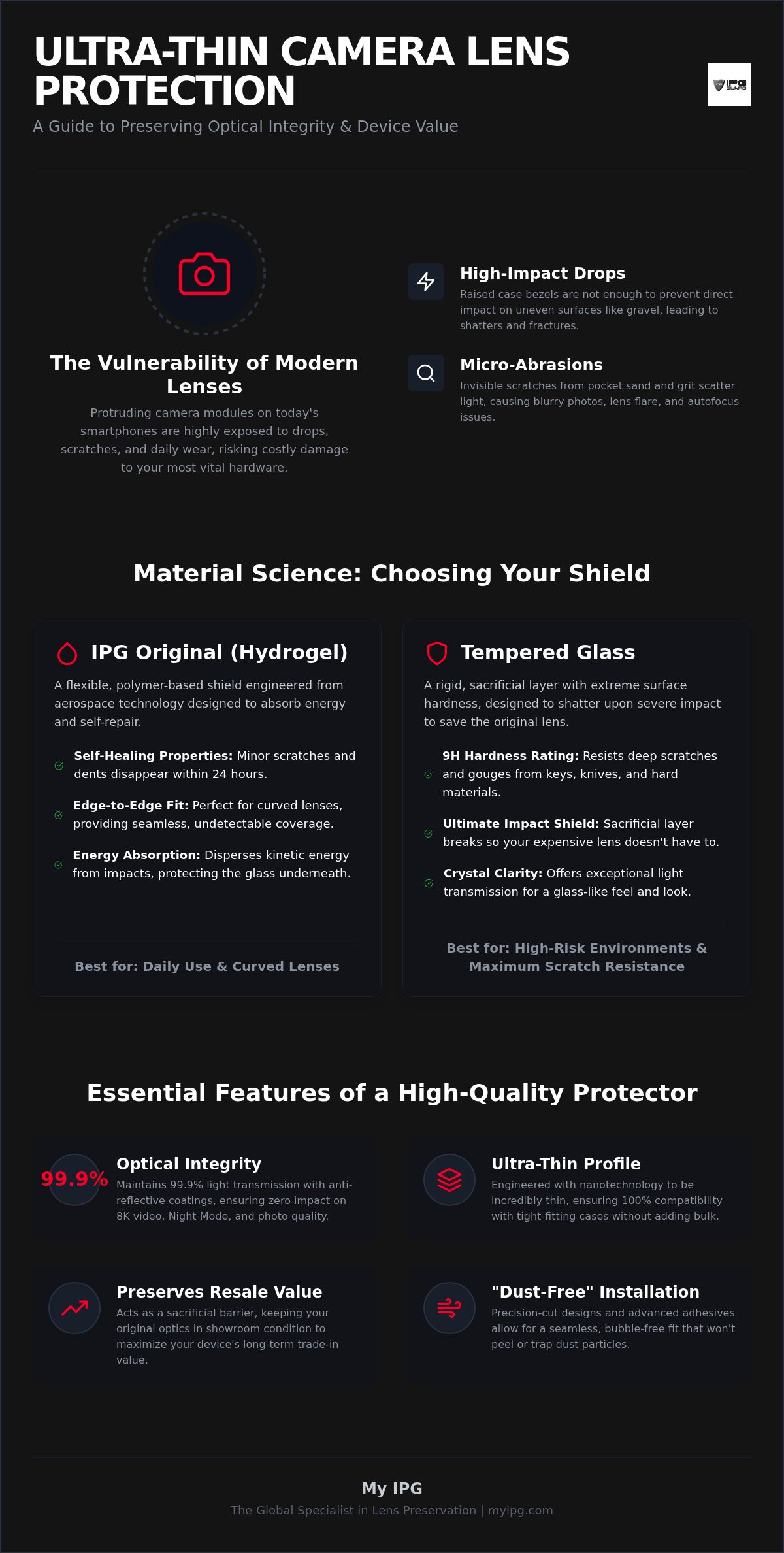
- Discover how precision-cut designs and anti-reflective coatings maintain 99.9% light transmission for flawless 8K video and night mode photography.
- Master the "Dust-Free" installation technique to ensure a seamless, bubble-free fit that won't peel off in your pocket.
- Explore why precision-engineered films preserve your device’s long-term resale value without adding unnecessary bulk to your phone's profile.
Why Modern Smartphones Demand an Ultra Thin Camera Lens Protector
Protect your vision. Your smartphone’s camera system is a marvel of precision engineering, but it's also the most exposed part of your device. As sensor sizes grow to capture more light, lenses must protrude further from the chassis. This design evolution creates a vulnerability that traditional protection often ignores. You need a dedicated ultra thin camera lens protector to bridge the gap between high-end performance and daily durability.
Micro-abrasions are the silent enemies of your 8K footage. While a catastrophic shatter is obvious, tiny scratches from pocket grit or sand are more common. These imperfections scatter light before it reaches the sensor. They cause ghosting in night photos and force the autofocus to hunt for clarity. Unlike a traditional Lens cover that you'd find on a DSLR, these mobile shields must remain permanent and perfectly transparent. They serve as a sacrificial barrier, taking the hit so your original optics remain factory-fresh.
Standard phone cases usually feature a raised bezel around the camera module. It's a start, but it's insufficient. If you place your phone on an uneven surface or drop it on gravel, that bezel won't stop a sharp object from striking the glass directly. You're left with a choice: risk a lens replacement that costs hundreds or apply a precision-cut film that feels like nothing is there. We believe in proactive defense over reactive repair.
The Vulnerability of 2026 Smartphone Optics
Modern sensors in 2026 utilize massive surface areas to achieve professional-grade bokeh. This physical growth increases the probability of impact. The "table-wobble" effect isn't just a minor design flaw; it's a constant source of friction. Every time you set your phone down, the lens glass makes first contact with the environment. We've seen that even sapphire-coated lenses succumb to quartz-based dust. A specialized ultra thin camera lens protector acts as a guardian, absorbing these micro-impacts before they reach the substrate.
Invisible Stewardship: The Case for Ultra-Thinness
True stewardship means protecting a device without altering its soul. We define "ultra-thin" through the lens of nanotechnology. These films are engineered to a specific thickness that ensures 100% compatibility with tight-fitting cases. If a protector is too thick, it can interfere with the depth-of-field sensors or cause vignetting in wide-angle shots. Using an IPG Phone camera lens protector ensures the optical path remains clear. It provides emotional security. You can slide your phone into a pocket full of keys and know your lenses are shielded by a layer designed for performance.
Material Science: Hydrogel vs. Tempered Glass Lens Shields
Choosing the right defense for your optics is a matter of physics. You are balancing surface hardness against energy absorption. Every ultra thin camera lens protector on the market utilizes one of two core materials: tempered glass or hydrogel. Understanding the molecular behavior of these shields allows you to select the guardian that best fits your environment. While both offer invisible stewardship, they react differently to the stresses of daily use.
The primary trade-off involves hardness versus flexibility. Tempered glass provides a rigid, sacrificial layer designed to shatter so your lens doesn't. Hydrogel offers a flexible, elastic response that absorbs kinetic energy. Material choice also impacts thermal management. During extended 8K video sessions, heat dissipation is critical. High-quality materials ensure that your camera module stays within safe operating temperatures without trapping heat against the sensor housing.
IPG Original (Hydrogel): The Flexible Guardian
Our hydrogel technology finds its origins in aerospace-grade protection. It was originally engineered to shield helicopter rotor blades from abrasive desert sand. This material is a polymer-based shield that self-heals within 24 hours. If a set of keys leaves a minor dent, the material’s "memory" allows it to return to its original, smooth state. It is the superior choice for modern devices with curved lens edges. It provides a seamless, edge-to-edge fit that remains virtually undetectable to the touch. For those who prioritize a slim profile, the IPG Original (Hydrogel) offers robust defense without the weight of traditional glass.
Tempered Glass: The Ultimate Impact Shield
When impact risk is high, tempered glass is the industry standard. These protectors are rated at 9H hardness on the pencil scale. This means they resist deep gouges from the hardest pencils and common pocket items like coins or steel zippers. The physics of tempered glass allows it to act as a sacrificial barrier. In a high-velocity drop, the protector absorbs the shock and cracks, dispersing the energy away from the expensive smartphone optics.
Premium glass shields are engineered to mimic the native refractive index of your camera lens. This ensures that light passes through the protector without bending or distorting. Consider these factors when choosing your ultra thin camera lens protector:
- Optical Clarity: Tempered glass often provides the highest level of transparency for professional photography.
- Durability: Glass is more resistant to deep scratches but can chip at the edges over time.
- Fit: Hydrogel is more forgiving on complex, multi-lens camera bumps.
Protect your gear with the material that matches your risk profile. Whether you need the self-healing flexibility of hydrogel or the rigid impact resistance of tempered glass, precision engineering is the only way to maintain the integrity of your device.
The Optical Integrity Test: Will a Protector Ruin Your Photos?
Don't let a protective layer compromise your creative vision. A common fear among mobile photographers is that adding an ultra thin camera lens protector will degrade image sharpness or introduce ghosting. We treat your smartphone's optics with the same respect as a professional DSLR lens. The goal is total transparency. By utilizing specialized materials that achieve 99.9% light transmission, My IPG ensures your 8K cinematic video and high-resolution RAW photos remain crisp and vibrant.
Optical performance relies on refractive index matching. If the protector's material bends light differently than the original lens glass, you'll experience chromatic aberration or distortion. Our engineering process aligns the shield's light path with the sensor's requirements. We also integrate advanced oleophobic coatings. These vacuum-plated layers repel skin oils and fingerprints. Without this protection, oils build up and create a "soft" glow that ruins contrast and detail. A clean lens is a sharp lens. Our coatings keep your optics ready for the perfect shot at any moment.
Solving the Flash Glare Phenomenon
Poorly designed shields often turn a clear night shot into a hazy mess. This happens when light from the flash bleeds through the edge of the protector and reflects directly back into the lens. My IPG solves this through precision-cut designs and black silk-screened rings around the flash aperture. This "black circle" design isolates the light source completely. By maintaining a "No-Glue" zone over the actual lens aperture, we prevent adhesive artifacts from distorting your photos. It's a technical solution for a frustrating problem. You get the full benefits of the flash without the unwanted fog.
Maintaining Professional-Grade Clarity
Clarity is a measurable metric, not a marketing buzzword. My IPG defines light transmission efficiency as the percentage of ambient light that successfully reaches the sensor after passing through the protective layer. High-end shields minimize reflection and absorption to keep this number as close to 100% as possible. This ensures that your low-light performance and night mode results remain unaffected. To achieve this, installation is key. Even a single speck of dust can create a permanent artifact in your images. Follow these steps for a perfect result:
- Clean thoroughly: Use an alcohol wipe followed by a microfiber cloth to remove all oils.
- Dust removal: Use a dedicated sticker to lift micro-particles just before applying the shield.
- Alignment: Ensure the ultra thin camera lens protector is centered to avoid edge-shading on wide-angle shots.
Preserve your hardware. Protect your art. Our commitment to optical integrity means you never have to choose between a scratch-free lens and a perfect photograph.
How to Choose and Install a Seamless Lens Guard
Precision is the final step in stewardship. You've selected the right material; now you must apply it with the care your device deserves. An ultra thin camera lens protector requires a steady hand and a controlled environment to ensure zero optical interference. We treat your lenses as the eyes of your device. Proper application ensures they stay clear for years of high-resolution capture.
Creating a dust-free zone is the secret to a factory-perfect look. Many professionals recommend applying the shield in a bathroom after a hot shower; the steam pulls airborne particles to the floor. Clean the lens surface thoroughly with an alcohol wipe. Buff it with a lint-free microfiber cloth until it shines. Use a dust-removal sticker to lift any remaining micro-grit. This preparation ensures your protector bonds perfectly without trapped artifacts that could soften your images.
The Perfect Alignment Strategy
Modern multi-lens modules, like those on the iPhone 17 Pro Max, demand absolute centering. Even a fraction of a millimeter of misalignment can cause vignetting on ultra-wide shots or interfere with LiDAR sensors. Use the "hinge method" by taping one side of the protector to the phone before removing the adhesive backing. This creates a fixed pivot point for a perfect drop every time. If your kit includes a plastic alignment frame, snap it on first to lock the protector in place. For more detailed techniques on ensuring a straight application, learn how to install a screen guard like a pro.
Troubleshooting Common Installation Issues
Air bubbles are usually the result of trapped dust or uneven pressure. If a bubble appears, use a credit card or your thumb to push it firmly toward the nearest edge. Persistent bubbles often indicate a micro-particle of grit. If a speck of dust is visible, lift the edge of the shield slightly with a piece of tape and use a second sticker to "fish" the particle out from the adhesive side. When it's time to refresh your gear, you must know how to safely remove a screen protector without damaging the delicate factory lens coatings. Never use metal tools or sharp knives; a thin plastic pick or your fingernail is sufficient to break the seal.
Compatibility is non-negotiable. Our ultra thin camera lens protector is engineered to sit flush with the lens housing. This ensures it doesn't collide with the raised lip of heavy-duty protective cases. You get 360-degree security without the bulk. Ready to secure your optics? Explore our precision-cut lens shields to find the perfect fit for your device.
Why My IPG is the Global Specialist in Lens Preservation
Stewardship is more than a service; it's a commitment to the longevity of your technology. At My IPG, we don't just manufacture accessories. We engineer precision-cut guardians for your most valuable assets. Our legacy began with high-stakes protection for Tesla door handles and Nikon DSLR displays. We've now refined that industrial-grade expertise into the ultimate ultra thin camera lens protector for your smartphone. This isn't just about retail convenience. It's about applying professional material science to the device you carry every day.
Our global reach ensures that whether you're in the United States or an international market, your optics are shielded by the best. We understand that a smartphone is a significant financial and emotional investment. Our "ZeroDust" advantage means our materials stay clearer for longer, resisting the yellowing and adhesive degradation common in generic alternatives. We take a proactive approach to technology preservation. By shielding your lenses today, we ensure your device maintains its peak performance and maximum resale value for the future.
Engineering Beyond the Smartphone
Our technical authority comes from years of protecting specialized electronics in harsh environments. We've designed high-precision films for marine navigation displays and industrial tools where clarity is a matter of safety. This background in high-stakes environments informs every ultra thin camera lens protector we produce. We treat your smartphone's camera module with the same meticulous care as a professional camera rig. We understand light filtration, material properties, and the physics of impact. For a complete breakdown of our preservation methodology, explore The Ultimate Guide to My IPG Phone Camera Lens Protectors.
The My IPG Guarantee: Performance Without Compromise
Our "Invisible Shield" philosophy is simple: you shouldn't have to see protection for it to work. We believe that the best guardian is one that never interferes with your user experience. Thousands of flagship iPhone and Samsung users trust My IPG because we prioritize optical integrity above all else. We provide the security of a sacrificial layer without the bulk of a traditional case. Your high-value optics deserve a dedicated specialist who understands the emotional and financial value of your gear. Don't settle for generic covers that soften your images. Protect your optics with My IPG Camera Lens Protectors today and join a global community of users who value precision and performance.
Preserve Your Creative Vision Today
Your smartphone is a professional-grade camera. It deserves specialized defense. We've explored how protruding lens modules create a high-risk environment for micro-abrasions. You now understand that maintaining 99.9% light transmission requires a perfect balance of thickness and transparency. From self-healing hydrogel to rigid 9H tempered glass, the right choice ensures your 8K footage remains crisp and artifact-free. True stewardship is about proactive protection before the first scratch occurs.
Don't leave your optics to chance. Investing in an ultra thin camera lens protector is the most cost-effective way to maintain your device's resale value and performance. We utilize aerospace-grade material technology and precision-cut engineering to ensure perfect sensor alignment for every shot. It's why we're trusted by professional photographers and EV owners alike to guard what matters most. Shield your hardware today. Keep your lenses factory-fresh and your creative vision unobstructed. You've invested in the best technology; now give it the best guardian.
Secure Your Optics with IPG Ultra-Thin Protection
Frequently Asked Questions
Do camera lens protectors affect photo quality or clarity?
No, premium shields maintain total optical clarity through refractive index matching. High-end materials ensure light passes to the sensor without distortion or loss of detail. We apply vacuum-plated oleophobic coatings to repel fingerprints that usually cause image softening. Your 8K videos and high-res RAW photos will look exactly as they did before application. Stewardship of your optics means preserving performance, not compromising it.
Will a lens protector cause glare when using the flash at night?
Well-engineered protectors prevent this issue entirely. We use precision-cut "black circle" designs that isolate the flash from the lens aperture. This prevents light from bleeding through the protector's edge and creating a hazy fog in your night shots. If you see glare, it's usually a sign of a low-quality, generic cover that lacks these optical isolation rings. Professional-grade protection ensures your night mode remains crisp.
Is it hard to remove a camera lens protector if it cracks?
Removing a cracked shield is a straightforward process that won't damage your device. The adhesive is designed to hold firmly but release cleanly when you lift an edge with a plastic pick or fingernail. It acts as a sacrificial layer; it absorbs the energy of an impact and breaks so your actual lens doesn't. Your factory glass remains untouched and scratch-free underneath, ready for a fresh protector.
Can I use a lens protector with my existing phone case?
Yes, compatibility is a core part of our design philosophy. We engineer our ultra thin camera lens protector to sit flush with the camera module so it doesn't interfere with the raised bezels of protective cases. Whether you use a slim silicone cover or a heavy-duty rugged case, the protector's footprint remains within the safe zone. This ensures 360-degree security without any physical conflict between your favorite accessories.
Does the iPhone 17 Pro Max really need a camera protector if it has sapphire glass?
Even sapphire glass requires stewardship against micro-abrasions. While sapphire is incredibly hard, common environmental elements like sand contain quartz, which can still scratch high-end smartphone optics. A protector serves as an affordable insurance policy for your most expensive component. It's much easier to replace a removable film than to pay for a full camera module replacement at a service center after a single unlucky drop.
What is the difference between hydrogel and tempered glass for cameras?
The choice depends on your specific environment and risk profile. Tempered glass provides a 9H hardness rating that excels at resisting deep gouges and high-velocity impacts through a sacrificial shatter response. Hydrogel is a flexible polymer that offers self-healing properties for minor scuffs and a more seamless fit on curved lens edges. Both materials are engineered for maximum transparency; they just handle physical stress using different material physics.
How do I prevent air bubbles during the installation of a lens shield?
Achieving a perfect fit starts with a sterile environment and total dust removal. We recommend installing your ultra thin camera lens protector in a humid room to minimize airborne particles. Use the provided alcohol wipe and dust-removal sticker to ensure the lens surface is surgically clean before application. If you align the protector correctly and apply pressure from the center outward, air bubbles will dissipate naturally during the bonding process.
Will a lens protector make my phone's camera bump look bigger?
The added thickness is negligible and virtually undetectable to the naked eye. Modern nanotechnology allows us to create protection that is measured in fractions of a millimeter to preserve your device's original aesthetics. It sits flush with the camera housing rather than stacking awkwardly on top of it. You get the security of a professional guardian without changing the sleek, high-end profile of your flagship smartphone.