
A 4-way filter gives more consistent privacy, but it isn't automatically the better choice. A 2-way vs 4-way privacy screen filter comparison comes down to how you hold and share your phone: 2-way filters restrict views from the left and right in portrait mode, while 4-way filters also block views from above and below. Rotate a 2-way filter, and its privacy direction rotates with the screen.
Both types work by limiting the direction in which light passes through the display, often using micro-louver technology. This can make the screen look dimmer, and neither option makes it completely invisible from every angle. The filter’s design, screen brightness, and viewing conditions all affect what others can see.
Choose 2-way if you mainly use your phone upright or want to share photos and videos more easily when you rotate it. Choose 4-way if you switch orientations often and want more consistent side privacy, including from above and below. This guide compares viewing angles, clarity and brightness, and everyday sharing so you can match the filter to the way you use your device.
Key Takeaways
- Choose based on how you hold your phone: two-way privacy suits mostly portrait use, while four-way coverage stays more consistent when you rotate the screen.
- Expect some brightness tradeoff with either filter. The design, screen brightness, and viewing conditions all influence clarity.
- Consider whether you often share photos or videos. Broader directional privacy can make side-by-side viewing less convenient.
- Match the protector to your exact device model, and weigh its viewing-angle coverage alongside its price.
- Understand how light-filtering technology works to set realistic expectations about what people nearby can see.
Brightness and display clarity tradeoffs
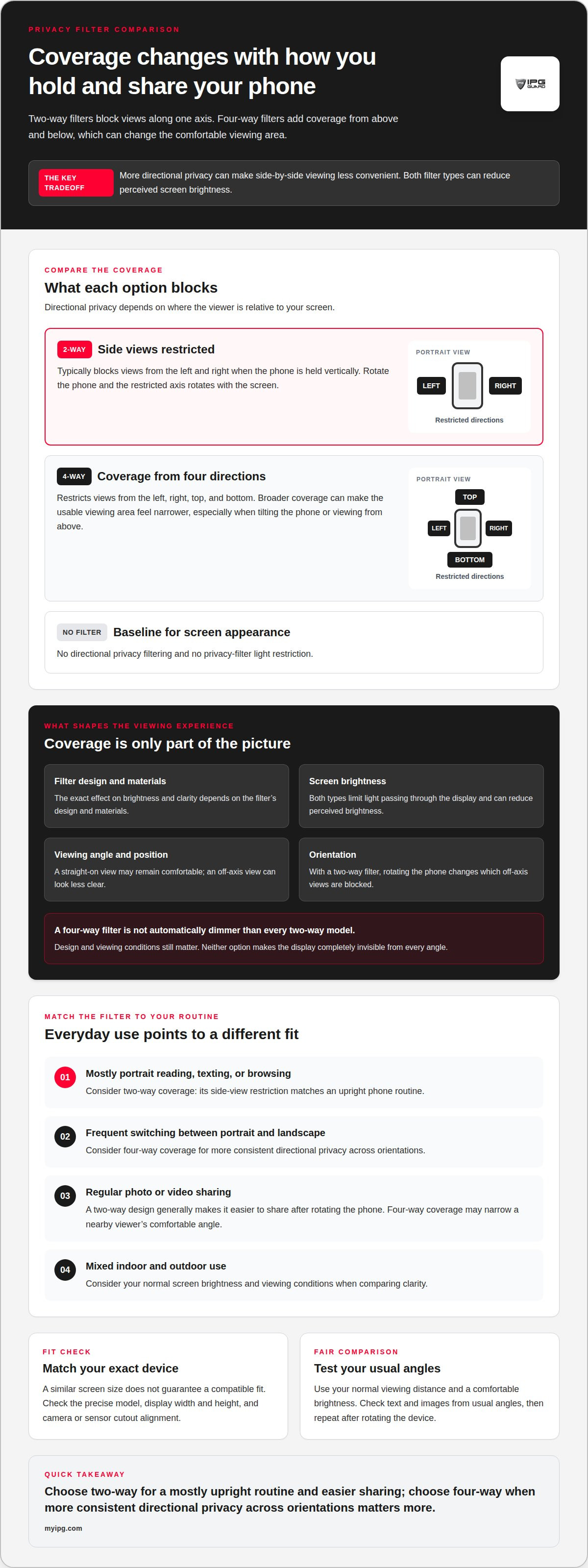
Four-way filters restrict more viewing directions, which can narrow the comfortable viewing area compared with two-way filters. Both types can reduce perceived brightness by limiting the light that passes through the display. The exact effect depends on the filter’s design and materials, screen brightness, and viewing conditions.
Four-Way Filter Brightness and Clarity
A four-way filter restricts views from the left, right, top, and bottom. This broader coverage can make the usable viewing area feel narrower, especially when you tilt the phone or look at it from above. That added restriction doesn’t mean every four-way filter will look dimmer than every two-way model. Design and viewing conditions still matter.
For example, a screen viewed straight on may remain comfortable, while an off-axis view may look less clear. If you often adjust your phone’s position, those changes may be more noticeable. Compare the screen at your usual brightness and viewing angle, not only while holding it directly in front of you.
Two-Way Filter Brightness and Clarity
A two-way filter restricts visibility along one axis, typically from the left and right when the phone is vertical. It still limits light, so it can reduce perceived brightness. Its narrower directional coverage doesn’t mean the screen will always look clearer; the result depends on materials, design, brightness settings, and viewing conditions.
Picture reading a message on a vertically held phone. The filter blocks side views, while the display remains easier to see from other angles than with a four-way design. Rotate the phone, though, and the restricted axis rotates too. This changes which off-axis views are blocked, not the filter’s underlying brightness tradeoff.
Compare the viewing experience across these options:
| Option | Directional coverage | Brightness and clarity consideration | Best comparison point |
|---|---|---|---|
| Two-way filter | Two opposing directions | Can reduce perceived brightness | View from the sides in portrait mode |
| Four-way filter | Left, right, top, and bottom | Can reduce perceived brightness; usable viewing area may feel narrower | View from several angles and orientations |
| No privacy filter | No directional privacy filtering | No privacy-filter light restriction | Use as a baseline for screen appearance |
Use a consistent test: hold the phone at your normal distance, set a comfortable brightness, then check text and images from your usual angles. Repeat after rotating the device. This helps distinguish changes caused by viewing direction from those caused by screen brightness.
Be cautious with labels such as “30-degree privacy.” That claim is incomplete unless it explains the angle convention, tested axis, and threshold used to define privacy. For the 2-way vs 4-way privacy screen filter choice, prioritize the screen angles you use most, then weigh how much directional coverage you need against comfortable viewing clarity.
Choosing a protector based on viewing habits
To choose the right size, match the protector to your exact device model. If choosing by dimensions, measure the visible display’s width and height, then compare them and the camera or sensor cutouts with the protector specifications.
Your usual phone position is the next consideration. A two-way filter suits someone who mostly reads, texts, or browses in portrait mode. For example, if you hold your phone upright during a commute, its side-view restriction matches that routine. A four-way filter is more relevant if you frequently switch between portrait and landscape.
Rotation matters because a two-way filter’s restricted axis rotates with the phone. In portrait mode, it typically blocks views from the left and right. In landscape mode, the primary blocked views shift, so someone beside you may see the display more clearly. If you regularly watch videos sideways in public, consider where nearby people are sitting.
Sharing is another useful test. A two-way design generally makes it easier to show a photo or video after rotating the phone. A four-way filter restricts more directions, so a friend beside you may have a narrower comfortable viewing area. That tradeoff can suit solo viewing but feel limiting during a quick side-by-side review.
- Mostly portrait use: Consider two-way coverage for routine messaging and browsing.
- Frequent rotation: Consider four-way coverage for more consistent directional privacy across orientations.
- Regular screen sharing: Consider how the filter may affect a nearby viewer’s angle.
- Mixed indoor and outdoor use: Include your normal screen brightness and viewing conditions in the decision.
Before choosing, picture three everyday moments: reading a message upright, watching a landscape video, and showing a photo to someone beside you. Decide which moment calls for the most privacy and which needs the easiest shared view. A four-way filter provides broader directional coverage, but its narrower comfortable viewing area may not suit every routine.
Match the protector to your precise phone model, not just a similar screen size. Devices with similar dimensions can differ in display shape or front-camera placement. Use the model name to find a compatible fit; if comparing listed measurements, check the display width and height as well as cutout alignment. Correct fit and viewing direction solve different problems.
Choose two-way if portrait use dominates and occasional sharing matters. Choose four-way if you rotate often and want coverage from the sides, above, and below. If your routine changes throughout the day, prioritize the situations where other people are most likely to view your screen.
Four-way privacy across orientations
A four-way filter restricts visibility from the left, right, top, and bottom. This coverage remains useful when you rotate a phone between portrait and landscape. Unlike a two-way filter, its restricted directions don’t shift to a different pair of sides when the screen turns.
Picture reading a message on an upright phone, then rotating it to watch a landscape video. With four-way coverage, side views remain restricted in both positions. The filter also limits views from above and below, which can matter when someone is standing nearby or looking down at a screen held below eye level.
Those added directions can help when sightlines change. For example, a passenger using a phone in a vehicle may tilt the display while seated. Someone walking through a busy station might hold the screen low. Four-way filtering addresses more off-axis directions in these situations, though its performance depends on the filter’s design, screen brightness, and viewing conditions.
- Portrait reading: Side views remain restricted, with additional coverage from above and below.
- Landscape video: Rotating the phone doesn’t remove the filter’s four-direction coverage.
- Changing grip: Tilting the screen changes the viewer’s angle, so privacy can vary.
- Nearby sharing: A person beside you may have a less comfortable viewing angle.
Four-way coverage doesn’t make the screen completely invisible. Neither a two-way nor a four-way filter prevents someone directly behind you from seeing the display. Someone positioned at an angle may also see more or less, depending on screen brightness and filter design. Keep sensitive content angled away from nearby viewers when privacy matters.
Consider how the phone moves during a typical task. For example, you might check a message upright, then switch to landscape for a video or map. If the screen rotates often, consistent privacy across both orientations may be useful. If you frequently show content to someone seated beside you, broader restrictions may make that interaction less convenient.
Four-way filtering also changes the balance between privacy and shared viewing. Its wider directional coverage can narrow the comfortable viewing area for you and anyone looking alongside you. A direct-on position provides the clearest reference point, while tilting or turning changes the viewing conditions. Test those positions with ordinary content, such as text and a photo.
Choose four-way coverage when people may approach from several directions and the phone changes orientation throughout the day. It offers more consistent off-axis privacy in portrait and landscape, including from above and below. It still cannot control every sightline, so position your screen thoughtfully when displaying private information.
How privacy screen protectors work
Many privacy screen protectors use micro-louver technology to control the direction of light. Imagine tiny parallel barriers across a display: light travels through toward the viewer in front, while off-axis light is restricted. This creates a clearer head-on view and a darker appearance from selected angles. The filter changes what nearby viewers can see, not the information displayed on the phone.
A two-way design restricts views along one axis. On a vertically held phone, that usually means the left and right sides. A four-way design restricts views from the left, right, top, and bottom. The difference is directional coverage, not a digital setting or screen-lock feature. For example, a person beside you may see less through a two-way filter, while a four-way design also limits views from above.
Light direction explains why privacy filters affect your view, too. The filter limits some light reaching your eyes, so the display can seem dimmer or less clear. A head-on view may look different from an angled one. Performance depends on filter design and materials, screen brightness, and viewing conditions, such as overhead lighting or a tilted phone.
- Directly in front: The intended viewing position allows the user to see the display.
- Off-axis: Micro-louvers restrict light traveling toward a viewer at an angle.
- Two-way coverage: The filter restricts two opposing directions along one axis.
- Four-way coverage: The filter restricts left, right, top, and bottom views.
Neither design makes the screen completely invisible. Someone directly behind you is aligned with the display and may still see it. For example, a person standing behind you on a train is in a different position from someone seated to your side. Keep sensitive messages angled away from nearby people; a filter supports privacy but doesn’t replace careful screen positioning.
Privacy filters are physical layers, so installation direction matters. Align the filter with the display, then view the screen from the front and sides. If text looks unusually dark straight on, the filter may be misaligned or viewed under different lighting. A claim such as “30-degree privacy” also needs context: the angle convention, tested axis, and privacy threshold determine what that number means.
Removability depends on the attachment style. An adhesive film lifts from the display, while a clip-on filter detaches as a separate piece; whether an adhesive film can be reapplied depends on its construction. Reversing a filter isn’t a dependable way to change its privacy direction, because its optical structure is designed to control light from a particular viewing orientation.
How much do 2-way and 4-way privacy screen filters cost?
There isn’t one reliable price for every two-way or four-way filter. The cost depends on the exact device model, the filter’s materials and design, and what the package includes. Compare options for the same phone before treating a price difference as a difference in privacy performance.
Start with compatibility. A filter made for one phone may not fit another, even when their screens look similar. For example, camera placement, display shape, and edge dimensions can differ between models. Compare listings for your exact device, then check that each option specifies two-way or four-way coverage. A lower-priced filter for a different model isn’t a useful comparison.
Next, compare what comes in the package. One listing may include a single protector, while another may include multiple pieces. Check the stated quantity and whether installation accessories are included. A multi-piece package can cost more overall than a single protector, but the useful comparison is the cost per usable, compatible piece.
Materials and construction also affect what you’re comparing. Tempered glass and flexible film are different product types, and privacy coverage alone doesn’t make them equivalent. Look for clear details about the material, fit, and viewing directions. Don’t assume a four-way filter must cost more simply because it restricts more directions. Product design and included items also shape the price.
Use this comparison sequence before choosing:
- Match the model: Compare options made for the same phone.
- Confirm the coverage: Identify whether the listing describes two-way or four-way privacy.
- Review the package: Compare quantity and included installation items.
- Compare the material: Separate glass options from film options.
- Assess the fit: Check that the stated protector dimensions and cutouts suit the device.
Then weigh the price against how you’ll use the filter. If you mainly hold your phone upright, paying more for four-direction coverage may not add value to your routine. If you rotate the screen often, broader coverage may better suit your privacy needs. Products won’t all offer the same clarity, since design, materials, brightness, and viewing conditions affect performance.
For a fair decision, compare two listings side by side and note model, coverage, material, quantity, and total price. Don’t compare a single-piece film with a multi-piece glass package as though only the privacy direction differs. The 2-way vs 4-way privacy screen filter decision should reflect both your viewing habits and the exact product specifications. Explore privacy screen protector options to find a device-focused solution.
My IPG: IPG Privacy Screen Protector
My IPG’s IPG Privacy Screen Protector is a next step for readers seeking added screen privacy. Consider it when nearby viewing is a concern and you want a protector suited to your device. Match the selection to your exact phone model, then weigh the viewing directions you want restricted against your usual habits.
Keep the tradeoffs in mind: privacy filters can affect perceived brightness and comfortable viewing angles. The right fit matters, too; a protector designed for another model may not align with your display. For broader device protection, My IPG also offers IPG iPhone screen protectors and IPG Samsung screen protectors.
Contact My IPG to discuss your screen protection needs.
Make your next screen-protection choice with confidence
Let your everyday routine guide the final choice. The 2-way vs 4-way privacy screen filter decision should fit how you use your device, not simply favor the option with broader coverage. Keep the exact phone model in mind, too, so the protector suits the screen it’s meant to protect.
Think beyond the display when planning device care. My IPG also offers an IPG Phone camera lens protector, an IPG iPhone screen protector, and an IPG Samsung screen protector. These options let you consider protection for other parts of your phone alongside your privacy needs.
Choose the level of privacy that feels practical for your routine, then take the next step with a product suited to your device. Contact My IPG to discuss your options and move forward with a more considered protection choice.
Frequently Asked Questions
What Is a Privacy Screen Protector?
A privacy screen protector is a layer placed over a display to limit visibility from selected off-axis positions. It helps make information less visible to people nearby while you use your device. For example, someone seated beside you may see less of a message than you do from directly in front. It supports discreet viewing, but doesn’t replace careful screen positioning when displaying sensitive information.
How do 2-way and 4-way privacy screen filters work?
Many privacy filters use micro-louver technology to control the direction in which light passes through the display. The filter allows a clearer view from the intended position and restricts light travelling toward selected side angles. A two-way design applies this effect along one axis; a four-way design extends it to vertical and horizontal off-axis views. Room lighting, screen brightness, and the viewer’s position affect the result.
What is the difference between 2-way and 4-way privacy filters?
A two-way filter restricts visibility in two opposing directions, while a four-way filter covers the left, right, top, and bottom. The practical difference appears when your viewing position changes. For instance, a two-way filter’s restricted axis rotates with the phone, while four-way coverage remains more consistent in portrait and landscape. That wider coverage can make sharing a screen with someone beside you less convenient.
Which viewing angles do 2-way and 4-way privacy filters block?
A two-way filter typically blocks views from the left and right when a phone is held vertically. Rotate the phone, and the blocked axis rotates too. A four-way filter restricts views from the left, right, top, and bottom. Neither type blocks someone directly behind you, since that person looks toward the display from roughly the same direction as you.
Do 2-way or 4-way privacy filters make screens darker?
Either type can make a display appear dimmer because the filter restricts the direction of light. The effect varies with the filter’s design and materials, screen brightness, and surrounding conditions. For example, a display in a bright room may look different from the same screen in softer lighting. Consider whether the direct-on view is comfortable at your usual brightness.
How do 2-way and 4-way filters affect screen clarity and touch sensitivity?
Clarity can change with viewing angle, brightness, and filter design. A wider restriction may make the comfortable viewing area feel narrower, particularly when you tilt the screen. Touch sensitivity depends on the specific protector and its fit, so don’t assume every filter behaves identically. Check that the product is designed for your device, then test common actions such as typing and scrolling after installation.
Are 2-way or 4-way privacy filters better for laptops and monitors?
The better fit depends on how you use the display and where other viewers sit. A two-way filter can suit a workstation where privacy from either side matters. A four-way filter may suit a screen viewed from changing positions, including above or below. For a laptop or monitor, match the filter to the exact device and consider how its fixed or adjustable position affects viewing angles.
Are 2-way or 4-way privacy filters better for phones and tablets?
For a phone used mostly upright, two-way coverage may suit a steady portrait routine. If you frequently switch between reading, video, and other tasks, four-way coverage keeps directional privacy more consistent across orientations. Tablets often change position during use, so consider whether you prioritize wider privacy or easier side-by-side viewing. In either case, choose a protector designed for your exact device model.