

A wide-angle photo can look distorted even when the camera protector ring isn’t changing the lens itself. Wide-angle lens distortion with a camera protector ring involves two separate questions: how the lens maps the scene, and whether the ring or protective material interferes with light near the frame’s edge. A ring doesn’t change perspective or the lens’s optical design, but anything that enters the field of view can affect edge visibility.
Curved lines, stretched-looking edges, and enlarged foreground objects can all appear in wide-angle images, but they have different causes. It’s easy to blame a protector for every change in a photo. This guide explains how field of view relates to edge detail, how optical distortion differs from perspective distortion, and when a camera protector ring may matter. You’ll be better equipped to identify what you’re seeing and protect your camera without confusing lens behavior with an obstruction at the image edge.
Key Takeaways
- Understand how a wide field of view affects what appears at the edges of an image.
- Learn to distinguish optical distortion from perspective changes caused by camera position and subject distance.
- Recognize why correcting curved lines can affect edge detail.
- See how a protector ring may cause darkened corners or edge interference if it intrudes into the camera’s view.
- Find out when a phone camera lens protector can help protect the lens without confusing protection with image correction.
Wide-angle field of view
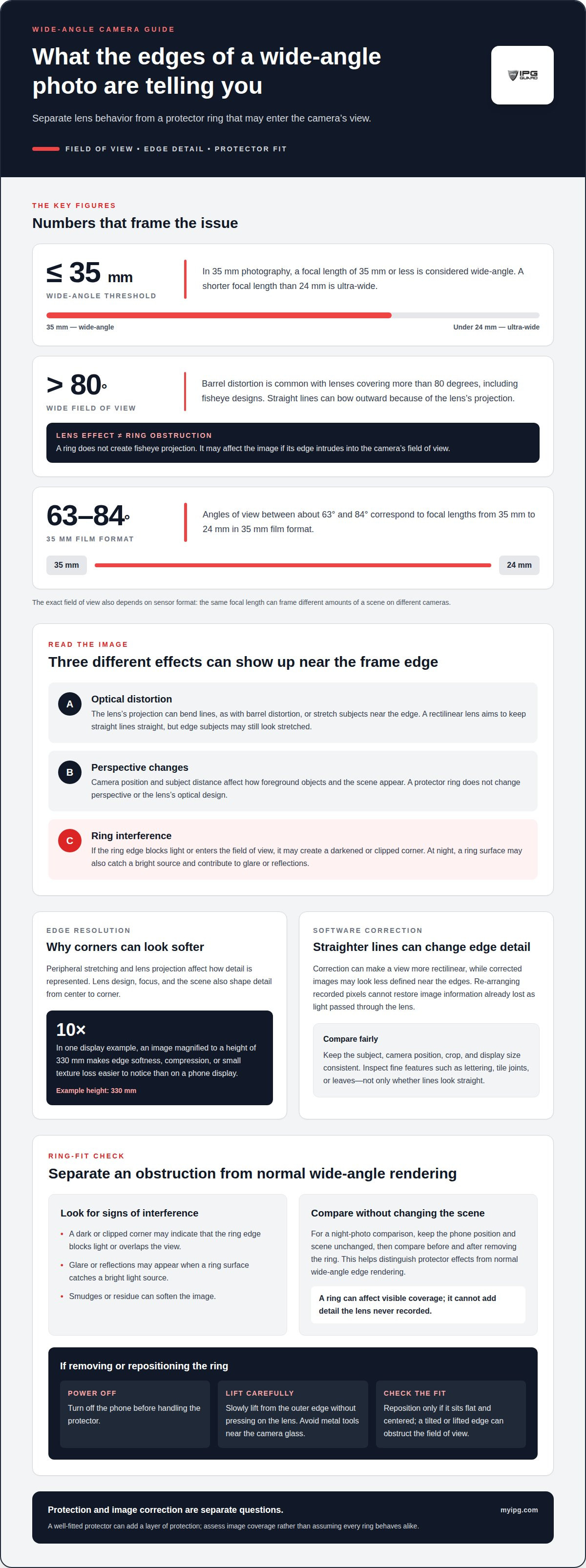
A wide-angle lens captures a broader scene than a longer focal-length lens from the same camera position. In 35 mm photography, a focal length of 35 mm or less is considered wide-angle, while a focal length shorter than 24 mm is ultra-wide. The exact field of view also depends on the sensor format, so the same focal length can frame different amounts of a scene on different cameras.
A wider view brings more objects near the frame edges. For example, a rectilinear lens aims to keep straight lines straight, but subjects near the edge can still look stretched. A fisheye lens uses a different projection and can bend lines that would appear straight in the scene. These are lens and projection effects, not evidence that a protector ring has changed the lens’s focal length.
For lenses with a field of view greater than 80 degrees, barrel distortion is common, including with fisheye designs. Barrel distortion makes straight lines bow outward. A ring can affect the captured view if its edge intrudes into the lens’s field of view, but it doesn’t create the same optical projection as a fisheye lens. The distinction matters when diagnosing a dark corner or clipped edge.
Whether to use a camera protector ring or leave a wide-angle lens uncovered depends on your priorities. A well-fitted protector can add a layer of protection, but an ill-fitting ring may obstruct the frame’s edge or affect light entering the lens. Choose protection designed for your camera layout, and assess image coverage rather than assuming every ring behaves alike.
No phone model can be singled out as always having wide-angle issues with protector rings. The result depends on the camera arrangement and the ring’s fit, so models with different lens placement or ring dimensions may behave differently.
To remove or reposition a ring, power off the phone and slowly lift the protector from its outer edge without pressing on the lens. Avoid using metal tools near the camera glass. Reposition it only if it sits flat and centered, since a tilted or lifted edge can obstruct the field of view.
At night, a protector ring may contribute to glare or reflections if its surface catches a bright light source. Smudges or residue can also soften the image. Compare a night photo before and after removing the ring, keeping the phone position and scene unchanged. This helps distinguish protector effects from the wide-angle lens’s normal edge rendering.
Wide-angle lenses serve close-up uses at ATMs, card-locked garage entries, and multi-door entryways needing high image detail and a wide field of view. In 35 mm film format, angles of view between about 63° and 84° correspond to focal lengths of 35 mm to 24 mm.
Edge resolution and image detail
Edge resolution describes how clearly an image records fine detail near its outer boundary. In a wide-angle image, a brick seam or sign near the center may look crisp, while similar detail near a corner appears softer. Barrel distortion can reduce resolution as objects move farther from the image center. The sensor still records the scene, but lens projection and peripheral stretching affect how detail is represented across the image.
A rectilinear lens keeps straight scene lines straight, yet its projection stretches the scene toward the edges. This geometric stretching can increase apparent resolution at the image edges, but it doesn’t mean every lens resolves fine detail equally well from center to corner. Lens design, focus, and the scene itself still shape the recorded detail. For example, a row of window frames may remain straight while the outer frames look wider or less natural.
Software correction changes image geometry after capture. Software correction can adjust image geometry to make the view more rectilinear. Software correction can change how edge detail appears, so corrected images may look less defined near the edges. A corrected building photo may look more natural because its vertical lines are straight, yet its outer brickwork may appear less defined. The correction changes how recorded pixels are arranged; it can’t restore image information already lost as light passed through the lens.
Magnification makes the trade-off easier to see. In one display example, an image is magnified 10X to a height of 330 mm. At that scale, edge softness, compression, or small texture loss becomes easier to notice than on a phone display. Compare the same corner in the original and corrected images. Look at fine features, such as lettering, tile joints, or leaves, rather than judging only whether the overall lines look straight.
For a useful comparison, keep the subject, camera position, and crop consistent. Inspect the original file at the same display size, then compare it with a corrected copy. If corner detail looks clipped or unusually dark, consider whether an obstruction overlaps the camera’s view. A protector ring can affect visible coverage, but it can’t add detail the lens never recorded. This helps separate an edge obstruction from software processing and ordinary wide-angle rendering.
Choose the result that suits the photograph. Architectural images may benefit from straight lines, while natural scenes may retain more believable edge shapes without correction. In either case, a rectilinear appearance doesn’t guarantee sharper corners. Judge the actual sensor image, especially when fine edge detail matters.
Optical lens distortion
Optical distortion comes from how a lens projects the scene, while a protector ring can obstruct light at the frame’s edge. Separating these effects helps identify whether curved lines come from the lens or a visible obstruction.
Ring-Related Vignetting and Image Distortion
Vignetting is darkening toward an image’s corners. A ring can cause it if its edge blocks light entering the lens. This matters most with a wide field of view, because the camera captures light from angles near the lens’s outer edge. The result may be a dark or clipped corner, unlike the barrel or pincushion pattern produced by optical projection.
A ring that sits unevenly can obstruct one side more than another, so the shading may appear asymmetrical. By contrast, barrel distortion bends straight scene lines outward, while pincushion distortion bends them inward. A Nikon 18-200mm VR lens can show barrel and pincushion distortion at different focal lengths, illustrating that lens distortion can change with zoom position without a ring.
Identifying Distortion from a Protector Ring
To see whether a ring affects a photo, compare matched images with the ring installed and removed. Keep the camera position, subject distance, framing, and focal length unchanged. Look for dark corners, clipped edges, or a change that follows the ring’s position. If straight lines curve in the same way in both images, the lens’s optical projection is the more likely cause.
Check more than one scene. A building with straight window frames can reveal barrel or pincushion distortion, while a bright point near a corner can reveal obstruction or flare. A rectilinear lens keeps real-world straight lines straight in the image, though its edges can still look stretched. Fisheye designs use a different projection, so curved lines alone don’t prove that a protector is responsible.
Focal length also matters. Many wide-angle lenses for the 35 mm format produce roughly rectilinear images, although some barrel distortion is common. Lenses between 8 and 16 mm may use either rectilinear or fisheye designs, so focal length alone doesn’t identify the projection. Even a 50 mm prime lens can produce barrel distortion at close subject distances.
Judge the pattern, not just the word “distortion.” A dark wedge that appears only with the ring points to blocked light. Curvature that remains after removal points to the lens design or focal length. Software correction may straighten lines, but it changes the image mapping rather than proving the ring caused the original optical effect.
An architectural photo example describes a fisheye view covering 180 degrees from corner to opposite corner. That extreme coverage shows why a curved architectural line is not enough, on its own, to identify a protector ring as the cause; the projection may account for the appearance. Compare the pattern across the frame and with the ring removed before drawing that conclusion.
A commenter cites an article claiming that front mobile phone cameras can distort faces by up to 30%. This is a separate kind of perspective effect, and it reinforces the value of judging the capture setup as well as the lens. A change in apparent shape does not by itself show that an accessory caused it.
Perspective distortion from wide-angle lenses
Perspective distortion describes changes in apparent size and shape caused by camera position and subject distance. A wide-angle lens doesn’t independently make nearby objects larger; the effect comes from viewpoint. Because a wide field of view includes more of a scene, photographers may move closer to fit a subject, making near objects appear much larger than distant ones.
Distance is central. Perspective magnification is proportional to 1 / Z, where Z represents an object’s distance from the camera. A hand held close to a phone can therefore appear oversized beside a face farther away. Changing to a longer lens while keeping the camera in the same position changes framing, but not that viewpoint relationship.
Frame-edge stretching can also come from perspective. With a wide-angle lens, an object near the edge may be tilted relative to the camera and closer to it than its center. The nearer portion then appears larger. Rectilinear lenses keep straight scene lines straight, but they can’t remove perspective effects caused by the angle and distance of objects.
Camera alignment matters for architecture and other flat subjects. A flat surface perpendicular to the optical axis has uniform scaling when all its points share the same depth. Tilt the camera away from that perpendicular position, and parts of the surface sit at different distances. A circular detail on an obliquely viewed flat surface projects as an ellipse, even if the lens has no visible optical defect.
Thin or individual-lens protectors don’t reduce perspective distortion compared with a full camera-plate protector. Perspective comes from the camera’s position and the scene’s geometry, not protector thickness or coverage. A protector can matter if it obstructs the image edge.
To assess a wide-angle photo, keep the camera position fixed and change only one factor at a time. First, photograph a subject with the camera level and centered. Then tilt the phone while keeping your distance steady. If the subject’s shape changes, alignment contributes; if its apparent size changes after you move closer, distance contributes.
Compare objects at the center and edges, too. A doorway photographed from close range may show its near side larger than its far side, while a distant façade may look more even. Curved lines and perspective effects are different: curved lines can reflect lens projection, while unequal object sizes point to viewpoint and depth. A rectilinear image can still have strong perspective.
For a more natural perspective, step farther from the subject and reframe only if the scene allows it. In a tight room, distance may be limited, so close foreground objects will remain visually prominent. The lens records that spatial relationship; a protector ring can’t correct it.
How does a camera lens protector ring cause vignetting or image distortion?
A protector ring affects a photo if it changes the light reaching the camera lens or enters its field of view. The result may be darkened corners, glare, or blocked edges. It doesn’t change the lens’s focal length or the scene’s perspective. For wide angle lens distortion with camera protector ring, first distinguish an obstruction from the optical projection created by the lens.
Vignetting occurs when less light reaches the sensor near the image corners. A ring that extends too far in front of a wide-angle lens can block light arriving from outer angles. The photo may show dark corners or a shaded edge, especially if the obstruction sits off-center. A ring designed for a different camera layout may also sit too close to one lens.
Physical clearance matters on phones with several closely spaced cameras. The wide-angle camera may capture a broader view than its neighboring lens. If a raised rim overlaps that view, it can cut off part of the scene. Look for a dark crescent, a hard edge, or an object clipped at the frame boundary. These signs suggest blocked coverage rather than curved lines caused by lens projection.
Reflections create another visible effect. At night, a street lamp or headlight can reflect between protective surfaces or off a surface facing the lens. The result may look like haze, glare, or a faint duplicate light. Fingerprints and dust can scatter light, too, softening the image even when the ring doesn’t block the frame.
Use a controlled comparison to separate these causes. Photograph the same scene with the ring fitted and removed, keeping the camera, position, and framing unchanged. Use a bright, evenly lit wall to reveal corner shading. Then photograph straight edges to assess curvature, followed by a night scene with a bright point near the frame edge to reveal reflections.
If a shadow or flare disappears after removing the ring, the ring or its surface is affecting the image. If curved lines remain, the lens’s optical design is the more likely cause. A protector can’t correct perspective changes caused by camera position, either. To diagnose wide angle lens distortion with camera protector ring, compare the specific image symptom rather than treating every edge effect as the same problem.
A compatible camera lens protector should protect the lens without intruding into the camera’s view. Match the protector to the phone’s camera layout, and keep its surface clean before photographing bright night scenes. That practical distinction helps preserve both lens coverage and the detail in the images you care about.
My IPG
My IPG helps you protect your phone’s camera lens while keeping lens coverage and image quality in mind. If a photo shows dark corners or clipped edges, first distinguish possible ring obstruction from the lens’s own optical and perspective effects. A protector is for protection, not for correcting lens distortion.
My IPG offers phone camera lens protectors, including options for iPhone and Samsung devices. Choose protection that fits your phone’s camera layout and suits how you use its wide-angle camera.
For help with your camera protection needs, contact My IPG.
Protect your camera with confidence
Understanding wide-angle lens distortion with a camera protector ring gives you a clearer basis for choosing protection. Let your photography guide the decision: notice whether you often shoot near frame edges, capture bright lights at night, or rely on fine detail across the image. Those habits help you prioritize lens coverage and an unobstructed view.
My IPG offers an IPG Phone camera lens protector, an IPG iPhone screen protector, and an IPG Samsung screen protector. Choose protection that fits your device, remembering that a protector safeguards the lens rather than correcting its optical design or perspective.
If you’re ready to consider camera protection for your phone, contact My IPG. Keep capturing the wide scenes you value, with protection chosen thoughtfully for your device.
Frequently Asked Questions
What is Lens Distortion?
Lens distortion is a change in the shape or position of image features caused by how a lens projects a scene. For example, a grid photographed with a lens that produces barrel distortion may show lines bowing outward. Distortion affects geometry, while softness describes reduced clarity. Separating those signs helps you decide whether an image needs geometric correction or a check of focus and detail.
Where does the wide-angle look come from?
The wide-angle look comes from a lens capturing a broad area of the scene, combined with the camera’s viewpoint. Imagine photographing a table setting: a cup close to the phone can appear much larger than a plate farther away. That strong size contrast makes the scene feel spacious and deep. Moving the phone changes the perspective, even if you keep the same camera lens selected.
Can a camera protector ring cause distortion with a wide-angle lens?
Yes, if the ring blocks part of the camera’s view or reflects light toward the lens. A bright window near the edge might produce haze or a faint duplicate reflection, while a ring that overlaps the lens’s view can darken or cut off an edge. Those effects differ from curved lines created by lens projection. Compare the same scene with and without the ring to identify changes.
What are the best camera protector rings for wide-angle lenses?
Choose a protector ring designed for your camera layout that sits flat and centered. Check that it doesn’t obstruct the edges of the frame.