
Why does a premium tablet screen, engineered with sophisticated glass, still look like a grease-streaked mess after just five minutes of use? It's a persistent frustration that ruins your visibility and degrades your user experience. Selecting a high-performance anti-fingerprint screen protector for tablets is no longer a luxury. It's a necessary step in professional stewardship over your most valued hardware. You shouldn't have to scrub your screen every hour just to see your work clearly.
We know you're tired of the constant smudges and the fear of scratching your original glass during cleaning. You want a display that remains as pristine as the day you unboxed it. This guide promises to reveal how advanced oleophobic technology and precision-engineered materials maintain a smudge-free surface. We'll examine the technical specifications of 9H hardness, the benefits of 0.33mm thickness, and the chemistry of oil-resistant coatings. You'll discover how to secure a smooth touch experience and long-lasting clarity for your device. Let's find the guardian your technology deserves.
Key Takeaways
- Identify the primary causes of screen degradation, including skin oils and environmental moisture, to better protect your high-value display.
- Master the science of oleophobic coatings and choose the best anti-fingerprint screen protector for tablets to ensure long-lasting oil resistance.
- Compare matte and clear finishes to balance visual clarity with professional-grade glare reduction and surface tension management.
- Ensure zero stylus latency and precise touch sensitivity through meticulous material selection tailored for modern, bezel-less hardware.
- Leverage aerospace-grade film technology to maintain a pristine, smudge-free viewing experience without compromising device aesthetics.
The Science of Smudges: Why Tablet Screen Protection Matters
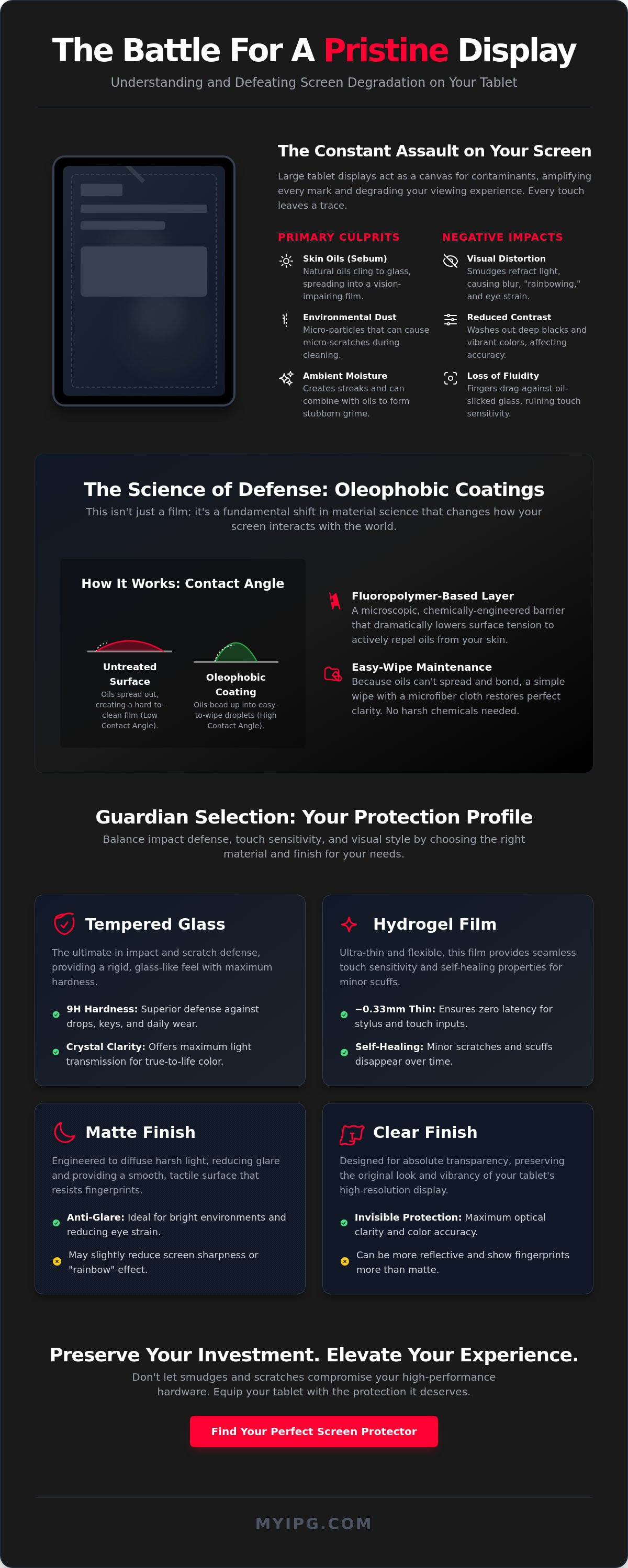
Your tablet is a high-performance tool, but it's under constant biological assault. Every interaction leaves behind a cocktail of skin oils, environmental dust, and ambient moisture. While a smartphone screen is small enough to ignore minor streaks, the expansive glass of a tablet acts as a canvas for contamination. Larger displays amplify every smudge because they catch light at more angles. This makes fingerprints impossible to ignore. For professionals relying on color accuracy or creative precision, these marks aren't just an eyesore. They're a persistent barrier to performance and clarity.
The Biological Factor: Sebum and Screen Interaction
The primary enemy of your display's clarity is sebum. This natural, waxy substance produced by your skin's sebaceous glands is designed to protect your body, but it's a nightmare for glass. High-intensity touch activities like digital illustration or gaming accelerate oil transfer. Understanding The Science of Smudges reveals why these oils cling so tightly. Without a barrier, removing these lipids requires harsh chemicals that can damage factory-applied coatings. These oils have high surface energy, making them spread quickly across untreated glass surfaces.
Optical Interference and User Fatigue
Contamination physically alters how you see your work. Fingerprint ridges refract light, causing "rainbowing" and significant eye strain. When light hits a smudge, it scatters in unpredictable directions. This reduces the effective resolution of your screen, making text appear blurry and images lose their crisp edges. Over a long workday, your eyes work harder to compensate for this lack of focus. This leads to fatigue that could have been easily avoided with the right surface treatment.
- Reduced contrast levels that wash out deep blacks and vibrant colors.
- Increased light scattering which creates distracting glare in bright environments.
- Degraded color accuracy, which is a critical failure for photographers and designers.
- Loss of tactile fluidity as fingers drag against oil-slicked glass.
Maintaining a professional standard of purity requires more than a microfiber cloth. It demands a proactive defense strategy. An anti-fingerprint screen protector for tablets functions as a precision-engineered sacrificial layer for your device. It takes the brunt of daily wear while utilizing advanced material science to keep oils at bay. By installing a dedicated barrier, you preserve the integrity of the original glass. This ensures your touch experience remains fluid and responsive while your display stays crystal clear. Protection is about the long-term preservation of the technology you value most.
Understanding Oleophobic Coatings and Tablet Materials
True oil resistance isn't a surface-level feature. It's a fundamental shift in material science. When you choose an anti-fingerprint screen protector for tablets, you're investing in a specialized fluoropolymer-based layer that drastically lowers surface tension. This thin, invisible barrier dictates how your device handles the daily reality of human contact. It's the difference between a pristine workspace and a degraded viewing experience. High-end protection doesn't just sit on the glass; it changes how the glass behaves.
What is an Oleophobic Layer?
An oleophobic coating is a fluoropolymer-based layer that lowers surface energy to repel oils. The effectiveness of this layer is measured by its "contact angle." A higher angle ensures that skin oils bead up into tiny droplets rather than spreading into a stubborn, visible film. This beading effect is critical for maintaining optical clarity. It allows for "easy-wipe" cleaning using only a dry microfiber cloth. Technical evaluations found in Tablet Screen Protection Selection Criteria confirm that these treatments are vital for maintaining display integrity under heavy use. You don't need harsh detergents or abrasive chemicals when the chemistry does the heavy lifting for you.
Hydrogel vs. Tempered Glass: The Fingerprint Battle
Choosing between materials requires a balance of protection and performance. Tempered glass provides a robust 9H hardness rating, offering superior impact defense against drops. However, hydrogel films are often thinner, maintaining a profile of approximately 0.33mm. This ultra-thin design ensures maximum touch responsiveness for complex tablet gestures and high-speed gaming. Hydrogel is particularly effective for creative professionals. The IPG Original (Hydrogel) Screen Protector features unique self-healing properties that glass cannot match. Minor scuffs and surface indentations from your stylus literally vanish over time as the material returns to its original state. This keeps the surface smooth and smudge-resistant for much longer than traditional films.
Precision protection extends beyond the main display. The same advanced technology used to shield your screen is applied to high-end optics. Look at the IPG Phone camera lens protector to see how we preserve clarity across all your hardware. Whether you prefer the rigidity of tempered glass or the flexibility of hydrogel, the goal remains the same: total preservation of your device's original quality. Secure your hardware with specialized tablet protection that understands the value of a clean, responsive display. Each layer is engineered to act as a guardian for your technology.
Matte vs. Clear: Choosing Your Anti-Fingerprint Style
Selecting an anti-fingerprint screen protector for tablets requires a strategic choice between two distinct engineering philosophies. One relies on physical surface texture to hide contamination, while the other utilizes advanced chemical engineering to repel it. This decision directly impacts your display's optical performance and tactile feedback. Understanding the trade-offs between light diffusion and color vibrancy is essential for maintaining the professional integrity of your hardware. You must decide whether you value the "paper-like" friction of a matte finish or the high-definition clarity of a clear coating.
The Matte Approach: Diffusion and Texture
Matte protectors employ a microscopic, etched surface to scatter incoming light. This diffusion process effectively masks fingerprints and eliminates distracting reflections from overhead lighting. For digital artists and note-takers, the primary benefit is the tactile resistance. This texture mimics the feel of writing on paper, providing the precision necessary for intricate stylus work. However, this physical barrier comes with a technical cost. The same pits that scatter glare also cause minor light refraction from the pixels, which can lead to "screen grain" or a slight reduction in absolute sharpness. Low-quality matte films often suffer from a "sparkle" effect that can degrade your viewing experience during long sessions.
The Clear Approach: Chemical Resistance
Clear protectors are designed for users who refuse to compromise on display resolution. These films rely 100% on high-grade oleophobic layers to manage oils. By leveraging the science of oleophobic coatings, these protectors maintain a high contact angle that causes skin lipids to bead up. This ensures your 4K or HDR content remains vibrant and color-accurate. Clear films are the ideal guardian for media consumers and photographers who need to see every detail without the interference of a textured surface. They preserve the original "naked" aesthetic of the tablet while providing a robust defense against daily smudges.
- Artist Persona: Prioritize matte finishes for superior stylus control and glare reduction in bright studios.
- Media Persona: Choose clear coatings to preserve maximum brightness and color depth for video editing or streaming.
- The Satin Middle-Ground: Look for "Satin" or "Semi-Matte" options that offer a balanced compromise, reducing glare without the heavy grain of traditional matte films.
Your choice should reflect your primary workflow. If you spend your day sketching or working under harsh office lights, the light-scattering properties of a matte film are invaluable. If your tablet is a portable cinema or a high-end portfolio, a clear anti-fingerprint screen protector for tablets ensures your work is seen exactly as intended. Both styles serve as a dedicated sacrificial layer, but they communicate with your eyes and hands in fundamentally different ways. Protect what you value by choosing the finish that aligns with your specific performance needs.
Tablet Screen Protection Selection Criteria
Selecting the right anti-fingerprint screen protector for tablets requires a focus on technical precision. Your hardware is a high-value investment. It deserves a guardian that respects its engineering. A generic fit is no longer sufficient for modern, bezel-less displays. You must evaluate the material's interaction with your specific workflow, whether you're navigating spreadsheets or rendering complex 3D models. The goal is a seamless integration that preserves the device's original aesthetic while providing a robust defense against daily contamination.
Precision Fit and Edge Integrity
Modern tablets feature edge-to-edge glass with incredibly tight tolerances. A deviation as small as 0.1mm during the cutting process leads to the "halo" effect. This occurs when the edges fail to adhere perfectly, creating a gap where dust and oils accumulate. This eventually causes the film to peel. Meticulous cutouts for ambient light sensors, front-facing cameras, and microphones are essential for maintaining full device functionality. We utilize the same precision-cut standards for our consumer films as we do for specialized industrial and marine screens. This benchmark ensures that your protection remains invisible and secure, even at the very edge of the glass.
Stylus Compatibility and Pressure Sensitivity
Your creative tools depend on consistent surface tension. If you use an Apple Pencil or S-Pen, the thickness of the material directly impacts your experience. A protector that is too thick introduces stylus latency or inconsistent pressure mapping. You want a surface that provides the right amount of "drag" or friction without compromising the digitizer's response time. Before finalizing your choice, verify that the material supports the full range of tilt and pressure sensitivity your tablet offers. A high-quality protector should feel like the original glass, only cleaner.
- Case-Friendly Dimensions: Ensure there's a microscopic gap at the edge to prevent your protective case from lifting the film.
- Touch Responsiveness: Test for zero-lag performance in high-speed gestures and multi-touch commands.
- Optical Clarity: Confirm the material doesn't introduce "rainbowing" or pixel distortion.
- Installation Systems: Look for IPG Zerodust Screen Protector technology to ensure a bubble-free, pristine application on the first try.
Longevity is the final, critical factor. Most oleophobic coatings on the market degrade within weeks of heavy use. Premium protectors utilize molecularly bonded layers that resist the friction of constant swiping. This ensures the oil-repellent properties last for months, not days. Don't settle for a temporary fix that requires frequent replacement. Secure your hardware with precision-engineered tablet protection that stands the test of time. Your display remains the primary interface with your digital world. Keep it pristine, responsive, and professional.
IPG: The Guardian of Your Tablet Display
Choosing an anti-fingerprint screen protector for tablets is a decision about long-term stewardship. You aren't just buying a plastic film; you're appointing a guardian for your most vital interface. While mass-market alternatives focus on high-volume turnover, we focus on high-end preservation. Our engineering philosophy treats your tablet as a precision instrument that requires specialized defense. We don't settle for "good enough" when your professional clarity and device value are on the line. You deserve a solution that matches the sophistication of your hardware.
Aerospace-Grade Durability
Precision matters. Our films originated in the high-stakes world of aerospace engineering, where optical clarity and surface integrity are mission-critical requirements. This military-grade heritage translates directly to the glass on your desk. By utilizing materials originally designed to protect cockpit displays and sensitive sensors, we provide a level of scratch and oil resistance that consumer-grade films cannot replicate. This technology ensures your protection remains invisible. It stays out of the way of your work while providing a robust, molecularly bonded barrier against daily wear. You get the strength of an industrial shield with the elegance of a retail finish.
Installation and Long-Term Stewardship
A protector is only as effective as its application. Achieving a professional, bubble-free finish requires a methodical approach. Follow these three steps for a pristine result:
- Sanitize your environment: Work in a draft-free space to minimize airborne dust particles.
- Align with precision: Use the provided guides to ensure the 0.1mm tolerances match your tablet's sensors perfectly.
- Seal the bond: Apply firm pressure from the center outward to evacuate all air and secure the adhesive.
Maintaining your anti-fingerprint screen protector for tablets is equally vital. To avoid stripping the specialized oleophobic coating, never use harsh household glass cleaners or high-concentration alcohol wipes. A simple, water-dampened microfiber cloth is all you need. The low surface energy of the IPG film does the heavy lifting, allowing smudges to lift away without aggressive scrubbing. This careful maintenance preserves the fluoropolymer layer for months of heavy use. It ensures your touch experience remains fluid and your display stays sharp.
Your tablet is more than a gadget. It's a gateway to your creativity and a vault for your data. Don't compromise its integrity with inferior materials. Secure your device with a partner that understands the science of protection. Protect your tablet with My IPG precision shields and experience the confidence of a truly pristine display. We take the hit so your technology doesn't have to. Trust the specialist to maintain your edge.
Secure Your Digital Clarity
Your tablet is a high-performance tool that demands professional-grade stewardship. Maintaining its integrity requires more than a simple cleaning cloth. It requires a dedicated guardian. You now understand that true oil resistance is a product of advanced oleophobic chemistry and high surface tension. Whether you prioritize 4K vibrancy with a clear film or the tactile friction of a matte finish, precision fit remains non-negotiable. A 0.1mm deviation can compromise your entire display. Investing in a high-performance anti-fingerprint screen protector for tablets ensures your hardware remains as pristine as the day you unboxed it.
We leverage aerospace-grade material technology trusted by industrial and marine professionals to provide unmatched security. Our shields are precision-cut for all major tablet models, ensuring edge-to-edge integrity without the risk of peeling. Stop fighting persistent smudges and start focusing on your creative output. Secure your tablet display with IPG precision shields. Your technology is an investment in your future. Protect it with the meticulousness it deserves and enjoy a crystal-clear viewing experience every single day.
Frequently Asked Questions
Do anti-fingerprint screen protectors really work on tablets?
Yes, they work by employing advanced fluoropolymer layers that reduce surface energy. This causes skin oils to bead into tiny droplets rather than spreading into stubborn streaks. While no film is 100% immune to marks, a high-quality anti-fingerprint screen protector for tablets makes cleaning effortless. You'll spend less time scrubbing and more time working on a clear, professional-looking display.
Will a matte screen protector make my tablet screen look blurry?
Matte protectors introduce a microscopic texture that scatters light to reduce glare. This diffusion can cause a subtle "sparkle" or a slight reduction in absolute pixel sharpness. If you're a creative professional, this trade-off is often worth the paper-like tactile response. Media consumers who prioritize 4K resolution should opt for clear coatings to maintain absolute visual clarity.
How long does the oleophobic coating last on a screen protector?
The lifespan of an oleophobic coating depends on your daily touch frequency and cleaning habits. Generally, these waxy, oil-repellent layers remain effective for several months of heavy use. Using harsh chemical cleaners or abrasive cloths will strip the coating prematurely. Stick to dry microfiber to preserve the material's integrity and maintain long-lasting oil resistance.
Can I use a stylus with an anti-fingerprint screen protector?
Absolutely. Most modern protectors are engineered to be fully compatible with the Apple Pencil and S-Pen. Choosing an anti-fingerprint screen protector for tablets with a 0.33mm thickness ensures zero stylus latency and perfect pressure sensitivity. Artists often prefer matte finishes because the added friction provides better control over intricate strokes and digital illustrations.
What is the best way to clean a tablet screen protector without damaging it?
A dry microfiber cloth is the safest tool for maintaining your protector. For stubborn debris, use a slightly dampened cloth with plain water. Avoid all detergents, window cleaners, and high-concentration alcohol wipes. These substances break down the chemical bonds of the oleophobic layer. Gentle maintenance is the key to protecting your technology for the long term.
Is hydrogel or tempered glass better for stopping fingerprints?
Both materials offer excellent oil resistance, but they serve different needs. Tempered glass provides 9H impact protection and a slick, factory-glass feel. Hydrogel is thinner and offers self-healing properties for minor surface scuffs. If your priority is impact defense, choose glass. If you value a slim profile and tactile responsiveness, hydrogel is the superior guardian for your hardware.
Does a screen protector affect the color accuracy of my tablet?
Clear protectors do not degrade color accuracy or HDR performance. They are designed to be optically transparent, preserving the vibrancy of your display. Matte protectors can slightly reduce contrast by diffusing light, which may make deep blacks appear slightly grey. Your choice should align with your user persona, whether you're a color-critical photographer or a glare-weary professional.
Why do some anti-fingerprint protectors feel "rubbery"?
That "rubbery" sensation is a characteristic of thermoplastic polyurethane or hydrogel materials. This flexibility allows the film to absorb impacts and "self-heal" from minor indentations. It provides a grippier surface that some users find more secure for navigation. If you prefer the frictionless glide of original glass, a tempered glass protector is the better match for your tactile preferences.