
Why does your premium tempered glass keep failing at the edges of your flagship smartphone? It's a persistent issue for anyone who values the sleek aesthetics of a waterfall display. You shouldn't have to tolerate edge lifting or dust accumulation on a high-value device. Finding a reliable screen protector for curved edge phone models requires moving beyond basic retail options. We view ourselves as guardians of your technology, ensuring your hardware stays as pristine as the day you unboxed it.
We agree that your screen's integrity is non-negotiable. You deserve a solution that doesn't hinder touch sensitivity or block your ultrasonic fingerprint sensor. This guide empowers you to master the science of curved display protection. With the global market for these accessories projected to hit USD $63.6 billion in 2026, the technology has finally caught up to the hardware. You'll learn why specialized elastic polymers and hydrogels outperform traditional glass on aggressive curves. We'll examine specific material properties and installation precision to ensure your device remains secure, responsive, and fully functional.
Key Takeaways
- Understand why rigid tempered glass creates a bridge over waterfall edges and why flexible materials offer superior contouring.
- Identify the ideal screen protector for curved edge phone models by prioritizing full adhesive coverage and case-friendly dimensions to prevent lifting.
- Compare the performance of Hydrogel, UV Cured Glass, and TPU to find the optimal balance between impact protection and touch sensitivity.
- Master the Center-Out squeegee technique and deep-cleaning protocols to eliminate micro-oils and ensure permanent edge adhesion.
- Discover how aerospace-grade materials and Zerodust technology provide a flawless, bubble-free application for high-value displays.
The Engineering Challenge of Curved Edge Displays
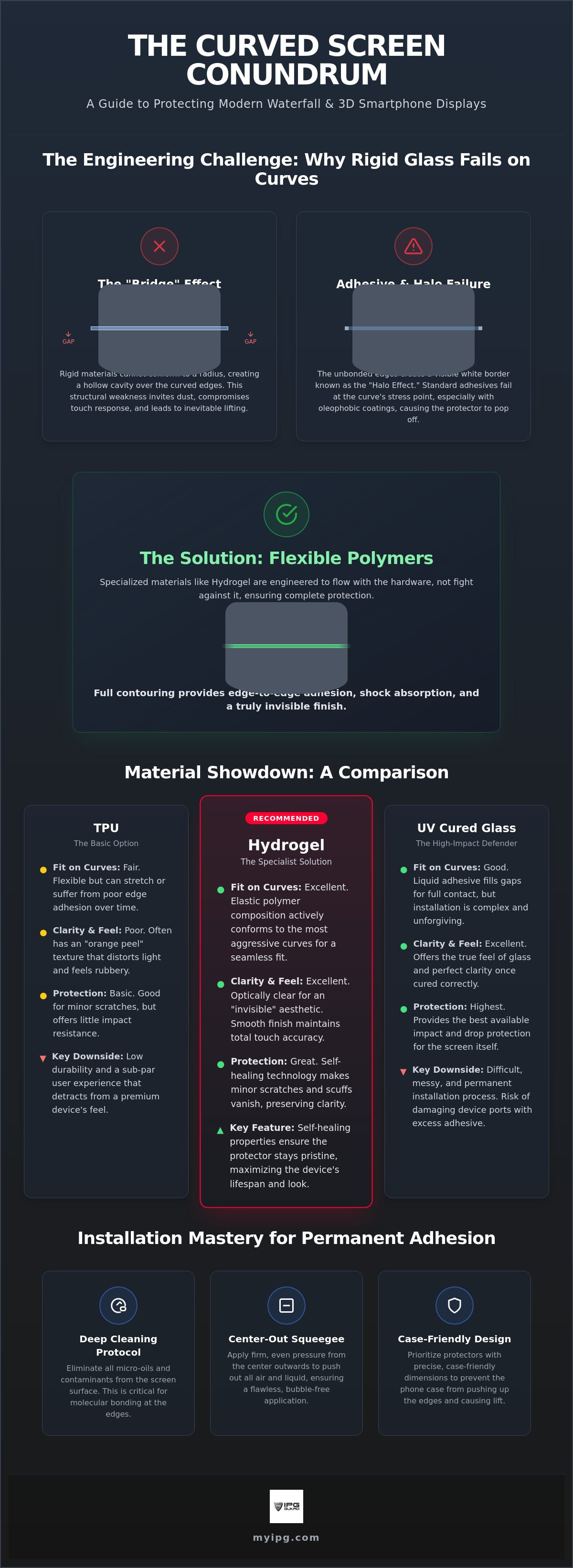
Modern smartphone architecture has moved beyond the flat panel. Waterfall and 3D curved displays wrap the screen around the chassis to create a seamless visual experience. This design looks stunning, but it creates a nightmare for physical protection. When you apply a standard rigid protector, you encounter the "bridge" effect. Rigid materials cannot conform to a radius. Instead, they span the gap between the flat center and the outer edge. This leaves a hollow cavity. It's a structural weakness. Air ingress is inevitable. Within days, dust traps form along the perimeter. This compromise ruins both aesthetics and touch response. Your high-value device deserves better than a makeshift solution.
Curved edges also amplify impact stress on the display's corners. Because the glass is exposed at the sides, a side-angle drop directs kinetic energy directly into the structural weak points. A proper screen protector for curved edge phone hardware must act as a shock absorber. It shouldn't just be a scratch guard. It needs to dissipate force across the entire surface area. Without total contact, the protector fails to protect the most vulnerable parts of your phone.
Rigid Glass vs. Flexible Geometry
Traditional tempered or toughened glass relies on its inherent stiffness for impact resistance. This material accounted for 91.3% of the market in 2025, yet it struggles with modern 3D surfaces. The "Halo Effect" occurs when the glass fails to meet the screen's edge. This leaves a visible white border of unbonded material. It's a failure point. Temperature fluctuations exacerbate the issue. As materials expand and contract, the bond weakens. Choosing the right screen protector for curved edge phone displays means prioritizing flexible geometry. You need a material that flows with the hardware, not one that fights it.
Why Traditional Adhesives Fail on Curves
Adhesion requires consistent surface tension. Most curved displays feature factory-applied oleophobic coatings designed to repel oils. These same coatings resist standard adhesives used in cheap protectors. At the transition point where the flat glass begins its curve, mechanical stress is at its peak. Rigid protectors often "pop off" because the adhesive cannot counteract the material's desire to return to a flat state. You need molecular bonding. Without it, the edges lift and invite debris. Protective stewardship requires a specialized material. It must maintain integrity at the curve transition to ensure your screen remains pristine and responsive.
Comparing Materials: Hydrogel vs. UV Glass vs. TPU
Material science dictates the performance of your display protection. For years, the market relied on rigid glass, but curved architecture has forced a shift toward flexible polymers. Choosing the right screen protector for curved edge phone hardware means balancing impact resistance with physical adaptability. While tempered glass dominated 91.3% of the market in 2025, it isn't always the superior choice for a 3D radius. You need a material that bonds at a molecular level rather than just sitting on the surface.
Thermoplastic Polyurethane (TPU) remains a common entry-point. It's affordable and flexible. However, TPU often suffers from an "orange peel" texture that distorts light and feels rubbery to the touch. Hybrid materials attempt to solve this by layering glass dust within a polymer matrix, but these often lack the necessary "stretch" for deep waterfall edges. The engineering of touch screens has evolved to require thinner, more conductive layers, making material choice critical for maintaining sensitivity. If you want a solution that disappears onto your device, you should consider the IPG Original (Hydrogel) Screen Protector for its superior contouring.
The Hydrogel Advantage for 2026 Devices
Hydrogel has emerged as the premium standard for curved displays. Unlike rigid glass, it uses a moisture-rich, elastic composition that actively conforms to 3D surfaces. It doesn't just sit on the screen; it wraps around it. One of its most protective features is self-healing technology. Minor scratches and scuffs from keys or coins literally vanish within hours as the material's molecular structure resets. This ensures your view remains unobstructed. It provides an "invisible" aesthetic that preserves the original look of your flagship device while maintaining total touch accuracy across the entire curve.
UV Liquid Glass: Pros and Cons
UV cured glass offers the highest level of impact protection. It uses a liquid adhesive that fills the gap between the protector and the screen, which is then hardened under a UV light. This creates a solid bond. However, the installation is notoriously high-risk. Liquid adhesive can easily seep into earpieces, buttons, or charging ports, causing permanent hardware damage. It's also significantly harder to remove than dry-apply films. If the glass cracks, you're left with a difficult cleanup process that could compromise your screen's factory oleophobic coating. While it offers security, the complexity often outweighs the benefits for daily users.
Essential Features for Curved Screen Integrity
Total surface adhesion is the baseline for security. Many generic protectors utilize edge-only adhesive rings to simplify manufacturing. This is a critical failure point for a 3D display. It creates a microscopic air gap between the protector and the glass. This cavity acts as a resonant chamber, causing a distracting "clicking" sound during use. It also invites dust and moisture to infiltrate the perimeter. You must insist on full adhesive coverage. This ensures the screen protector for curved edge phone hardware remains bonded under mechanical stress. It preserves the tactile response you expect from a premium device.
Longevity also depends on the quality of the surface treatments. High-performance protectors feature vacuum-electroplated oleophobic and hydrophobic coatings. These aren't just temporary sprays. They are bonded layers that repel fingerprints and skin oils for months of heavy use. This prevents the "sticky" feeling common with low-grade films. It maintains the factory-fresh glide of your original display. When we talk about stewardship, we mean protecting the experience as much as the hardware.
Biometric Transparency and Sensor Support
2026 sensor arrays are more sophisticated than ever. Modern ultrasonic fingerprint sensors rely on sound wave pulses to map your unique ridges. If a protector is too dense or poorly bonded, it distorts these pulses. Your biometric security fails. You need a material with high acoustic transparency. Similarly, under-display camera systems require exceptional light transmission specs. We look for 99% clarity to prevent hazing in selfies or video calls. Maintaining 100% touch sampling rates on the curved edge is equally vital. A protector should never come between you and your device's performance.
Case Compatibility and Edge Gaps
The "push-up" effect is the primary cause of protector failure on curved screens. Rugged cases often feature high, protective lips that wrap around the phone's corners. If your screen protector for curved edge phone extends too far, the case will catch the edge. This mechanical pressure lifts the film, creating bubbles that never go away. Precision is paramount. We recommend a 1mm to 2mm gap at the perimeter. This requires precision-cut geometry tailored to specific phone models. Avoid "universal" fits. They are rarely compatible with the tight tolerances of modern protective cases. A dedicated specialist understands that a perfect fit is a measured fit.
Installation Mastery: Preventing Edge Lift
Perfection starts with total decontamination. Standard cleaning wipes often fail to reach the deep 3D radius where skin oils accumulate from daily handling. These micro-oils are the primary cause of premature failure for any screen protector for curved edge phone. Use a high-concentration isopropyl alcohol prep pad to scrub the transition point between the flat display and the waterfall edge. This ensures the adhesive has a pristine surface for molecular bonding. If you leave even a trace of oil, the material will eventually "memory-flex" back to its flat state, causing the edges to peel.
Static is your greatest enemy during application. In a non-sterile home environment, floating dust particles are drawn to the screen the moment you peel the backing. We recommend performing the installation in a high-humidity area, such as a bathroom after a hot shower. The moisture in the air grounds the dust. Once the film is positioned, use the "Center-Out" squeegee technique. Start at the longitudinal center of the display and push outward toward the curves. This method displaces air trapped in the "bridge" zone and prevents tension from building up at the perimeter. For a flawless, debris-free finish, utilize the IPG Zerodust Screen Protector system to maintain a clean workspace.
The Wet-Apply vs. Dry-Apply Debate
Choosing between application methods depends on the display's geometry. Wet-apply solutions are superior for aggressive curves because they allow the film to "float" into the perfect position. This prevents the adhesive from grabbing too early. Always seal your speakers and charging ports with protective tape before starting. If "ghost bubbles" appear after the initial application, don't panic. These are usually pockets of trapped moisture or oxygen that will permeate through the breathable film over time. Avoid the urge to pick at the edges, as this will introduce permanent debris.
Final Bonding and Edge Sealing
Final edge security requires manual intervention. Once the main surface is set, use your thumb wrapped in a microfiber cloth to "massage" the edges. Work in 1-inch segments, applying firm, downward pressure toward the phone's frame. This mechanical force activates the pressure-sensitive adhesive. If the material feels too rigid, a hair dryer on its lowest setting can increase elasticity. Keep the heat source at least 6 inches away to prevent damaging the internal display components. The settling period is the 24 to 48-hour window during which the adhesive fully stabilizes and microscopic bubbles naturally dissipate through the material’s breathable structure. Wait for this period to conclude before attempting to fit a protective case.
IPG Original: The Specialist Shield for Curved Glass
Mass-market solutions often fail because they prioritize volume over precision. At My IPG, we operate as dedicated guardians of your high-value hardware. We utilize precision-cut aerospace-grade material specifically engineered for the unique, aggressive architecture of modern displays. This isn't a one-size-fits-all approach. Every screen protector for curved edge phone we manufacture is tailored to exact device tolerances. We ensure that the wrap-around edges remain bonded through daily wear and mechanical stress. Our commitment is to the preservation of your device's integrity and aesthetic value. We don't just cover your screen; we secure its future.
Installation is where most protective films fail. We solved this with our proprietary My IPG Zerodust Screen Protector technology. It eliminates the frustration of trapped debris and unsightly bubbles in non-sterile home environments. Whether you are shielding a flagship from a major manufacturer or a niche device, our coverage is comprehensive. We support iPhone, Samsung, and specialized hardware with the same level of meticulous detail. We treat your screen as a vital component, not just a surface. Choosing a screen protector for curved edge phone displays shouldn't be a gamble. It should be a calculated step toward long-term device stewardship.
Why My IPG Leads in Curved Protection
Our expertise is documented and refined through years of material science research. You can explore our foundational principles and technical standards in The Ultimate Screen Protector Guide. We don't just provide a physical barrier. We provide a performance-matched solution. For users with specific hardware, we offer tailored insights, such as our dedicated iPhone screen protector needs analysis. Our advanced hydrogel mimics the tactile feel of original glass. It ensures your interaction with the device remains seamless, responsive, and clear. We believe protection should be invisible yet invincible.
Securing Your High-Value Tech
Protecting a curved-edge flagship is an investment in its future resale value. Scratches on the 3D radius are difficult to repair and significantly devalue the hardware. My IPG acts as a professional partner in maintaining your device's pristine condition. We understand the emotional and financial value of your technology. Our "Guardian" persona isn't just marketing. It's a reflection of our meticulous manufacturing process and specialized register. We ensure your screen remains a window to your world, unobstructed and secure. Don't leave your display's safety to chance. Secure your curved display with My IPG precision today.
Secure Your Display’s Future
Mastering display protection means understanding the physics of your device. Rigid materials fail where flexible polymers thrive. You've learned how molecular bonding eliminates the "halo effect" and why full adhesive coverage is the only way to maintain sensor accuracy. Selecting a specialized screen protector for curved edge phone hardware ensures your flagship remains as responsive as the day you unboxed it. Compromise isn't an option when it comes to high-value technology.
We take our role as guardians of your hardware seriously. Our aerospace-grade material durability provides a resilient barrier against impacts. With precision-cut designs for 10,000+ devices and global shipping featuring secure protective packaging, your device is in expert hands. Don't settle for generic fits that risk edge lifting or sensor failure. Shop Precision-Cut Curved Screen Protectors at My IPG to maintain your screen’s pristine integrity. Your device is an investment; let's keep it perfect together.
Frequently Asked Questions
Why do glass screen protectors always lift on curved edges?
Glass lifts because rigid materials lack the flexibility to follow a 3D curve. Standard tempered glass is manufactured flat. When forced onto a radius, the material's internal tension pulls it back toward its original shape. This constant mechanical pull eventually breaks the adhesive bond. Choosing a specialized screen protector for curved edge phone hardware solves this by using materials that bond at a molecular level without fighting the screen's geometry.
Will a screen protector interfere with my ultrasonic fingerprint sensor?
High-quality protectors won't interfere if they are designed with biometric transparency. Ultrasonic sensors use sound waves to map your fingerprint. If a protector is too thick or uses low-grade adhesive, it dampens the signal. Modern hydrogel films are engineered to be thin enough for 100% sensor accuracy. Always re-register your fingerprints after installation to ensure the system calibrates to the new protective layer.
What is the difference between TPU and Hydrogel for curved screens?
TPU is a basic thermoplastic polyurethane that provides flexibility but often distorts light with an "orange peel" effect. Hydrogel is a premium evolution of this technology. It uses a moisture-retaining composition that offers superior self-healing properties and better optical clarity. While TPU feels rubbery, hydrogel mimics the smooth glide of original glass. It's the preferred choice for flagship devices requiring an invisible, high-performance shield.
How do I stop my phone case from peeling off my screen protector?
You must select a "case-friendly" design that leaves a 1mm to 2mm gap at the perimeter. This prevents the case's lip from physically pushing against the protector's edge. Proper curing is also vital. Wait at least 24 hours before putting your case back on. This allows the adhesive to reach maximum bonding strength, ensuring the screen protector for curved edge phone displays stays secure during daily handling.
Can I use a screen protector on a screen that is already cracked on the edge?
Installing a protector over existing cracks is generally ineffective and potentially risky. The air trapped within the cracks prevents the adhesive from forming a vacuum seal. This leads to persistent bubbles and edge lifting. Additionally, the pressure required for installation could push glass splinters deeper into the display assembly. We recommend professional screen repair before applying any new protective layer to maintain the structural integrity of your device.
How long does it take for bubbles to disappear after installing a hydrogel protector?
Most microscopic bubbles and streaks will naturally disappear within 24 to 48 hours. Hydrogel is a breathable material that allows trapped air and moisture to permeate through its surface over time. Resist the urge to push or pick at these small imperfections immediately after installation. Manual interference often causes permanent stretching or debris ingress. Give the material its necessary settling period to achieve a perfectly clear finish.
Are "UV Glue" screen protectors safe for my phone?
UV glue protectors are safe only when installed by a specialist or an extremely meticulous user. The liquid adhesive provides an excellent bond, but it can easily seep into earpieces, microphones, and charging ports. This ingress causes permanent hardware damage. If you choose this method, ensure all ports are sealed with protective tape. It is a high-reward protection strategy that requires a high-risk installation process compared to dry-apply films.
Is a screen protector necessary if my phone has Gorilla Glass Victus 3?
Yes, because drop resistance and scratch resistance are two different engineering goals. While Gorilla Glass Victus 3 excels at surviving impacts, it is still vulnerable to micro-scratches from common materials like sand or quartz. These small abrasions accumulate over time, weakening the glass and ruining optical clarity. A dedicated protector acts as a sacrificial layer. It preserves the factory-fresh surface of your expensive display and maintains its long-term resale value.