
The strongest screen protector alternatives aren’t defined by a hardness claim alone. Compare tempered-glass and flexible-film protectors by screen coverage, case fit, and how clearly their impact claims are explained. In one impact test, a normal tempered-glass protector broke at 14 inches when tested with a 200 g steel ball.
It’s sensible to look beyond a tough-sounding label when protecting a valuable phone. The right choice should cover the areas you want to protect and fit neatly with your case. Read claims about hardness or impact resistance in context.
This comparison explains how protector types differ, what to check for edge coverage and case compatibility, and why hardness claims don’t tell the whole story. Use these criteria to narrow your options to a protector that suits your device and how you use it.
Key Takeaways
- Match the protector’s edge coverage to your screen and case; a close fit helps avoid lifting or interference.
- Compare total value by looking beyond the shelf price to what the package and any replacement terms include.
- Choose tempered glass based on device fit and the features that matter to you, rather than brand name alone.
- Assess clarity, touch response, and fingerprint resistance as separate factors, since one feature doesn’t guarantee the others.
- Use the decision guide to weigh coverage, compatibility, performance, and warranty terms against your priorities.
Screen coverage and case compatibility
In the United States and globally, screen protector alternatives are available through phone-accessory retailers, electronics stores, and online marketplaces like CommercePal. Before choosing, compare the exact phone model and screen shape. A protector designed for one iPhone or Samsung Galaxy may not align with another model’s edges, sensors, or front camera.
Coverage describes how much of the display a protector covers. A flat, case-friendly design may leave a narrow border around the screen. A curved-edge protector may reach farther toward the sides, but the fit depends on the phone’s display and the protector’s cut. Check product diagrams for edges, camera openings, speaker slots, and uncovered areas.
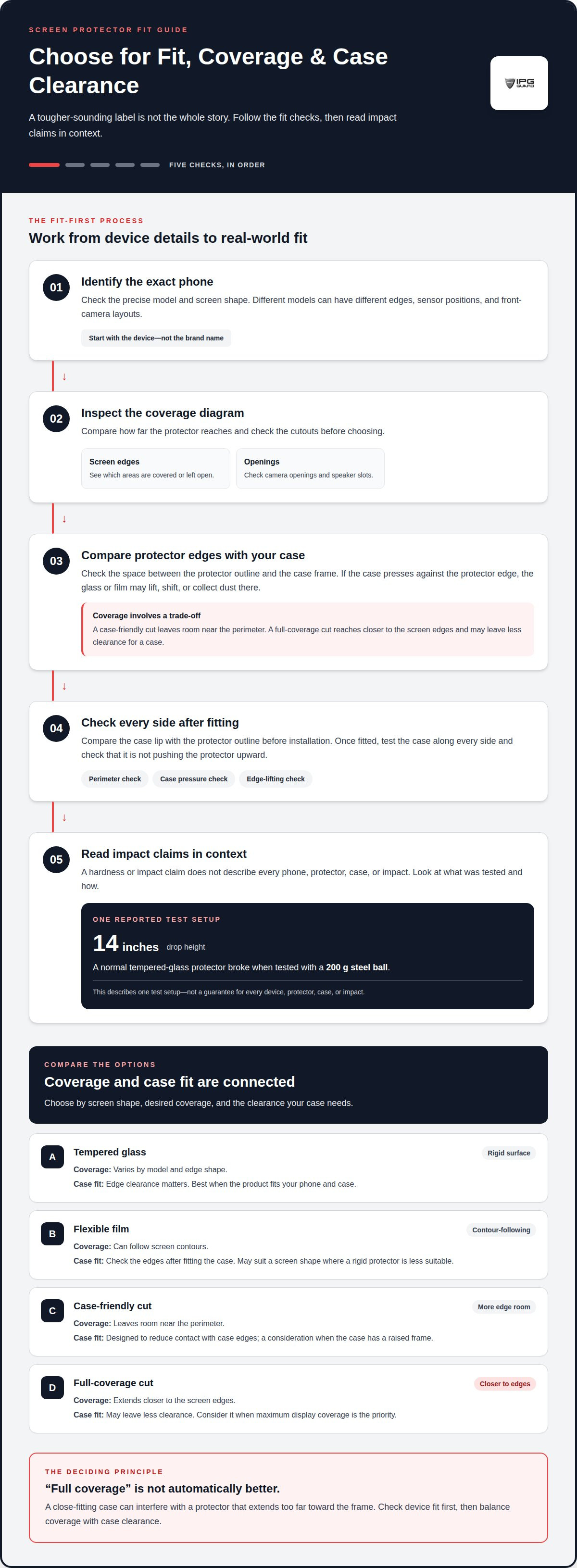
Case compatibility depends on the space between the protector and the case frame. If the case presses against the protector’s edge, the film or glass may lift, shift, or collect dust there. Before installation, compare the case lip with the protector’s outline. After fitting, check around the perimeter to make sure the case isn’t pushing the protector upward.
| Protector option | Screen coverage | Case compatibility | Best fit when |
|---|---|---|---|
| Tempered glass | Varies by model and edge shape | Edge clearance matters | You want a rigid surface and the product fits your phone and case |
| Flexible film | Can follow screen contours | Check edges after fitting the case | Your screen shape makes a rigid protector less suitable |
| Case-friendly cut | Leaves room near the perimeter | Designed to reduce contact with case edges | Your case has a raised frame around the display |
| Full-coverage cut | Extends closer to the screen edges | May leave less clearance for a case | Maximum display coverage is your priority |
Use this fit check before buying: identify your phone’s exact model, inspect the protector’s coverage diagram, and compare its edges with your case. After installation, test the case along every side. “Full coverage” isn’t automatically better: a close-fitting case may interfere with a protector that extends too far toward the frame.
A drop test also needs context. In the reported test, a 200 g steel ball was used, and a normal tempered-glass protector broke at 14 inches. That result describes one test setup, not a guarantee for every phone, protector, case, or impact. Choose by device fit first, then weigh coverage against the clearance your case needs.
How do ZAGG InvisibleShield alternatives compare in price?
There’s no single price comparison that applies to every screen protector. The total depends on the material, phone model, package contents, and whether installation is included. A single tempered-glass protector and a multi-piece kit aren’t equivalent, even if both fit the same iPhone. Compare what’s included, not just the product label or shelf position.
Start with the same device model, such as a specific iPhone or Samsung Galaxy, then compare protectors made for that exact phone. One model-specific package may include only a screen protector, while another may bundle camera protection or an installation tool. Those extras add value only if you need them. Don’t pay for components that won’t protect a surface you intend to cover.
- Material: Compare tempered glass with flexible film as separate options. Their construction and intended fit differ, so a lower listed price alone doesn’t make one equivalent to the other.
- Package contents: Check whether the box includes one protector, multiple protectors, an alignment frame, or cleaning supplies. Count usable pieces, not accessories you may leave unused.
- Coverage: Compare the covered area and cutouts for the same phone. A screen-only protector and a package with camera coverage protect different surfaces.
- Replacement terms: Read the conditions attached to any replacement program. A program’s restrictions can change its practical value, even when the initial purchase looks attractive.
For example, imagine two protectors for the same Samsung phone. One package contains a single glass screen layer; another includes extra installation items. If you already have suitable cleaning supplies, the add-ons may not improve the second package’s value. If alignment is a concern, those same items may matter more than a small difference in listed price.
Separate the initial purchase from the cost of replacing a damaged protector. Some brands offer replacement coverage or multi-piece packs, but terms and quantities vary. Read the current product description for the exact package, applicable conditions, and any replacement charges. Don’t assume every model includes a warranty, replacement benefit, or installation service.
For a fair comparison, note the device, material, number of protectors, included tools, coverage area, and replacement terms. Compare products that match on those points. This gives you a clearer view of the value offered by ZAGG InvisibleShield alternatives, without relying on a headline price or treating unlike packages as equal.
Which brands make the best tempered-glass screen protectors for iPhone and Android?
No single brand is best for every iPhone or Android phone. The right choice is made for your exact model, fits its display, and has features that match your priorities. ZAGG InvisibleShield is one familiar option, while IPG offers iPhone and Samsung screen protectors. Compare the brands by device fit and product details, not reputation alone.
For iPhone owners, start with the precise model name. Apple changes screen dimensions, camera placement, and sensor layouts across models, so a protector intended for another iPhone may not align correctly. IPG’s iPhone screen protector is a brand-specific option to consider. Review its model compatibility and coverage before comparing it with an InvisibleShield protector or another alternative.
Android buyers need the same model-specific approach. “Android” includes devices from different manufacturers with varied screen shapes, camera cutouts, and edge contours. Samsung Galaxy models, for example, aren’t interchangeable. IPG offers Samsung screen protectors, giving you another brand to compare for a compatible Samsung device. Match the exact model before judging value or fit.
Use these checks to compare a brand’s tempered-glass option without relying on broad claims:
- Device match: Confirm the full phone model, not only “iPhone” or “Samsung.”
- Glass description: Check that the product is explicitly identified as tempered glass. A brand may offer different materials across its range.
- Display cut: Inspect the edges, speaker opening, and front-camera area shown for your model.
- Installation support: Compare the included alignment method and instructions. These can affect how accurately the glass sits.
- Package terms: Read the listed contents and replacement conditions for that specific product.
A brand name alone can’t establish scratch resistance, impact performance, or case fit. Treat claims such as “hard,” “ultra-clear,” or “edge-to-edge” as prompts to inspect the product description. The impact test previously described used a 200 g steel ball, and a normal tempered-glass protector broke at 14 inches. That test result doesn’t establish that every protector from one brand performs identically.
For a practical shortlist, compare ZAGG InvisibleShield and IPG using the same checklist. Include another brand only when its exact model-specific specifications are available. Choose the product whose material, coverage, and installation details suit your phone, rather than assuming one brand leads across every iPhone and Android model.
Which screen protectors offer the best clarity, touch sensitivity, and fingerprint resistance?
The right choice depends on which screen experience matters most. A clear protector should preserve the display’s appearance, respond reliably to taps, and resist visible fingerprints. These are separate qualities: a claim of “high clarity” doesn’t establish smooth touch response or an easy-to-clean surface. Compare each feature for your specific iPhone or Android model.
For clarity, look for a transparent screen protector without a privacy filter or visibly tinted finish. Privacy protectors intentionally limit viewing angles, changing how the screen looks from the side. If color and brightness matter, check product images and descriptions for claims about transparency, glare, or light filtering. Compare the same image on your uncovered phone and through the installed protector at consistent screen brightness.
Touch sensitivity depends on the protector, the phone’s screen, and the fit. Uneven placement or trapped debris can make taps feel inconsistent. After installation, test the whole display: open the keyboard, type near the edges, scroll through a page, and pinch to zoom on a photo. If your phone has an under-display fingerprint reader, test unlocking with the protector installed and follow the phone maker’s setup instructions if needed.
Fingerprint resistance usually refers to a surface treatment that helps reduce visible oil marks or makes them easier to wipe away. It doesn’t mean fingerprints never appear. Look for an explicit fingerprint-resistant or oleophobic-coating claim in the product description. Then check in practice: view the screen under bright light, touch it normally, and wipe it with a clean microfiber cloth. How easily marks come off can matter as much as how quickly they appear.
- For natural display appearance: Choose a clear protector without a privacy layer, then assess colors and glare on your phone.
- For responsive operation: Check typing, edge taps, scrolling, and gestures after installation.
- For cleaner-looking glass: Look for a stated oil-resistant surface treatment and assess how easily marks wipe away.
- For fingerprint unlocking: Test the feature on your exact phone after applying the protector.
Apply the same checks when comparing ZAGG InvisibleShield alternatives. Brand claims can narrow the options, but your phone’s display and daily habits determine the right balance. Clear glass may suit someone who prioritizes screen appearance; a privacy finish serves a different need. If you often use your phone outdoors, glare may stand out. If you type frequently, edge response may matter more. Start with the feature you notice most, then verify the others in the product details and through normal use.
Are there good alternatives to ZAGG with a lifetime warranty or replacement program
Warranty wording can make two screen protectors seem more alike than they are. “Lifetime” may apply only for the product’s usable life, and a replacement program may require specific steps. Compare the written terms for each phone model before treating either benefit as a reason to buy. A long warranty label alone doesn’t explain what happens after damage.
Distinguish a product warranty from a replacement program. A warranty covers issues defined in its terms; a replacement program explains how an eligible buyer can obtain another protector. Details matter: a program may set conditions for proof of purchase, replacement requests, or the damaged item’s condition. Read those requirements before choosing an alternative.
Use this checklist for each brand you’re considering, including ZAGG InvisibleShield:
- Coverage: Identify the events or product issues included, and note exclusions.
- Duration: Find when coverage starts and how the terms define “lifetime,” if used.
- Replacement process: Check what documentation and steps a claim requires.
- Additional charges: Look for shipping, handling, or replacement fees in the terms.
- Device eligibility: Confirm the exact phone model and protector are covered.
For example, if your protector cracks after an impact, don’t assume a lifetime warranty covers replacement. The policy may address a product defect instead or treat accidental damage separately. Similarly, “replacement program” doesn’t automatically mean unlimited replacements. The actual terms determine whether the benefit suits how you use your iPhone or Android phone.
Compare the full policy alongside the product’s material, screen coverage, and case fit. A warranty can add value when its terms address the risk you care about. It matters less if exclusions rule out the damage you want covered or the claim process doesn’t suit your needs. Keep the policy with your purchase record so you can find the applicable conditions later.
For a fair comparison, note each brand’s coverage, duration, exclusions, claim requirements, and extra charges. Weigh those terms against the protector itself. Don’t rank alternatives by “lifetime” alone: a clearly explained, limited program can be more useful than a broad-sounding promise with narrow conditions. Choose a policy that matches your expectations, not just its headline.
If you’re choosing screen protection for an iPhone or Samsung device, explore screen protector options alongside the warranty terms. Compare the product fit and protection needs separately from any replacement benefit.
My IPG: IPG Phone camera lens protector
My IPG’s IPG Phone camera lens protector is an option if you want to protect your phone’s camera lenses as well as its display. For screen coverage, compare the IPG iPhone screen protector or IPG Samsung screen protector with the device-specific options you’re considering. The IPG Camera Lens Protector for iPhone Samsung Tempered glass is another camera-protection option.
Choose based on the surface you want to protect: the display, camera lenses, or both. Match the protector to your phone and consider how it fits with your preferred case. My IPG’s products offer a natural next step after you compare screen coverage and materials. Visit My IPG to explore phone protection options.
Choose protection that fits your next step
You don’t have to settle every screen-protection question at once. Start with the device you rely on most, then decide which surface needs attention first. This makes it easier to compare ZAGG InvisibleShield alternatives without letting broad claims distract you from your priorities.
For your phone, consider whether to protect the display, the camera lenses, or both. My IPG offers phone camera lens, iPhone screen, and Samsung screen protectors. Start by matching the option to your device and the protection you want.
If you’re ready to explore a device-specific option, contact My IPG for help. Take the next step toward protecting the phone you value.