
The "official" screen protector you purchased with your new device is likely the weakest link in your tech setup. Most big brands prioritize high margins over high performance, leaving you with overpriced glass that chips at the first sign of impact. You deserve a higher standard of stewardship for your high-value electronics. Transitioning to specialty device screen protectors allows you to move beyond basic glass and embrace materials engineered for the specific contours of your hardware.
We understand the frustration of seeing a premium display marred by edge-lifting or a cracked lens. It's a common pain point; standard protectors often fail to cover curved edges or critical camera modules effectively. In this guide, you'll discover why precision-cut hydrogel and advanced films are outperforming traditional glass in 2026. We will explore how these specialized materials provide superior clarity, self-healing properties, and a seamless fit that covers every millimeter of your device. It's time to secure your tech with the meticulous care it requires.
Key Takeaways
- Stop paying for a brand name. Discover why manufacturer accessories often prioritize profit margins over actual material durability and coverage.
- Explore the self-healing power of hydrogel. These specialty device screen protectors absorb impact and eliminate the edge-chipping common with standard tempered glass.
- Protect what the big brands ignore. Learn how precision-cut films secure vulnerable camera lenses and curved displays on the latest 2026 hardware.
- Compare technical specifications. See how specialized materials dissipate force differently than rigid glass to preserve the integrity of your high-value electronics.
- Achieve a professional-grade fit. Discover how ZeroDust and ProActive technology lines provide tailored security for over 5,000 unique device models.
Why Look for Alternatives to Phone Manufacturer Screen Protectors?
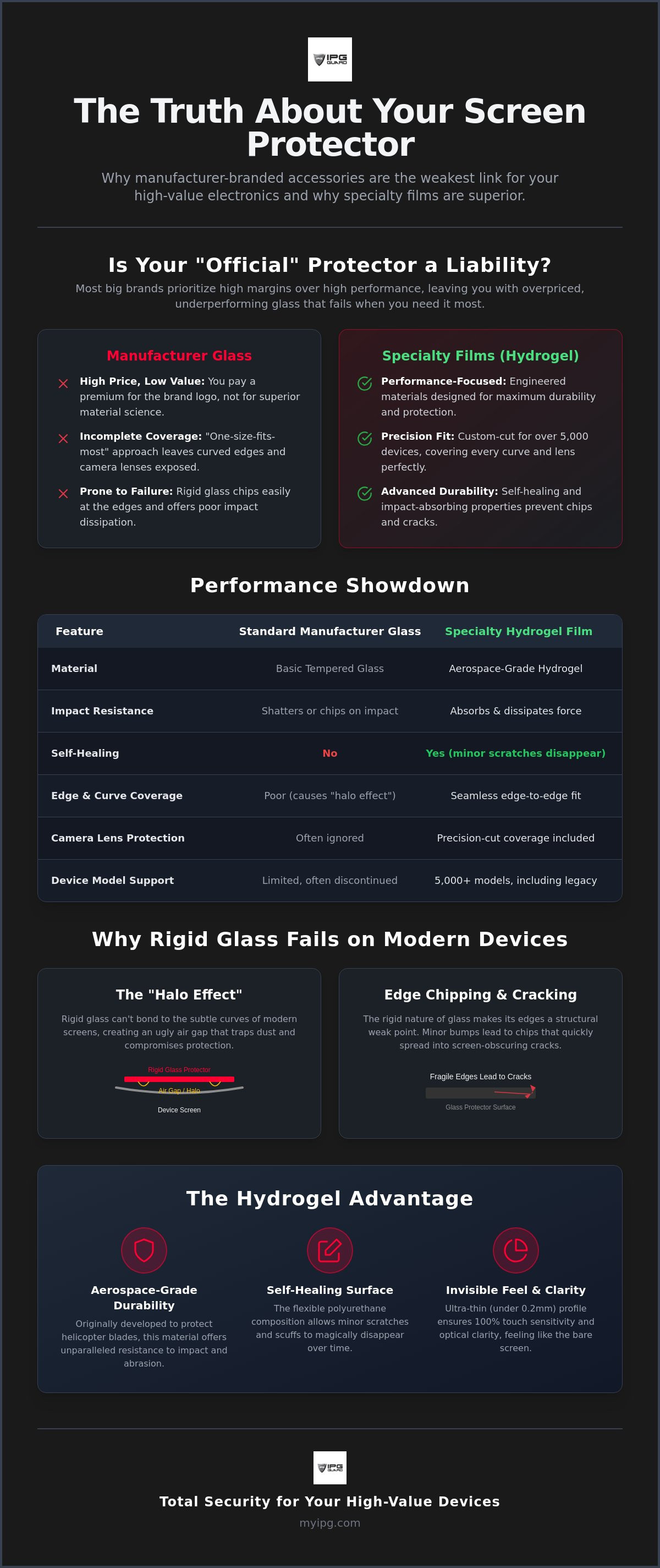
Buying an official screen protector feels like the safe choice. It isn't. You are paying for a logo, not elite material science. Phone manufacturers focus on hardware sales; accessories are high-margin afterthoughts. These "official" options are almost exclusively basic tempered glass. While the history of screen protectors shows a shift from simple plastic to glass, big brands have plateaued. They ignore the evolution of specialty device screen protectors that offer advanced impact dissipation and superior edge-to-edge security.
The markup on manufacturer accessories is significant. You pay a premium for a product that often ignores the most vulnerable parts of your device, like the protruding camera modules on the latest iPhone 17 or Samsung S26. Specialists provide targeted protection for these lenses. Most big brands leave them exposed. If you own a device more than two years old, your manufacturer has likely stopped stocking its specific accessories. Specialist providers maintain inventory for over 5,000 devices. We ensure your legacy tech remains guarded.
Mass production relies on "one-size-fits-most" templates. This approach fails on modern hardware. Manufacturers stick to rigid glass because it's easy to ship, even if it doesn't solve the real-world problems of edge-chipping or glare. Innovation lives with the specialists. By choosing specialty device screen protectors, you access aerospace-grade hydrogel and precision-cut films that big brands simply don't offer.
The Hidden Limitations of Official Brand Accessories
Official catalogs are surprisingly thin. You'll rarely find specialized finishes like matte anti-glare or high-security privacy filters in a manufacturer's store. They stick to standard glass to keep supply chains simple. Specialist providers offer a broader spectrum of materials. These include self-healing hydrogel and specialized automotive shields. These alternatives reflect a genuine commitment to the long-term health of your high-value items.
Structural Failures: The Halo Effect and Edge Lifting
Modern displays aren't flat. Subtle 2.5D curves on 2026 flagship models present a challenge for rigid manufacturer glass. This mismatch creates the "halo effect," a visible air gap around the perimeter where the protector fails to bond. It looks unprofessional. It's also a structural hazard. These gaps invite dust and grit to accumulate. Over time, trapped debris acts as an abrasive. It scratches the very screen you intended to protect. Flexible specialty films wrap around these contours for a seamless, hermetic seal.
Specialized Protective Films: The Rise of Hydrogel Technology
Hydrogel is a chemically enhanced, polyurethane-based material engineered for high-impact environments. Unlike traditional rigid shields, it acts as a flexible energy buffer. It doesn't just sit on your screen; it bonds with it. This material represents the pinnacle of specialty device screen protectors in 2026. While big brands focus on mass-produced glass, hydrogel offers a level of stewardship over your device that rigid materials cannot match. It prioritizes the preservation of the original display's integrity through superior energy dissipation.
The My IPG Original (Hydrogel) Screen Protector utilizes aerospace-grade durability originally developed to protect helicopter rotor blades from abrasive desert sand. Bringing this technology to consumer electronics ensures your hardware survives more than just a light scratch. Impact testing of screen protectors indicates that flexible TPU-based materials can effectively distribute force across a wider surface area. This reduces the localized stress that typically shatters glass displays. It's a technical solution for a high-value investment.
Maintaining the original look and feel of your device is critical. Hydrogel's ultra-thin profile, often under 0.2mm, ensures that touch sensitivity and optical clarity remain uncompromised. It's nearly invisible. It provides a seamless user experience that feels like the bare screen while offering a professional layer of security. Securing your hardware with an My IPG Original (Hydrogel) Screen Protector ensures your display remains pristine regardless of daily wear.
Hydrogel vs. Traditional Plastic Film
Old-school PET plastic films are prone to yellowing and peeling. Modern 2026 hydrogel is a different class of material. It uses a wet-install process for total precision. This method eliminates the air pockets and dust traps common with dry-apply films. Hydrogel also offers a subtle, high-friction grip. It feels secure in the hand. It reduces the likelihood of the device slipping from your grasp, providing a secondary layer of drop prevention through improved tactile feedback.
Self-Healing Science: How It Works
The secret lies in the molecular memory of the polyurethane. When the surface is compromised, the molecules don't just break; they displace. Applying mild thermal energy stimulates the material's internal memory, causing the polyurethane layers to expand and bridge the physical void left by a surface scratch. This makes minor abrasions from keys or coins disappear within hours. It's a reliable, self-maintaining shield that keeps your screen looking new without requiring constant replacements.
Performance Comparison: Specialized Alternatives vs. Manufacturer Glass
Rigid manufacturer glass relies on surface hardness alone. While it scores high on the Mohs scale, typically a level 6 or 7, it lacks structural flexibility. When a device falls, that rigidity becomes a liability. The force travels directly through the glass, often causing it to shatter or transfer the vibration to the delicate internal display. Transitioning to specialty device screen protectors made from advanced thermoplastic polyurethane (TPU) or hydrogel changes this dynamic. These materials prioritize energy absorption over simple hardness.
Academic research on screen protector impact resistance confirms that flexible materials can effectively dissipate kinetic energy across a larger surface area. This prevents the concentrated stress points that lead to screen failure. While tempered glass might resist a scratch from a coin better than a film, the film will survive a drop that would leave a manufacturer's glass protector in pieces. For users seeking long-term stewardship of their tech, longevity is found in resilience, not just hardness.
Touch sensitivity remains a primary concern for modern flagship users. Rigid glass can interfere with ultrasonic fingerprint sensors, requiring higher pressure or causing frequent read errors. Specialized films maintain a thinner profile that preserves haptic feedback and biometric accuracy. They ensure your 2026 device functions exactly as the engineers intended, providing security without compromising the user interface.
Clarity and Optical Integrity
Achieving perfect transparency is a technical challenge. Many cheap alternatives suffer from the "rainbow effect" or light refraction issues that distort colors. You can evaluate light transmission rates and material properties in the ultimate screen protector guide. Modern 2026 protective films utilize advanced anti-yellowing technology. These UV-resistant layers ensure your display stays crystal clear for the duration of the product's life cycle, preventing the murky discoloration seen in older plastic shields.
The Shatter Factor: Safety Considerations
Shattered glass is a physical hazard. When a standard manufacturer protector cracks, it creates microscopic shards that can cut fingers or lodge in your pocket. This is a critical consideration for households with children. specialty device screen protectors designed with non-shattering materials offer a safer alternative. If a severe impact occurs, these specialized films hold the original glass together. They prevent pieces from falling out and maintain the device's structural integrity until a professional repair at iPhone Kliniek is possible.
Niche Protection: Lenses, Watches, and Wearables
Your phone manufacturer leaves the most vulnerable component of your device completely exposed. While flagships like the iPhone 17 and Samsung Galaxy series feature advanced optics, the primary brand rarely provides a dedicated shield for the camera module. This is a critical oversight. A single micro-scratch on a lens cover can ruin every photo you take. Utilizing specialty device screen protectors specifically for optics ensures your hardware remains professional-grade. We provide tailored security for these high-value components that big brands simply ignore.
The need for protection extends beyond the pocket. Wearables and professional diagnostic tools face extreme environments. Whether it is a Garmin DESCENT on a dive or a Snap-on diagnostic tool in a busy shop, these displays require more than standard glass. They need materials that handle curved edges, UV exposure, and chemical contact. Our precision-cut shields for Autel and Snap-on systems provide a level of stewardship that mass-market accessories cannot provide. Protect your professional investments with an IPG industrial-grade screen protector today.
Preserving Photo Quality with Dedicated Lens Shields
Even sapphire lens covers are susceptible to micro-scratches from sand and grit. These tiny defects cause light to scatter, leading to hazy images and reduced contrast. IPG Phone camera lens protectors are engineered to maintain 99.9% optical transparency. This precision ensures your 2026 flagship captures images exactly as intended. Our shields eliminate the flare and ghosting common with low-quality third-party glass. They offer a hermetic seal against dust while remaining nearly invisible to the sensor.
Rugged Protection for Smartwatches and Marine Gear
Smartwatches feature aggressive curves that cause standard protectors to lift and peel. An IPG universal round watch screen protector uses flexible film technology to wrap around these edges for total coverage. For marine electronics like the Lowrance Eagle or Garmin series, protection must include saltwater and UV resistance. Standard manufacturer options often fail under intense sun exposure, leading to adhesive breakdown and screen yellowing. Our specialty device screen protectors are tested for these harsh environments. They provide a secure, bubble-free fit that maintains touch sensitivity in wet conditions. Do not settle for a one-size-fits-all round protector that leaves your high-end watch vulnerable to edge impacts.
Choosing IPG: The Specialist Alternative for Total Security
Specialist protection isn't a mere accessory. It's a commitment to the longevity of your hardware. We provide precision-cut engineering for over 5,000 different devices, ensuring a tailored fit that mass-produced options cannot match. As a dedicated provider of specialty device screen protectors, IPG bridges the gap between basic coverage and total security. We understand that your high-value items require meticulous stewardship. Our global reach extends from consumer smartphones to complex industrial human-machine interfaces (HMIs), providing a consistent shield across every sector.
In the same way that a Gurum Pillow offers specialized ergonomic support for your physical well-being, these precision-engineered shields provide a foundation of security for your high-value electronics.
Our IPG Zerodust and ProActive lines represent the peak of 2026 shielding technology. These aren't generic films; they're engineered barriers. ProActive technology specifically targets high-use displays, like the 15.6 inch navigation screen in the BYD SEAL, while the Zerodust line ensures a pristine, contaminant-free bond. Installation is rapid and efficient. Our specialist kits outperform generic manufacturer boxes by including precision tools designed for a bubble-free finish. You don't have to settle for "close enough" when a perfect fit is available.
The IPG Guarantee: Reliability Beyond the Box
We act as guardians of your technology. Choosing a specialized retailer means receiving support from experts who understand material properties and device vulnerabilities. Large phone corporations prioritize hardware cycles; we prioritize device preservation. Identifying your specific model is the first step toward total security. If you're looking to secure a flagship device, consult our iphone screen protector buying guide to find the ultimate shield for your specific needs. We provide the technical authority you need to make an informed decision.
Total Device Coverage: More Than Just a Screen
Protection should be comprehensive. We integrate screen security with custom aesthetic and functional guards, such as IPG Tesla Model 3 door handle decals or Honda Center Cap Overlay Wheel Tire Decals. This holistic approach allows you to secure every vulnerable surface from a single, trusted source. Whether you're shielding a Harley Cluster Display or a Lowrance FishFinder, the standard remains the same: performance without compromise. Protect what you value. Choose specialist-grade shields for total peace of mind.
Secure Your Tech with Specialist Precision
The safety of your high-value electronics shouldn't depend on a generic accessory. Transitioning to specialty device screen protectors ensures every millimeter of your display and camera module remains guarded against the hazards of daily use. You've seen how aerospace-grade hydrogel outperforms standard tempered glass by absorbing energy rather than shattering. You also know that dedicated protection for your lenses and wearables is no longer optional; it's a necessity for maintaining professional-grade performance.
We take our role as your tech's guardian seriously. Our solutions are precision-cut for over 5,000 different devices. We utilize advanced materials designed to preserve clarity and touch sensitivity without compromise. Whether you're securing the latest flagship or a specialized industrial tool, we provide the technical expertise and reliability you deserve. Global shipping is available on all protective films. Professional-grade security is always within reach.
Find the perfect specialist shield for your device at My IPG and experience the difference that dedicated stewardship makes. Your technology is an investment. Protect it with confidence.
Frequently Asked Questions
Are third-party screen protectors as good as the ones from the phone manufacturer?
Specialist alternatives are frequently superior to manufacturer options because they utilize advanced material science that big brands overlook. While manufacturers focus on high-margin glass, specialists provide specialty device screen protectors made from aerospace-grade hydrogel. These materials offer better edge-to-edge coverage and impact dissipation. You get a product engineered for protection, not just profit. It is about choosing a dedicated guardian for your tech.
Will using a non-manufacturer screen protector void my phone warranty?
Using a third-party accessory will not void your manufacturer's warranty. Screen protectors are categorized as non-invasive external accessories. They don't alter the internal hardware or software of your device. Consumer protection laws ensure you have the right to choose the best stewardship for your hardware. You can apply a specialized shield without losing the coverage provided by your device's original manufacturer.
What is the difference between hydrogel and tempered glass screen protectors?
Tempered glass provides a rigid, sacrificial layer, while hydrogel offers a flexible, self-healing shield. Glass is excellent for resisting direct scratches from hard objects. Hydrogel is superior for modern curved displays and absorbing energy from drops. It maintains a slimmer profile. This makes it nearly invisible while providing a hermetic seal over the entire screen surface, including the difficult 2.5D edges.
Do I need a screen protector if my phone uses Gorilla Glass Armor?
Sacrificial protection remains essential even on devices equipped with Gorilla Glass Armor. While modern glass is increasingly durable, it isn't invincible. Microscopic sand particles and grit can still cause permanent surface scratches. Applying a dedicated shield ensures that these abrasions happen to a replaceable layer. It preserves the trade-in value and optical integrity of your high-value display for the long term.
How do I know if a screen protector is compatible with my fingerprint sensor?
Compatibility depends on the material's thickness and optical clarity. Most ultrasonic and optical fingerprint sensors require a thin profile to function accurately. Hydrogel and precision-cut films, typically under 0.2mm, allow for seamless biometric authentication. Thick, low-quality glass protectors often create air gaps. These gaps cause read errors and force you to apply excessive pressure to the screen, compromising the user experience.
Can I use a screen protector with a phone case from a different brand?
Most specialty device screen protectors are designed to be case-friendly. These protectors are cut with a precise margin of less than one millimeter from the edge. This prevents "lifting" when you install a rugged case. It ensures your device has 360-degree security. Always check that your chosen shield is labeled as case-friendly to ensure a seamless, professional fit with your existing protective setup.
How do I remove a screen protector without damaging the original screen?
Removing a shield is a safe, non-invasive process. Simply use a fingernail or a thin plastic card to gently lift one corner. Peel the material back slowly and steadily across the display. Modern adhesives don't leave a sticky residue on your display. If a small amount of adhesive remains, you can easily wipe it away with a microfiber cloth and a drop of isopropyl alcohol.
Do camera lens protectors affect the quality of my mobile photos?
High-quality lens protectors do not degrade your photographic output. Precision-engineered shields maintain 99.9% transparency. This ensures that light reaches the sensor exactly as intended. They prevent the micro-scratches that cause lens flare and ghosting. By guarding the optics, you actually preserve the long-term quality of your iPhone 17 or Samsung S26 camera module, ensuring every shot remains professional and clear.