
A single hairline scratch on your flagship lens can trigger a $549 repair bill or permanently blur your most precious memories. While repair professionals rely on wholesalers like deshgsm.com for high-quality replacement parts, the goal is always to prevent damage before it occurs. It's a high-stakes gamble every time you set your phone on a table or slide it into a pocket. You've likely asked the critical question: do camera lens protectors affect photo quality, or will adding extra glass just create annoying flare and ghosting? It's a valid concern for any photographer who refuses to compromise on clarity.
We understand that your device is a significant investment and a vital tool for your creative expression. You shouldn't have to choose between a vulnerable lens and degraded image sharpness. We promise to show you how the right optical-grade materials eliminate the trade-off between safety and performance. You can achieve total lens protection while maintaining the exact color accuracy and crisp detail you expect from your high-end hardware.
This guide breaks down the science of light transmission and refractive interference. We'll move past confusing marketing jargon to explain why precision-cut alumina silicate glass is the ultimate guardian for your technology. From mastering low-light shots without ghosting to ensuring a bubble-free fit, you're about to discover the 2026 truth about safeguarding your vision.
Key Takeaways
- Prioritize 99% light transmission to ensure your high-value sensors capture every detail without refractive interference. Sub-standard materials are the primary cause of image degradation.
- Identify the root causes of ghosting and lens flare in low-light photography. Eliminate distracting optical artifacts by choosing materials specifically designed for superior light filtration.
- Compare the structural benefits of optical-grade tempered glass against the seamless, self-healing coverage of the IPG Original (Hydrogel) Screen Protector. Match the material to your specific environmental hazards.
- Understand the technical reality of how do camera lens protectors affect photo quality by examining the impact of "Zero-Dust" installation and precision alignment. Safeguard your hardware without losing a single pixel of clarity.
- Leverage precision-cut engineering to maintain an unobstructed line of sight for all sensors. Trust in professional-grade stewardship to preserve the integrity of your iPhone or Samsung camera module.
The Science of Optics: How Light Passes Through a Protector
Every time you snap a photo, light travels through several layers of glass before hitting your sensor. Adding an extra layer raises a valid concern: do camera lens protectors affect photo quality by disrupting this path? To understand the answer, we must look at The Science of Optics and how light behaves when it encounters a secondary surface. High-end smartphone cameras are precision instruments. They require specialized shielding that respects the laws of physics. Protection should never come at the cost of your vision.
Understanding Light Transmission Rates
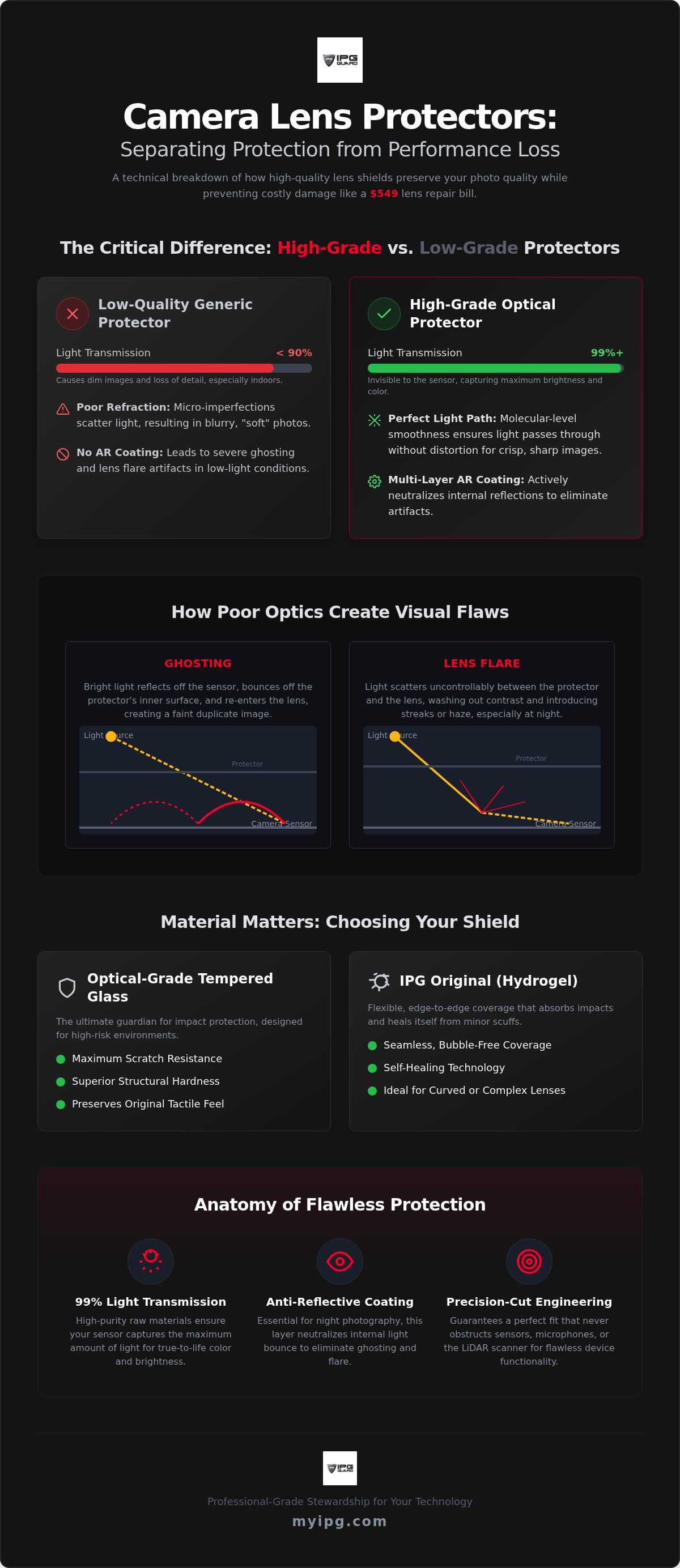
Standard tempered glass often blocks more light than you realize. Lower-quality materials can drop transmission rates below 90%, leading to darker images and lost detail. Professional-grade protection must maintain at least a 99% transmission rate to remain invisible to the sensor. Optical clarity is the ability for light to pass through a medium without scattering. When you use an IPG Phone camera lens protector, the light passes through without the diffusion seen in cheaper alternatives. We utilize high-purity raw materials to ensure your sensor receives the maximum amount of visual data.
- High-purity raw materials: Prevents color shifts and dimming.
- Molecular-level smoothness: Reduces light scattering at the entry point.
- Advanced light filtration: Optimizes the spectrum for the camera sensor.
The Impact of Refraction on Sharpness
Refraction occurs when light changes speed as it moves from air into glass. If the protector's surface has micro-imperfections, it bends the light at inconsistent angles. This creates "soft" images where edges look blurry. Modern phones use a sophisticated Image Signal Processor (ISP) to sharpen photos, but it can't fix data lost to poor refraction. High-end sensors demand high-end shielding. Poorly manufactured glass forces the ISP to work harder, often resulting in digital noise or artifacts. Precision-cut engineering ensures the surface is perfectly flat, maintaining the original path of light.
Anti-Reflective (AR) coatings are essential for preventing internal bounce. Without them, light reflects off the protector and back into the lens, causing ghosting. Thickness also plays a critical role. A protector that's too thick can shift the focal depth, confusing the autofocus system. We balance impact protection with focal precision. It's about maintaining a thin profile that absorbs shock without interfering with the camera's ability to lock onto a subject. It's not just a cover; it's a guardian for your technology.
Ghosting, Flare, and Blur: Identifying Low-Quality Protection
Visual artifacts like ghosting and flare aren't inevitable consequences of protection. They're symptoms of poor engineering. When users ask, do camera lens protectors affect photo quality, they're often reacting to the subpar performance of generic "one-size-fits-all" covers. These low-grade materials lack the essential coatings needed to manage light entry effectively. Your iPhone or Samsung camera is a precision instrument. It deserves better than generic shielding that compromises its output.
Ghosting occurs when bright light sources reflect off the sensor, bounce back off the protector, and return to the lens. This creates a "double" image of streetlights, the moon, or indoor lamps. Lens flare happens when light scatters between the two glass surfaces, washing out colors and reducing contrast. Quality matters here. A protector without the right optical properties turns a high-end camera into a budget sensor by introducing these avoidable distractions.
Why Lens Flare Happens at Night
Night-time cityscapes are the ultimate test for your gear. In low-light environments, every stray photon counts. Poor protectors act like a mirror, bouncing light internally rather than letting it pass through. Internal reflections are the enemy of clarity. Professional Anti-Reflective (AR) coatings neutralize this bounce at the molecular level. It's vital to distinguish between "artistic" flare, which is a design choice of the lens itself, and "protector" flare that creates a hazy, unappealing glow across your entire frame.
Focus and Sensor Alignment
Modern smartphones rely on more than just glass. They use LiDAR on iPhones and Phase Detection on Samsung devices to map distance and depth. If your protector's cutout is even half a millimeter off, it can block these invisible signals. A blocked LiDAR sensor means your phone can't calculate depth in the dark. This leads to hunting for focus and missed shots. Autofocus lag is often a physical obstruction issue, not a glass quality issue. Precision-cut engineering is the only way to ensure your sensors have a clear line of sight.
The "smudge factor" is another silent killer of sharpness. Without a high-grade oleophobic coating, finger oils cling to the protector. This creates a permanent haze that no software can fix. We treat every IPG Phone camera lens protector with specialized coatings to repel these oils. This ensures your high-value optics stay pristine even after a long day of use. Stewardship over your device means ensuring every pixel remains as sharp as the day you unboxed it.
Material Comparison: Tempered Glass vs. Hydrogel vs. Plastic
Choosing the right shield for your optics is an exercise in stewardship. Not all materials treat light with the same respect. When people ask, do camera lens protectors affect photo quality, the answer usually depends on whether they chose professional-grade tempered glass or a cheap plastic alternative. Understanding the physical properties of these materials helps you safeguard your device without compromising your art. We focus on providing options that maintain the exact color profile and sharpness of your unshielded lens.
Tempered Glass: The Pro Choice
Tempered glass remains the gold standard for high-stakes protection. Most premium options, like the IPG Camera Lens Protector for iPhone Samsung Tempered glass, feature a 9H hardness rating. This refers to the pencil hardness scale, meaning it resists scratches from common metal objects like keys or coins. The real benefit lies in its structural rigidity. It prevents the warping that often distorts images in lower-quality covers. For a deeper dive into these specifications, explore The Ultimate Guide to IPG Phone Camera Lens Protectors.
- 9H Hardness: Resists abrasive damage from grit and pocket debris.
- Optical Transparency: Engineered to mimic the refractive index of the original lens.
- Impact Absorption: Designed to sacrifice itself to save the expensive camera module.
Hydrogel and Film Alternatives
Some photographers prefer a lower profile. The IPG Original (Hydrogel) Screen Protector offers a unique alternative to rigid glass. Hydrogel is a flexible, "self-healing" polymer that absorbs minor scuffs and returns to its original state over time. It's significantly thinner than glass. This is the "invisible" factor many minimalist users crave. While glass offers superior impact resistance, hydrogel provides seamless edge-to-edge coverage that won't chip or crack. It's a specialized solution for those who want scratch protection without the added bulk of a glass layer.
Avoid plastic PET films at all costs. These are the primary culprits when do camera lens protectors affect photo quality becomes a complaint. Plastic is inherently soft. It scratches within days, creating a permanent haze over your sensor. It also yellows over time due to UV exposure, which ruins your color accuracy. High-end sensors require high-end shielding; settling for plastic is a disservice to your hardware. Stick to tempered glass for maximum clarity or hydrogel for a sleek, protective fit that respects the integrity of your device.
How to Ensure Zero Quality Loss: Installation and Maintenance
Hardware quality is only half the battle. Even the highest-grade optics fail if the application is compromised. When users ask, do camera lens protectors affect photo quality, the culprit is often a single trapped dust particle rather than the glass itself. A microscopic speck creates a physical air gap. This gap causes internal refraction, scattering light before it ever reaches the sensor. Stewardship over your device requires a "Zero-Dust" mandate. You must ensure a pristine, molecular bond between the protector and the lens to maintain original clarity.
The Perfect Installation Workflow
Achieving a bubble-free application is a methodical process. Start by creating a controlled environment. High humidity, such as in a bathroom after a shower, helps ground floating particulates. Use a specialized cleaning kit to remove oils and fingerprints. Alignment precision is non-negotiable. If the shield blocks even a fraction of the flash or LiDAR sensor, your phone's performance will degrade. For a comprehensive look at protecting all your high-value displays, consult The Ultimate Screen Protector Guide.
- Clean the lens with a dedicated lens cleaner or 70% isopropyl alcohol.
- Use a dust-removal sticker to lift stubborn fibers from the surface.
- Align the protector using the camera bump as a physical guide.
- Apply firm pressure from the center outward to secure the adhesive.
Long-Term Maintenance for Photographers
Consistent maintenance preserves the integrity of your shots. Your IPG Phone camera lens protector features a specialized oleophobic layer designed to repel finger oils and smudges. Harsh chemicals like window cleaners or abrasive soaps strip this coating over time. Use only dry microfiber cloths or slightly damp lens tissues for daily cleaning. Micro-scratches are inevitable over months of heavy use in pockets or bags. These tiny abrasions scatter light, causing a subtle loss in contrast and sharpness.
This physical wear is the primary reason why do camera lens protectors affect photo quality over time. It isn't the glass failing; it's the accumulation of surface damage. If you notice a persistent "haze" when shooting into direct sunlight, your protector has reached its end-of-life. Replacing a scratched shield is a minor task compared to the cost of a full camera module repair. Secure your hardware and your creative vision with a precision-cut IPG Phone camera lens protector to ensure your optics remain as sharp as the day you unboxed them.
IPG Camera Lens Protectors: Shielding Without Compromise
Choosing a protector is an act of trust. You've invested in world-class optics; your shielding must match that caliber. The common concern regarding whether do camera lens protectors affect photo quality is resolved through our commitment to precision-cut engineering and optical-grade materials. We don't believe in "good enough" for your high-value gear. We provide a professional-grade barrier that respects the physics of light and the integrity of your hardware. Protect your investment without sacrificing a single pixel of clarity.
Tailored Protection for Every Device
Universal, "slap-on" shields are a compromise that leads to sensor interference and light leakage. We reject that approach. Every IPG Phone camera lens protector is tailored to the specific micrometer of your device's camera module. Whether you use the latest iPhone or a flagship Samsung Galaxy, our protectors ensure a perfect alignment. This precision-cut fit prevents the air gaps and misalignments that cause ghosting or autofocus lag. It's a seamless extension of your phone, designed by specialists who understand the nuances of light filtration.
- Precision-cut engineering: Exact fits for iPhone and Samsung camera modules.
- Sensor-aware design: Zero interference with LiDAR, flash, or phase detection.
- Edge-to-edge security: Maximum coverage without the bulk of universal designs.
Why IPG is the Guardian of Your Gear
Our expertise extends beyond the pocket. IPG has a long history of protecting high-value technology in demanding environments. We provide specialized solutions ranging from automotive display shields to the IPG Camera Lens Protector for Harley Cluster Display protector. This industrial and automotive heritage informs every smartphone shield we create. We apply the same rigorous standards for durability and light transmission to your personal device that we use for high-end professional equipment. We aren't just selling a product; we're providing stewardship over the items you value most.
When you choose a guardian for your gear, the technical question of whether do camera lens protectors affect photo quality becomes a settled matter of excellence. Our materials are selected for their ability to maintain professional-grade transparency while absorbing the shocks of daily life. We blend technical authority with a personal commitment to your device's longevity. It's time to stop gambling with your optics and start shooting with confidence. Protect your lens. Preserve your memories. Ensure your vision remains as sharp as the day you unboxed it.
Protect Your Vision Without Compromising Your Art
The technical reality is clear: do camera lens protectors affect photo quality only when they are poorly engineered or incorrectly applied. By prioritizing 99% light transmission and optical-grade materials, you eliminate the risk of ghosting and flare. Precision-cut alignment remains essential for maintaining LiDAR and autofocus performance. Stewardship over your high-value optics means choosing a barrier that respects the laws of physics while providing total security.
IPG serves as the guardian of your technology; utilizing a specialized register for light filtration and durability. Our solutions are trusted by professionals for automotive and industrial shielding, bringing that same level of meticulous reliability to your smartphone. You don't have to choose between a vulnerable lens and a blurry shot. Secure your hardware and preserve your memories with a solution that feels like a natural extension of your device.
Secure Your Vision: Shop IPG Phone Camera Lens Protectors
Take the next step in safeguarding your creative tools. Your future captures deserve the clarity and protection that only professional-grade engineering can provide.
Answers to Your Critical Questions
Do camera lens protectors cause blurriness in photos?
Blurriness only occurs if you use low-quality materials or fail to maintain a clean surface. Sub-standard protectors scatter light before it reaches the sensor; which creates a soft; unfocused appearance. High-end options like the IPG Phone camera lens protector utilize optical-grade tempered glass to maintain a 99% transmission rate. This ensures your images remain sharp and clear. Most blur issues stem from trapped dust or oil smudges that accumulate on the protector surface.
Will a camera protector make my phone's flash look weird?
Flash "bleeding" is a symptom of poor alignment or lack of precision cutouts. This happens when light from the LED reflects off the protector's edge and enters the lens; creating a hazy or washed-out effect. We solve this through precision-cut engineering. Every shield features exact cutouts for the flash module to prevent internal light leakage. This design ensures your low-light photography remains crisp and color-accurate without any distracting optical artifacts.
How do I know if my lens protector is affecting my photo quality?
Check your images for unusual lens flare or "ghosting" when shooting toward bright light sources. If you see double images of streetlights or a persistent haze that wasn't present before; the protector is likely sub-standard. You can verify this by taking identical photos with and without the shield in a controlled environment. High-quality glass shouldn't change the refractive properties of your lens. Most quality issues stem from micro-scratches or poor light filtration.
Can I use a lens protector with a phone case?
Most modern protectors feature a slim profile designed specifically for compatibility with standard phone cases. You must ensure there is enough clearance around the camera bump so the case doesn't push against the protector's edges. This prevents lifting and the formation of air gaps. Our precision-cut designs account for these tight tolerances. If your case has a very restrictive integrated lens guard; a hydrogel option may provide a more seamless; low-profile fit.
Does the iPhone 17 Pro Max need a camera lens protector?
Protecting the iPhone 17 Pro Max is a matter of financial stewardship. As of 2026; replacing a flagship camera module can cost over $200; making prevention a logical priority. The protruding lens design makes it vulnerable to impact and surface scratches whenever you set the phone down. An IPG Phone camera lens protector acts as a sacrificial barrier. It absorbs the shock of a drop and prevents abrasive damage; ensuring your high-resolution sensors remain pristine.
What is the best material for a camera lens shield?
Optical-grade tempered glass is the gold standard for impact protection and clarity. It offers a 9H hardness rating to resist deep scratches and maintains the highest light transmission levels. For users seeking a thinner profile; hydrogel is an excellent alternative. Hydrogel provides edge-to-edge coverage and self-healing properties for minor scuffs. Avoid plastic PET films; they yellow quickly and are the primary reason people ask do camera lens protectors affect photo quality.
How do I remove a camera lens protector safely?
Remove the protector by gently lifting one corner with a thin plastic tool or a fingernail. Apply slow; steady pressure to break the adhesive bond without stressing the underlying lens. If the protector is shattered; use a piece of adhesive tape to keep the fragments together during removal. Clean any remaining residue with a 70% isopropyl alcohol wipe. Our protectors use high-quality adhesives that leave the surface pristine; allowing for a clean; safe transition.
Will a camera protector affect the LIDAR sensor on my phone?
A poorly aligned protector can interfere with LiDAR by blocking the infrared pulses used for depth mapping. This results in slow autofocus and poor portrait mode performance in low light. Precision-cut engineering is vital to keep these sensors unobstructed. We design our shields with exact openings for LiDAR and laser sensors. This ensures your phone's advanced spatial awareness and focusing capabilities remain fully functional while the surrounding glass stays shielded from damage.