
Your Garmin Descent's sapphire glass is tough, but it isn't bulletproof against a jagged tank valve or abrasive salt crystals at 30 meters. You've invested heavily in high-stakes dive tech. Your safety depends on that data. It's frustrating when salt, sand, or a simple gear bump threatens your display's integrity. The last thing you need during a decompression stop is a deep scratch or a salt-crusted smudge obscuring your vitals. Finding the right garmin descent screen protector is about more than just aesthetics; it's about maintaining a critical piece of mission-ready gear that must perform under pressure.
We understand that your watch is a significant investment and a vital tool for every descent. This guide shows you how to safeguard your device with precision-engineered films designed to survive the crushing pressure and corrosive environment of the deep. You'll discover the technical advantages of self-healing hydrogel over brittle tempered glass. We'll explain how to maintain crystal-clear visibility for your Mk1, Mk2, or the latest Mk3i models. We'll break down the material specifications and durability factors you need to ensure your device remains a reliable partner for every dive while preserving its long-term resale value.
Key Takeaways
- Understand the vital role of a sacrificial layer in shielding your sapphire display from abrasive salt crystals and jagged equipment.
- Discover why flexible hydrogel outperforms brittle tempered glass when subjected to extreme pressure changes and curved bezel designs.
- Identify the benefits of self-healing technology in a garmin descent screen protector to maintain a flawless finish after contact with dive gear.
- Ensure mission-critical visibility during decompression stops with HD clear films engineered for high-contrast legibility in low-light depths.
- Master the "Zero Dust" installation method to create a permanent, bubble-free seal that survives the rigors of saltwater immersion.
Why Your Garmin Descent Needs Dedicated Screen Protection
Your Garmin Descent is a high-value, mission-critical dive instrument. It's a $1,000+ investment in your safety and data. While the hardware is rugged, the display remains the most vulnerable point of failure in the marine environment. Every time you gear up, your watch face faces a gauntlet of threats. Jagged tank valves, abrasive salt crystals, and fine silt can turn a pristine display into a scarred surface in a single afternoon. Applying a precision-cut garmin descent screen protector creates a vital sacrificial layer. This barrier absorbs the daily abuse of the dive deck so your factory glass doesn't have to. Beyond mere aesthetics, this protection preserves the long-term resale value of your device. It ensures that when you're ready to upgrade to the next generation of dive tech, your current unit remains in mint condition.
While protecting your wearable tech is vital for the dive, ensuring your vessel's critical systems are monitored is equally important for any boat owner; inTouch R&B specializes in remote alert systems for bilge pumps and HVAC units to keep your entire setup secure.
The role of a screen protector in diving is unique. It must withstand extreme pressure cycles and constant saltwater immersion without peeling. Standard covers often fail under these conditions. You need a specialized shield designed for the high-stakes world of scuba and free diving. It's about maintaining the integrity of your primary data source when it matters most.
The Sapphire Myth: Why "Scratch-Resistant" Isn’t Enough
Many divers believe sapphire glass is invincible. This is a dangerous misconception. Sapphire is incredibly hard, sitting at a 9 on the Mohs scale, but hardness often comes with brittleness. While it resists scratches from most metals, it's prone to shattering or chipping upon high-velocity impact. A sharp knock against a steel ladder or a heavy lead weight can cause catastrophic failure. Furthermore, fine sand and silt are persistent enemies. These particles often contain minerals hard enough to mar even high-end watch faces over time. A factory screen repair is a costly, time-consuming process that leaves you without your computer for weeks. A dedicated protector is a low-cost insurance policy against these expensive accidents. It adds impact-dampening properties that sapphire alone lacks.
Preserving Visibility in the Marine Environment
Visibility is a safety feature. During a decompression stop or a low-light wreck penetration, you cannot afford a blurred display. Saltwater leaves behind crusty deposits as it dries, which can obscure critical depth and time data. A high-quality garmin descent screen protector features an advanced oleophobic coating. This surface tech repels skin oils, sunscreen, and salt residue. It ensures that water beads off instantly, leaving you with a crystal-clear view of your vitals. Maintaining this clarity is essential for rapid data recognition underwater. A smooth, clean surface also reduces glare from dive lights or the sun, ensuring your high-contrast display remains vivid and legible at every depth. Don't let a smudge or a salt streak compromise your situational awareness.
Hydrogel vs. Tempered Glass: Choosing the Right Shield for the Deep
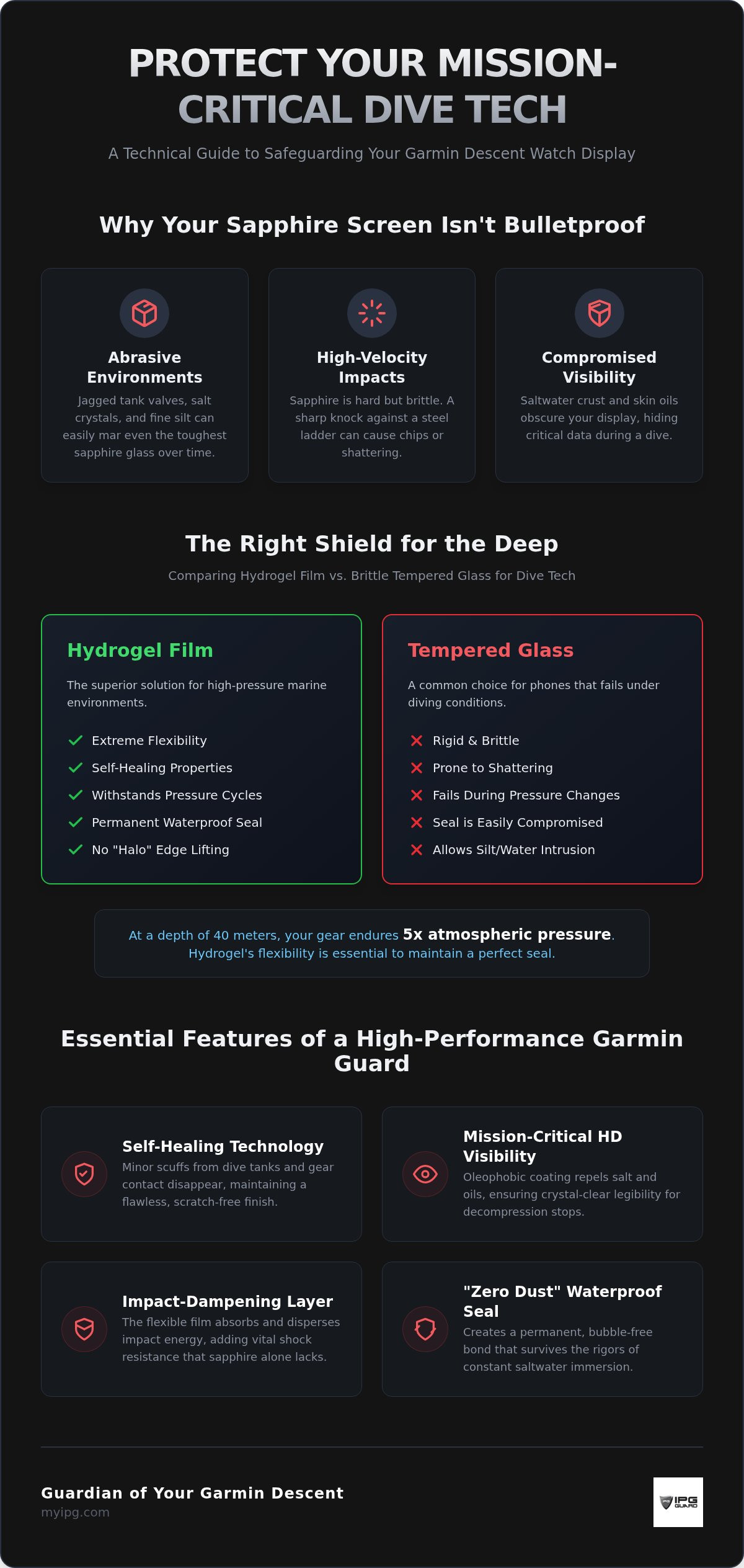
Selecting the right material for your garmin descent screen protector is a decision that impacts both gear longevity and underwater safety. While tempered glass is the standard for smartphone protection, it often fails in high-pressure marine environments. Diving involves extreme pressure cycles. At a depth of 40 meters, your equipment sustains five times the atmospheric pressure found at the surface. Rigid tempered glass cannot flex with the micro-expansions of your watch case during these transitions. This rigidity leads to "halo" lifting, where the edges of the protector detach, allowing corrosive saltwater and abrasive silt to seep underneath. Once the seal is compromised, the protector becomes a liability rather than an asset.
Hydrogel offers a superior solution for specialized dive tech. These flexible, high-performance specialized polymer films create a molecular bond with the watch face. They move with the device, maintaining a permanent waterproof seal regardless of depth or temperature shifts. This elasticity ensures that the protector stays flush against the bezel, preventing snags on wetsuit sleeves or BCD straps. If you want a solution that won't fail when the pressure rises, consider the IPG Original (Hydrogel) Screen Protector for its proven durability in extreme conditions.
The Benefits of Hydrogel for Wearable Dive Tech
Hydrogel is a "smart" material. It features advanced self-healing properties that allow minor scuffs from dive tanks or rocky overheads to vanish within 24 to 48 hours. The polymer chains physically move to fill in indentations, keeping your display smooth and clear. Because it's precision-cut from thin, pliable sheets, it provides true edge-to-edge coverage. This is vital for Mk3i users who rely on full touch sensitivity for surface navigation and menu toggling. The film is so thin it remains virtually invisible, ensuring that your high-resolution AMOLED or MIP display retains its factory-intended HD clarity without adding unnecessary bulk to your streamlined dive kit.
Why Tempered Glass Often Fails Divers
Tempered glass presents a significant shatter risk on a crowded dive boat. A single drop onto a steel deck can turn your garmin descent screen protector into a mosaic of sharp shards. These fragments are difficult to clear in a marine environment and can cause injury to your hands or damage to your exposure suit. Furthermore, glass is prone to chipping at the edges. These small chips create catch points that snag on gear, eventually leading to full adhesive failure. The added thickness of glass also increases the watch's profile, making it more likely to strike objects during a wreck penetration or while navigating tight swim-throughs. For professional-grade dive computers, the safety and flexibility of film outweigh the brittle hardness of glass.
Essential Features of a High-Performance Garmin Guard
A high-performance garmin descent screen protector must be more than a simple barrier. It acts as an optical extension of your device. Standard "universal" round protectors often leave gaps or use inferior adhesives that cloud over time. For dive computers, precision fitment is non-negotiable. A custom-cut shield for your Mk1, Mk2, or Mk3i ensures that the entire display area is sealed from the edge of the bezel to the center. This prevents salt crystals from lodging in the perimeter. It also ensures that the protector doesn't snag on gear during high-activity wreck penetrations or cave dives. Look for features that enhance, rather than hinder, your interaction with the device.
- HD Clarity: Maintains the vividness of high-resolution displays in murky or low-light underwater environments.
- Anti-Glare Coatings: Reduces surface reflections on the boat and light bounce-back at depth.
- Impact Absorption: Distributes the force of a direct hit to prevent factory glass failure.
Self-Healing and Smoothness: The IPG Advantage
The specialized polymer chains in the IPG Garmin DESCENT Screen Protector allow for a unique self-healing capability. When a sharp object like a dive tank valve scuffs the surface, the material physically returns to its original state. This chemical memory eliminates minor scratches within 24 to 48 hours. It keeps your display looking brand new after every trip. Beyond durability, the ProActive technology ensures a smooth-to-the-touch finish. This is critical for daily wearable use. It feels exactly like the original glass. It doesn't attract lint or fingerprints, maintaining a professional look from the office to the ocean floor.
Optical Performance and Light Filtration
Deep-water readability depends on light transmission. High-quality protectors offer 99% light transmission to ensure your data pops even in dark conditions. This is vital for maintaining the integrity of Garmin’s high-resolution AMOLED displays. Inferior films can cause a "mirror effect" in bright tropical dive sites, making the screen impossible to read at certain angles. Advanced light filtration technology manages these reflections. It ensures your decompression limits and gas pressures remain visible regardless of the sun's position. This optical precision turns your screen protector into a safety-enhancing tool rather than just a plastic cover.
Installation Guide: Achieving a Bubble-Free Waterproof Seal
Installing a garmin descent screen protector requires more than a steady hand. It demands a surgical approach to cleanliness. A dive computer faces intense pressure cycles that will exploit any weakness in the adhesive seal. If a single dust particle or oil smudge remains on the glass, saltwater will eventually find its way underneath. This leads to the "halo" lifting effect. Follow this technical framework to ensure a permanent, waterproof bond that survives every descent. Protecting your tech starts with a perfect application.
- Step 1: Deep Clean. Use 70% isopropyl alcohol. It strips away factory lubricants, skin oils, and microscopic salt crystals. Wipe in a single direction to avoid redepositing contaminants.
- Step 2: "Zero Dust" Environment. Run a hot shower in a small bathroom until the air is humid. This "steam room" trick grounds airborne lint and dust particles.
- Step 3: Precision Alignment. Align the edge of the film with the inner bezel of your Descent Mk1, Mk2, or Mk3i. These films are cut to micron-level tolerances for edge-to-edge coverage.
- Step 4: Squeegee Technique. Use firm, overlapping strokes from the center outward. This forces out air and sets the molecular bond between the film and the glass.
- Step 5: Curing Phase. Wait at least 24 hours before your next dive. The adhesive needs time to reach full strength before facing the crushing pressure of the deep.
Preparation: The Key to Long-Term Adhesion
A lint-free environment is the foundation of a successful hydrogel application.
Strip the factory oils thoroughly. Use a high-quality microfiber cloth. Avoid paper towels as they shed microscopic fibers. This preparation ensures the film adheres perfectly to the sapphire surface. A clean start prevents edge peeling during rapid depth changes. Secure your gear with the IPG Garmin DESCENT Screen Protector to ensure a professional, long-lasting finish that won't fail under pressure.
Troubleshooting Common Application Issues
Stray hairs or dust specks are common hurdles. If you spot one mid-install, use a piece of adhesive tape to gently lift the film and "pluck" the debris. Do not use your fingernails. This preserves the integrity of the adhesive layer. If you see micro-bubbles after the squeegee phase, don't panic. These typically disappear within 24 to 48 hours as the hydrogel settles and the air escapes through the polymer structure. For edge lifting on curved models like the Descent Mk2, ensure the bezel was perfectly dry and free of salt residue before application. Persistence in the prep phase leads to a flawless result.
The IPG Specialization: Guardian of Your Garmin Descent
IPG isn't a generalist. We are dedicated specialists. We protect precision instruments with a sense of stewardship. From high-performance automotive displays to mission-critical dive computers, our films provide a professional-grade defense. We understand the emotional and financial value of your gear. Our commitment to being the "Guardian of Technology" means we don't settle for "good enough." We use advanced material science to ensure your garmin descent screen protector performs in the most hostile environments on Earth. Whether you're exploring the Great Barrier Reef or the Red Sea, our global reach ensures your tech remains guarded. Our products are handled with care because we know what they mean to you.
Our manufacturing process utilizes rigorous technical specifications to ensure a perfect fit. We employ high-end cutting technology to match the exact dimensions of your watch face. This isn't a "one size fits most" approach. It is a tailored solution for a specific tool. We move quickly from identifying a hardware need to providing a finished solution. This efficiency mirrors the high-speed performance of the products themselves. You feel informed. You feel ready to act. We prioritize functional clarity and durability over everything else. This focus signals our deep expertise in this specialized niche. We are innovative partners in maintaining your personal devices.
Tailored Protection for Every Descent Model
We provide bespoke solutions for the entire Garmin lineup. This includes the latest Mk3i 43mm and 51mm variants. We also maintain legacy support for the original Descent Mk1. Our ProActive films allow us to stay ahead of release cycles. We ensure protection is available the moment you unbox your new device. Our precision-cut technology accounts for every bezel curve and sensor placement. It is a seamless fit that preserves the aesthetic and functional integrity of your watch. You don't have to worry about universal rounds that leave edges exposed. We provide the exact shield your specific model requires for maximum defense.
Beyond the Watch: A Complete Protection Ecosystem
Our expertise extends beyond your wrist. We provide comprehensive coverage for all your high-value displays. You can explore our broader philosophy in The Ultimate Screen Protector Guide. This resource details how we safeguard everything from smartphones to specialized marine electronics. For those who rely on surface tech for navigation and depth finding, we also offer specialized protection for Lowrance fishfinders. We are your partner in maintaining gear integrity across all environments. Don't leave your investment to chance. Secure your dive tech today with a garmin descent screen protector engineered for the deep. Trust the specialist guardian to keep your data clear and your display flawless.
Secure Your Mission-Critical Data for the Next Descent
Your Garmin Descent is more than a timepiece; it's a vital safety instrument. Throughout this guide, we've detailed why a precision-engineered barrier is essential for maintaining visibility and integrity at depth. By choosing a specialized garmin descent screen protector, you ensure that abrasive salt crystals and jagged equipment never reach your factory display. Flexible hydrogel technology outperforms brittle alternatives by moving with your device under extreme pressure, while self-healing properties keep your screen in mint condition dive after dive. It's about stewardship over your most valued gear and ensuring its long-term performance.
Don't let a single gear bump or abrasive silt particle compromise your situational awareness. Our films are precision-cut for Mk1, Mk2, and Mk3i models to provide a seamless, invisible defense. Trusted by divers worldwide, our self-healing hydrogel technology acts as the ultimate specialist guardian for your high-stakes tech. It's time to dive with total confidence in your equipment's durability. Protect Your Gear: Shop Garmin Descent Screen Protectors Now. Your next underwater adventure deserves the best protection available. Explore the deep with a display that remains as clear as the day you unboxed it.
Frequently Asked Questions
Does a screen protector affect the depth rating of my Garmin Descent?
A screen protector has no impact on your device's depth rating. It is a non-mechanical external layer that doesn't interfere with the watch's water-resistant seals or pressure-sensing hardware. Your Garmin Descent remains fully rated for its specified depth whether the protector is applied or not. It simply provides a defensive barrier for the sapphire or mineral glass surface against external physical trauma during your dive.
Will a hydrogel protector stay on in saltwater?
Hydrogel protectors are specifically engineered for high-moisture environments. Once the adhesive reaches full cure strength after 24 hours, it remains stable in both fresh and saltwater. The flexible nature of the film allows it to expand and contract during pressure changes without losing its bond. This makes a garmin descent screen protector significantly more reliable than rigid glass in maritime conditions where gear takes a beating.
Is it worth putting a protector on a sapphire crystal screen?
Even sapphire crystals benefit from a sacrificial layer. Sapphire is exceptionally scratch-resistant but remains brittle. A direct impact against a steel tank or a rocky overhead can cause it to chip or shatter. A protector absorbs the kinetic energy of these strikes, often preventing a catastrophic failure of the factory glass. It also guards against the micro-abrasions caused by fine silt and sand that can mar any surface over time.
Can I still use the touch screen on my Garmin Descent Mk3i with a protector?
Full touch sensitivity is preserved with high-quality film protectors. The ultra-thin polymer construction doesn't create a capacitive barrier, so your inputs on the Mk3i AMOLED display remain precise. Whether you're navigating surface maps or toggling dive settings, the response is instantaneous. You won't notice a difference in tactile feedback compared to the original factory glass surface, ensuring your mission-critical data stays accessible at all times.
How do I remove an old or damaged screen protector from my watch?
Removal is a straightforward process that requires no specialized tools. Gently lift an edge using a plastic card or your fingernail and peel the film back slowly. High-grade hydrogel is designed to release without leaving sticky residue on your sapphire display. If any minor adhesive traces remain, a quick wipe with a microfiber cloth and a drop of isopropyl alcohol will restore the factory finish without damaging the bezel or seals.
Does the screen protector interfere with charging or heart rate sensors?
Charging and sensor performance remain completely unaffected. Screen protectors are precision-cut to cover only the front display area. They don't wrap around the case or obstruct the rear-mounted heart rate sensors or the charging points. All health tracking metrics and power delivery functions continue to operate with factory-level accuracy and efficiency while your screen stays protected from the rigors of the dive deck and the deep.
What happens if I get bubbles under the film during installation?
Micro-bubbles are a common part of the installation process and usually resolve themselves. The polymer material is slightly porous, allowing trapped air to escape naturally over 24 to 48 hours. You don't need to peel the film off to fix them. If large bubbles persist, you can gently push them toward the nearest edge using a soft-tipped squeegee during the initial application phase to ensure a perfect, crystal-clear seal.
How often should I replace my Garmin Descent screen protector?
Replacement is only necessary if the protector sustains a deep gouge or begins to peel at the edges. Many divers find a single garmin descent screen protector lasts for months of regular use due to its self-healing properties. Minor scuffs from gear contact often vanish within a day. We recommend inspecting the seal after every dive trip to ensure the edges remain flush against the bezel for maximum defense during your next descent.