
Imagine standing on a high-speed production floor, racing to troubleshoot a critical fault, only to find your diagnostic screen completely blinded by overhead warehouse lighting. You squint against the glare while trying to navigate menus through a haze of oily fingerprints and tool-inflicted scratches. It's more than a nuisance; it's a direct threat to your operational uptime. Selecting a professional matte screen protector for industrial touchscreens is no longer just an accessory choice. It's a fundamental act of stewardship for the precision instruments that power your facility.
You already know that standard retail films can't survive the grit of a workshop or the chemical exposure of a modern factory. We agree that your HMI displays and diagnostic tools, from the Autel MaxiSYS MS919 to the Snap-on Apollo, are high-value assets that require specialized defense. This 2026 buying guide will show you how to eliminate blinding reflections and resist harsh contaminants while maintaining seamless touch response. You'll learn how to leverage advanced materials like our self-healing Original hydrogel to ensure crystal clear visibility and long-term display preservation for every critical interface in your inventory.
Key Takeaways
- Learn how a matte screen protector for industrial touchscreens uses advanced light diffusion to eliminate blinding reflections from overhead warehouse lighting.
- Compare the impact-absorbing benefits of IPG Original hydrogel against traditional glass, specifically for high-vibration and high-friction environments.
- Discover how precision-engineered, zero-gap fitment protects your Snap-on and Autel diagnostic tools from dust ingress and industrial contaminants.
- Understand the science of microscopic surface etching to maintain high-definition clarity without sacrificing touch precision or glove compatibility.
Why Industrial Displays Require Specialized Matte Protection
Industrial matte protection is a sophisticated multi-layer film designed to diffuse incident light while providing a high-friction resistance barrier. Unlike standard consumer films, a professional matte screen protector for industrial touchscreens is built for the rigors of the shop floor. It functions as a light-scattering antireflection layer, breaking up concentrated light beams before they reach the operator's eyes. This technology ensures that critical data remains legible regardless of the surrounding light intensity.
The "Glare Problem" is a constant reality in modern facilities. High-output LED and HID overhead lighting creates blinding white spots on standard glossy Human-Machine Interfaces (HMIs). These reflections don't just obscure data; they can lead to dangerous input errors. Specular reflection is the mirror-like reflection of light from a surface, which on a glossy HMI, turns your diagnostic display into a blinding source of visual interference.
Daily exposure to machine coolant, heavy grease, and abrasive dust further degrades these surfaces. Without a dedicated shield, these contaminants penetrate the screen's top layer, leading to erratic touch behavior. Investing in a premium protector for high-value diagnostic tools like an Autel MaxiSYS MS919 or a Snap-on Triton is a logical financial decision. It's the difference between a simple maintenance task and a total hardware replacement. You wouldn't operate a $5,000 tool without a case; you shouldn't operate its interface without a professional shield.
The Hidden Cost of Screen Degradation in Manufacturing
Microscopic grit trapped under a technician's glove acts like sandpaper. Over time, these micro-scratches accumulate, creating "dead zones" where touch sensors no longer respond. This degradation causes significant psychological fatigue. Operators shouldn't have to fight their equipment to read critical metrics. Protecting the surface ensures consistent touch responsiveness and prevents accidental inputs caused by surface smudges or oil buildup. Uptime is preserved when the hardware remains in peak condition.
Matte vs. Glossy: The Industrial Verdict
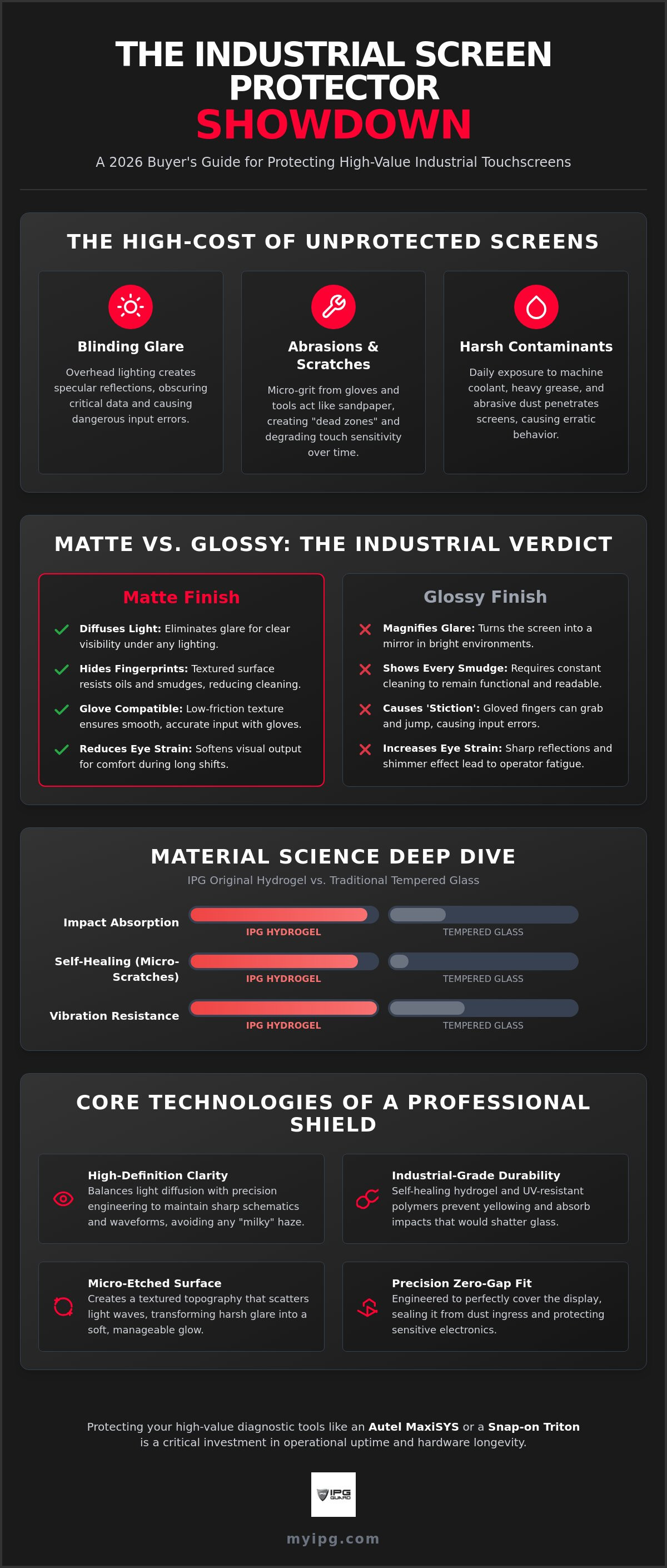
Glossy screens are designed for controlled, low-light environments. They fail immediately in bright bays or outdoor loading docks. A matte finish is the industry standard for 12-hour shifts. It reduces eye strain by softening the visual output and eliminating the "shimmer" effect common in high-intensity lighting. By choosing matte, you prioritize operator health and data accuracy over aesthetics.
- Matte: Diffuses light, hides fingerprints, and maintains tactile feedback even with gloves.
- Glossy: Magnifies glare, shows every smudge, and requires constant cleaning to remain functional.
The Science of Light Diffusion and Touch Precision
A professional matte screen protector for industrial touchscreens relies on microscopic surface etching to neutralize glare. This process creates a textured topography that scatters incoming light waves in multiple directions. Instead of a single, blinding reflection, the light is diffused into a soft, manageable glow. This precision engineering ensures that your HMI remains readable under high-intensity overhead LEDs or direct sunlight in the loading dock. It's a technical solution for a high-stakes environment.
High-definition clarity is often the first casualty of poor-quality films. Many generic options prioritize haze over visibility, resulting in a "milky" display that obscures fine details. A premium shield balances light diffusion with high-definition precision. It maintains the visual integrity required for reading complex electrical schematics or diagnostic waveforms on tools like the Autel MaxiSYS MS919. You don't have to choose between glare reduction and sharp data.
Tactile response is critical for operators wearing nitrile or heavy-duty gloves. Glossy surfaces often create "stiction," where the finger or glove grabs and jumps across the display. The matte texture provides a consistent, low-friction surface that ensures smooth swiping and accurate button presses. It transforms a frustrating interface into a reliable tool that responds exactly when you need it to. Accuracy on the shop floor is non-negotiable.
Industrial environments often feature high-UV exposure from specialized lamps or outdoor operations. Standard films degrade and yellow under these conditions, clouding the display and ruining the user experience. Our specialized materials incorporate UV-resistant polymers to preserve the original color temperature and clarity of your screen for years. A high-quality matte screen protector for industrial touchscreens defends your gear against every environmental threat.
Refractive Index and Pixel Clarity
Premium films are engineered to match the refractive index of the underlying glass. This alignment allows for 90%+ light transmission while eliminating up to 99% of specular glare. Lower-tier films often cause a "sparkle" or scintillation effect, where pixels appear to shimmer and distort. We eliminate this distraction by utilizing uniform, precision-etched patterns that respect the pixel pitch of modern industrial displays. You can explore our specialized diagnostic tool protectors to find the perfect fit for your hardware.
Oleophobic and Hydrophobic Coatings in the Shop
Modern manufacturing is a world of grease, oil, and machine coolants. We integrate oleophobic and hydrophobic layers directly into the matte structure. These chemically bonded coatings repel liquid contaminants, preventing them from pooling or staining the surface. While glossy screens magnify every fingerprint, the matte texture naturally hides smudges. When cleaning is necessary, a simple wipe with a standard industrial cloth restores the surface without damaging the protective layers. It's about maintaining the integrity of your most valued instruments.
Material Comparison: Hydrogel vs. Tempered Glass for HMIs
Choosing the right material for your facility isn't just about surface hardness. It's about how that material interacts with the specific stressors of your environment. For many, the choice between a matte screen protector for industrial touchscreens made of hydrogel versus tempered glass comes down to impact risk versus scratch frequency. Both materials offer distinct advantages, but their performance in a high-stakes manufacturing setting differs significantly.
IPG Original (Hydrogel) represents a significant shift in display stewardship. Unlike rigid glass, this flexible material is designed to absorb and disperse energy. When a tool or heavy part strikes the display, the hydrogel layer acts as a shock absorber, preventing the force from reaching the sensitive LCD beneath. It also features a remarkable self-healing property. Minor abrasions and surface dents from grit or fingernails literally disappear within hours as the polymer returns to its original state. This keeps the interface looking new even after heavy-duty shifts.
Tempered glass remains a stalwart for environments where sharp tools are the primary threat. With a 9H hardness rating, it offers superior resistance to deep scratches that might otherwise ruin a display. However, its rigidity is its weakness in high-vibration areas. A single point of impact can cause glass to shatter, creating a potential safety hazard in food processing or pharmaceutical lines. If your environment demands glass, ensure it includes a shatter-proof layer to keep shards contained and your operators safe.
Thermal stability is another critical factor to consider. Large industrial processors generate significant heat, which can cause materials to expand and contract. Hydrogel's elastic nature allows it to maintain its bond and clarity even during these temperature fluctuations. This prevents the bubbling or lifting often seen with lower-quality PET films. A high-quality matte screen protector for industrial touchscreens must handle the heat of the machine as well as it handles the light in the room.
Why Hydrogel is the Industrial Dark Horse
Hydrogel excels where glass fails, particularly on recessed or slightly curved diagnostic tool screens. Its flexible nature allows for a true edge-to-edge fit, leaving no gaps for dust or oil to accumulate. This impact dispersion is a lifesaver for mobile diagnostic units that might be dropped or bumped. For a deeper dive into the technical specs of these materials, consult The Ultimate Screen Protector Guide.
Tempered Glass: When Scratch Resistance is Priority #1
In environments where technicians use metal styluses or sharp-edged tools, 9H tempered glass is often non-negotiable. It provides a crystal-clear, armor-like barrier that is nearly impossible to scratch under normal operating conditions. While the lifespan of a film may be shorter in high-traffic touch areas, glass provides a long-term, rigid solution that maintains its structural integrity until a significant impact occurs.
How to Choose the Right Shield for Your Environment
Selecting the ideal matte screen protector for industrial touchscreens requires a clinical assessment of your workspace. A generic solution won't suffice when your uptime is at stake. You must match the protective material to the specific hazards of your facility. Follow these four steps to ensure your high-value displays remain operational and clear.
Step 1: Identify your primary environmental threat. If overhead LED arrays or high-lumen HID lighting create blinding spots, prioritize heavy light diffusion. If your displays are in high-impact zones where tools or parts frequently strike the surface, prioritize the energy-dispersing properties of hydrogel. For environments with heavy chemical exposure, ensure the film features high-density oleophobic layers to prevent surface etching from machine coolants or solvents.
Step 2: Identify your hardware exactly. A "close enough" fit is a failure. It allows abrasive dust to migrate under the edges, leading to bubbles and screen wear. We provide precision-engineered cuts for specific models like the Snap-on Triton, Apollo, and Solus+. Use your tool's SKU or measure the active display area to the millimeter to ensure a zero-gap fit. You can find your specific model in our industrial diagnostic tool catalog to guarantee compatibility.
Step 3: Determine the required level of matte finish. This is a balance between clarity and diffusion. High-detail work, such as analyzing complex electrical schematics or diagnostic waveforms, may benefit from a light matte finish. This maintains high pixel density while still breaking up harsh glare. For outdoor loading docks or bright service bays, a heavier diffusion level is necessary to keep the interface legible under direct sunlight.
Step 4: Verify touch sensor compatibility. Modern capacitive panels require high-sensitivity materials that don't interfere with electrical conductivity. Conversely, older resistive screens need a flexible film that translates physical pressure accurately. Our specialized films are designed to maintain seamless response for both technologies, even when operators are wearing heavy-duty gloves.
Selecting for Automotive Diagnostics
Mobile diagnostic workhorses like the Autel MaxiSYS MS909 and MS919 move constantly between dark vehicle interiors and bright sunlight. A matte screen protector for industrial touchscreens is essential for these tools to remain usable in every lighting condition. If your diagnostic equipment utilizes multi-lens camera systems for inspections, consult The Ultimate Guide to IPG Phone Camera Lens Protectors to safeguard your optical sensors against shop-floor grit.
Heavy Manufacturing and CNC Displays
In CNC machining and heavy assembly, monitors face constant bombardment from metal shavings and coolant spray. Protection here is about maintaining the tactile integrity of the interface. Our films resist corrosive fluids and ensure that the protector doesn't interfere with precision touch-point calibration. In high-soiling environments, we recommend replacing your protectors every 6 to 12 months to maintain peak visibility and hygiene.
IPG Precision: The Specialist Guardian for Professional Gear
Choosing a matte screen protector for industrial touchscreens is an act of professional stewardship. At IPG, we view your high-value diagnostic tools and HMI displays as critical assets that demand uncompromising defense. We don't believe in generic, "one-size-fits-most" solutions. A poorly fitted protector is a point of failure; it allows abrasive shop dust and corrosive fluids to migrate under the edges. This leads to edge-lifting, adhesive contamination, and eventual screen degradation. Our precision-engineered, zero-gap fit creates a seamless barrier that preserves the original factory finish of your equipment.
Our specialized catalog is built for the precision instruments you rely on daily. We offer exact, laser-cut fitment for the Autel MaxiSYS MS909 and MS919, alongside the Snap-on Triton, Apollo, and Solus+ series. These are not approximate shapes. They are high-performance protection layers based on the exact digital blueprints of the hardware. This meticulousness ensures that every sensor, camera, and button remains fully accessible and functional. We provide global shipping to ensure that precision protection reaches your facility, whether you are managing a single bay or a multinational production line.
Custom Solutions for Specialized HMI Hardware
Modern manufacturing often utilizes unique, large-format monitors that don't fit standard categories. We provide custom-fit solutions for these specialized industrial monitors, ensuring the same level of light-scattering antireflection performance across your entire floor. The installation process is designed for speed and reliability. Our specialized adhesive technology allows for a bubble-free installation on large-scale displays, even in environments with high ambient particulate levels. This rapid deployment keeps your operators focused on production rather than hardware maintenance. Protect your industrial investment with IPG's precision-cut shields.
Beyond the Screen: Comprehensive Tool Protection
Professional stewardship means looking at the total lifecycle of your technology. By utilizing a high-quality matte screen protector for industrial touchscreens, you directly extend the functional life and resale value of your gear. A pristine display is a hallmark of a well-maintained tool. Beyond screen films, we offer specialized automotive decals and logo overlays to maintain brand consistency across your service fleets. This holistic approach to device integrity makes IPG more than a vendor; we are a dedicated technology partner. Our commitment to material science and technical authority ensures your most valued items are handled with the care they deserve.
Elevate Your Industrial Interface Standards
Maintaining the visual and tactile integrity of your HMI is an essential investment in operational efficiency. We've explored how a professional matte screen protector for industrial touchscreens neutralizes blinding glare while preserving pixel-perfect clarity. You now understand the critical balance between impact-absorbing hydrogel and scratch-resistant glass. Precision matters. A zero-gap fit isn't just about aesthetics; it's about sealing out the grit and contaminants that threaten your hardware's lifespan.
Your diagnostic tools are the lifeline of your facility. Protect them with a guardian that understands their value. Secure your precision tools with IPG's industrial-grade matte protectors. Our shields are precision-engineered for Snap-on and Autel hardware, utilizing advanced hydrogel impact-absorption technology to keep your screens pristine. With worldwide tracked shipping, professional-grade protection is always within reach for your facility.
Take control of your workspace visibility. Trust in a partner dedicated to the preservation of your most critical technology. Your equipment deserves nothing less than the best defense available today.
Frequently Asked Questions
Will a matte screen protector make my industrial display look blurry?
No, a premium matte screen protector for industrial touchscreens is engineered to balance light diffusion with pixel clarity. High-quality films maintain over 90% light transmission, ensuring that complex schematics and diagnostic waveforms remain sharp. While lower-tier films can cause a shimmering sparkle effect, professional-grade options use uniform microscopic etching to prevent distortion and maintain high-definition visibility for your operators.
Can I install a matte protector on an already scratched screen?
Yes, installing a protector can often improve the appearance of a damaged display. The specialized adhesive layer fills in micro-scratches on the original glass, while the matte finish diffuses light that would otherwise catch on the edges of the scratches. This makes existing damage nearly invisible and prevents grit from further degrading the surface of your high-value diagnostic instruments.
Do matte protectors work with resistive touchscreens found on older CNC machines?
Yes, our specialized films are fully compatible with both resistive and capacitive sensor technologies. Resistive screens require physical pressure to register an input, and the flexible properties of our hydrogel materials ensure that this pressure is translated accurately. Your older CNC interfaces will maintain their tactile precision while gaining essential protection against metal shavings and coolant spray.
How do I clean an industrial matte screen protector without damaging it?
Use a clean microfiber cloth and a mild, ammonia-free cleaner or standard industrial wipes. Avoid using abrasive pads or concentrated solvents that could strip the oleophobic and hydrophobic coatings. Since the matte texture naturally hides smudges and resists oil buildup, maintenance is usually as simple as a quick wipe to remove shop-floor dust and grease before a shift begins.
Are hydrogel protectors better than tempered glass for factory environments?
Hydrogel is often the superior choice for high-impact factory environments due to its energy-dispersing properties. While tempered glass offers excellent scratch resistance, it can shatter upon heavy impact, creating safety hazards in food or pharmaceutical lines. Hydrogel absorbs the force of a strike and features self-healing technology to repair minor abrasions, providing more resilient stewardship for mobile diagnostic tools.
Will the adhesive fail in high-temperature or humid environments?
No, professional-grade adhesives are engineered for thermal stability in harsh conditions. These materials are tested to maintain their bond during the intense heat cycles generated by large industrial processors and in high-humidity service bays. This stability prevents the bubbling and edge-lifting that typically affect consumer-grade products when they are exposed to the rigors of an industrial workspace.
How do I find a protector for a specific diagnostic tool like a Snap-on Triton?
You can locate the exact shield for your device by searching our dedicated industrial catalog for your specific model number. We offer precision-engineered cuts for a wide range of professional gear, including the Snap-on Triton, Apollo, and Autel MaxiSYS MS919. Selecting a model-specific matte screen protector for industrial touchscreens ensures a zero-gap fit that seals out abrasive particulates and shop-floor contaminants.
Is it possible to get custom-sized matte protectors for non-standard monitors?
Yes, we provide custom-fit solutions for unique HMI displays and non-standard industrial monitors. If your machinery uses a bespoke screen size not found in our standard catalog, we can create a precision-cut protector based on your exact dimensions. This ensures that every piece of technology in your facility, regardless of its age or manufacturer, receives the same high level of protection and glare reduction.