
Your motorcycle's TFT display is a sophisticated optical instrument, not just a piece of plastic. It faces a constant assault from abrasive road dust, high-intensity UV radiation, and heavy-handed glove contact. Replacing a damaged modern instrument cluster can cost thousands of dollars, making a precision-cut motorcycle dashboard screen protector a critical investment for any serious rider. You've likely felt that frustration when midday glare washes out your navigation or a stray pebble leaves a permanent mark on your expensive tech.
We understand the drive to shield what you value. This guide explores why premium protection is essential for 2026's advanced displays and how to choose materials that offer maximum light filtration without sacrificing touch sensitivity. You'll learn how to achieve a bubble-free finish that remains invisible while providing a sacrificial layer against the elements. We will compare the self-healing properties of hydrogel technology against tempered glass durability to help you maintain a mint-condition dashboard for every mile ahead.
Key Takeaways
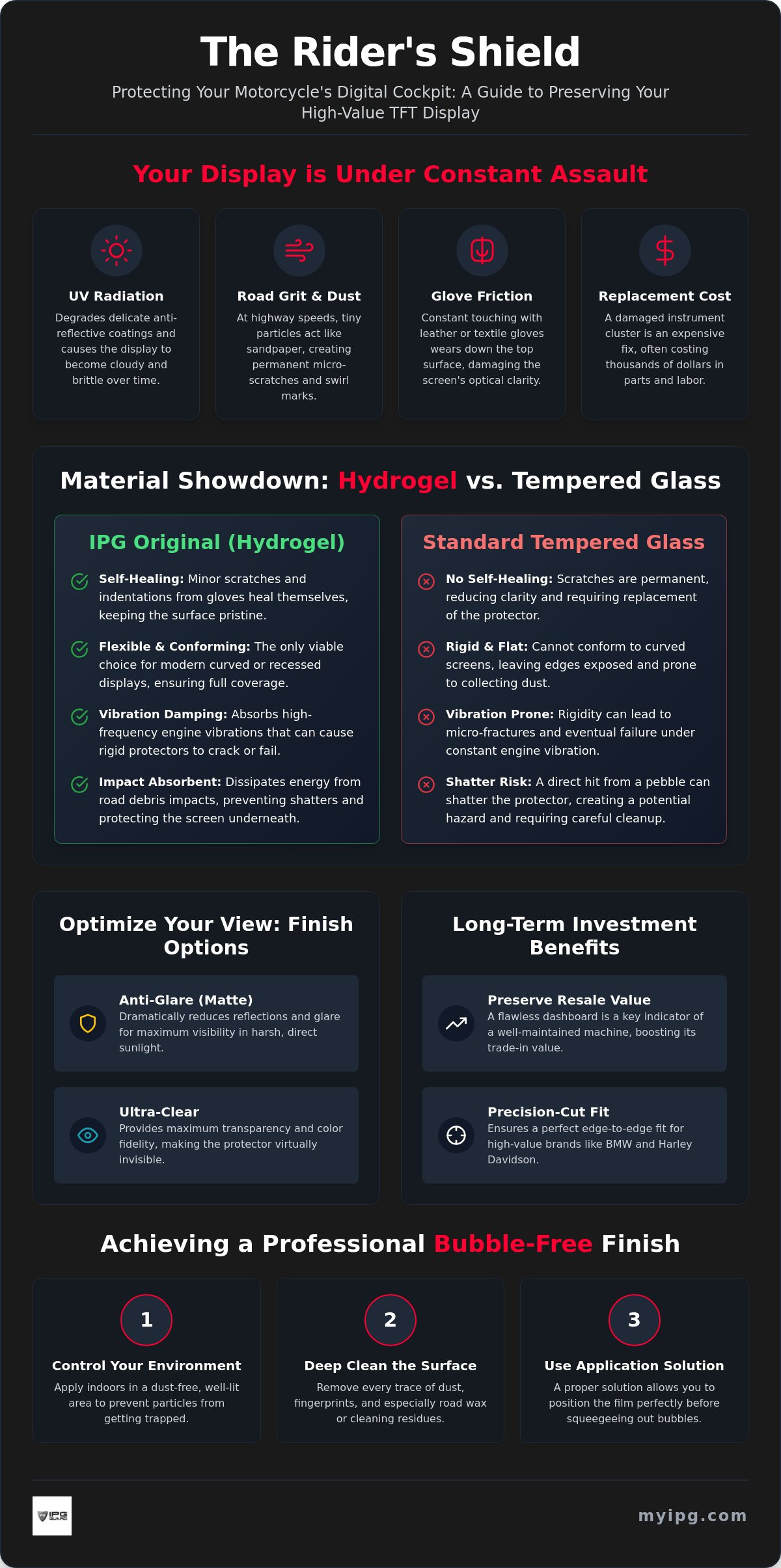
- Modern TFT clusters feature delicate anti-reflective coatings that require specialized shielding against UV rays and abrasive road grit.
- Choosing a motorcycle dashboard screen protector made from self-healing hydrogel ensures flexibility on curved displays while absorbing high-frequency vibrations.
- Optimize visibility by selecting between matte anti-glare finishes for harsh sunlight or ultra-clear films for maximum transparency.
- Achieve a professional, bubble-free installation by controlling your environment and removing every trace of road wax before application.
- Precision-cut technology ensures a perfect fit for high-value brands like Harley Davidson and BMW, preserving your instrument cluster's resale value.
Why Your Motorcycle Dashboard Needs a Dedicated Screen Protector
Your motorcycle's dashboard is no longer a simple analog gauge. It's a high-performance computer interface. Modern Thin Film Transistor (TFT) displays utilize sophisticated anti-reflective coatings to ensure visibility under direct sunlight. These chemical layers are incredibly thin. They are also incredibly fragile. Without a specialized motorcycle dashboard screen protector, these coatings can degrade within months of heavy use. A single scratch isn't just an eyesore; it's a permanent flaw in an expensive optical system.
Think about your riding environment. You travel through wind-borne grit and abrasive dust. At highway speeds, a single grain of sand acts like a microscopic chisel. Even your "soft" cleaning cloth can trap particles that swirl across the display during a routine wipe-down. The financial stakes are high. Replacing a modern instrument cluster often requires swapping the entire integrated unit. For many premium adventure and touring bikes, this component costs thousands of dollars in parts and specialized labor. A protector acts as a sacrificial layer, absorbing the damage so your display doesn't have to.
TFT vs. LCD: Understanding Your Display's Vulnerability
Older Liquid Crystal Displays (LCD) were rugged but lacked clarity. Modern TFT screens offer vibrant colors and high refresh rates but come with a trade-off: extreme surface vulnerability. These screens are prone to "swirl marks" caused by frequent glove-touch interaction. Constant friction from leather or textile gloves wears down the top substrate. When you understand the different screen protector materials available, you can choose a barrier that preserves this sensitive tech without losing touch sensitivity or color accuracy.
Resale Value and Long-Term Maintenance
A "mint condition" dashboard is a primary indicator of a well-maintained machine. Potential buyers look at the cockpit first. Scratched, clouded, or yellowed displays suggest neglect and can significantly drop a bike's trade-in value. Constant UV exposure is the silent killer of outdoor electronics. It causes the plastic layers to become brittle and lose clarity over time. A high-quality motorcycle dashboard screen protector filters these harmful rays, preventing the "clouding" effect that plagues older, unprotected bikes.
Beyond the money, consider the psychological benefit. A clear, readable cockpit reduces rider fatigue and improves safety. You shouldn't have to squint through a web of scratches to see your navigation prompts or gear indicator. Protect your investment. Secure your view. Maintain the integrity of your ride's most valuable electronic component from day one.
Choosing the Right Material: Hydrogel vs. Tempered Glass
Selecting the correct shield for your cockpit isn't just about scratch resistance. It's about environmental endurance. Your motorcycle dashboard screen protector must survive rapid temperature shifts, high-frequency engine vibrations, and direct UV bombardment. While smartphones live in pockets, your bike's cluster lives on the front lines. Understanding the fundamental comparison of screen protector materials is the first step in ensuring long-term clarity.
The IPG Original (Hydrogel) represents the pinnacle of flexible protection. Unlike rigid alternatives, hydrogel is a "living" material. It uses a specialized polymer chain that allows minor surface indentations to heal themselves. If your glove leaves a faint mark while you're adjusting settings at a stoplight, the material slowly returns to its original state. This flexibility makes it the only viable choice for the curved or recessed displays found on modern sportbikes and cruisers. If you're looking for this level of adaptive tech, explore the IPG Original (Hydrogel) Screen Protector for your specific model.
Nano-glass offers a middle ground. It's a hybrid approach that blends the clarity of glass with the impact-absorbing properties of plastic. It won't shatter like traditional tempered glass, making it a safer option for high-vibration environments. However, the choice often comes down to how your bike moves. Vibration is the hidden factor. A rigid protector on a vibrating mount is a recipe for premature failure. You need a material that moves with the machine, not against it.
The Benefits of Hydrogel for Motorcyclists
Hydrogel excels at energy dissipation. While glass resists impact, hydrogel absorbs it. For a rider, this means the protector won't shatter when a piece of road debris strikes the cluster. Its superior adhesion is equally vital. Motorcycles parked in the sun can see dashboard temperatures soar. Hydrogel remains stable and bubble-free where traditional adhesives might fail or peel. It provides a seamless, edge-to-edge fit that feels like part of the original hardware.
When to Opt for Tempered Glass
Tempered glass offers the highest level of optical clarity. It provides that "naked" screen feel that many touring riders prefer. If your bike has a large windscreen and a perfectly flat display, tempered glass is a strong contender. It feels identical to the original glass surface. However, there's a significant trade-off for off-road or high-vibration machines. Glass is brittle. Constant resonance from a large-displacement twin-cylinder engine can cause micro-fractures over time. In ADV conditions, a hard impact doesn't just scratch the protector; it shatters it. This creates a mess of sharp shards that can be difficult to remove safely from a delicate TFT surface. For most riders, the hybrid resilience of hydrogel offers a more reliable "set and forget" solution.
Solving the Glare Problem: Anti-Glare vs. Ultra-Clear
Visibility dictates safety. A high-quality motorcycle dashboard screen protector does more than stop scratches; it manages light. You've likely experienced the frustrating "white-out" effect on your TFT display when the sun hits a specific angle, rendering your navigation useless. This isn't just an inconvenience. It's a distraction that pulls your eyes off the road for too long. Choosing between Anti-Glare and Ultra-Clear finishes is a decision based on your primary riding environment and visual preference.
Anti-glare films utilize a microscopic matte texture to diffuse incoming light rays. Instead of reflecting a sharp, blinding beam into your eyes, the film spreads the light across the surface. This prevents the "mirror effect" common on high-gloss factory screens. There is a technical trade-off. These films can introduce a very subtle "grainy" texture to the display, slightly reducing the absolute sharpness of the pixels. However, for most riders, this is a minor compromise for the ability to read a GPS at high noon. Understanding the technical considerations for vehicle screen protectors shows that high-contrast TFT units are specifically designed to work alongside these diffusion layers to maximize readability.
Ultra-Clear protectors are the "invisible" choice. They offer maximum transparency and maintain the factory-fresh look of your cluster. If you mostly ride in overcast conditions, at night, or in regions with lower light intensity, Ultra-Clear is the superior option. It provides the same physical defense without altering the screen's appearance. It's the standard for riders who want the protection of a motorcycle dashboard screen protector without knowing it's even there.
Riding in Direct Sunlight: The Safety Aspect
Direct sunlight causes eye fatigue. Constant squinting to see your speed or gear indicator slows your reaction time. A dedicated anti-glare film ensures critical data remains visible instantly. You don't have to shift your body or head to find a "clear" angle. It keeps your focus on the apex, not on your instrument cluster. This is especially vital for adventure riders who transition between dark forest trails and bright, open fire roads.
UV Protection and Display Health
UV radiation is a silent threat to outdoor electronics. It doesn't just heat the display; it breaks down the liquid crystal layer over time. This leads to "burn-in" or permanent discoloration of the display substrate. IPG's specialized films include UV inhibitors that act as high-grade sunblock for your electronics. They prevent the yellowing and clouding that often occurs on unprotected clusters after a few seasons of exposure. For a deeper dive into display preservation, read The Ultimate Screen Protector Guide to see how we shield your tech from environmental decay.
Installation Guide: Achieving a Bubble-Free Finish
Achieving a factory finish on your dashboard requires meticulous preparation. It's a technical process, but one that any rider can master with patience. Unlike a phone, a motorcycle cluster is often coated in road film, chain wax, or detailing sprays. These contaminants will ruin your adhesion if not fully neutralized. Follow this methodical approach to ensure your motorcycle dashboard screen protector remains invisible and secure.
Step 1: Deep Cleaning. Begin by stripping away every trace of residue. Use a high-quality electronic cleaner or a mild isopropyl alcohol solution. Avoid glass cleaners with ammonia; they can attack the TFT's factory coatings. Focus on the edges where wax tends to build up. Use a microfiber cloth to ensure no lint remains.
Step 2: Environment Control. Never install your protector outdoors. Even a light breeze carries microscopic dust that will become a permanent bubble. Work in a closed, wind-free garage. If possible, perform the installation in a humid environment to keep airborne particles grounded and away from your sticky adhesive layer.
Step 3: Alignment. Use the "hinge method" for absolute precision. Position your protector perfectly while the backing is still on. Secure one side with low-tack tape. This creates a door that swings into the exact same position every time, ensuring your precision-cut edges line up perfectly with the display bezel.
Step 4: Squeegeeing. Peel the backing and swing the protector into place. Use a squeegee with a felt edge. Start from the center and move outward with firm, overlapping strokes. This pushes air to the perimeter where it can escape without being trapped.
Pro-Tips for Motorcycle Dashboards
Recessed screens present a unique challenge. Use your fingertips to ensure the edges are firmly pressed into the corners of the housing. Most importantly, wait 24 hours before your first high-speed ride. The adhesive needs time to "set" and reach maximum bond strength. This ensures it won't lift when hit by high-velocity wind or extreme engine heat. For a detailed walkthrough, see How to Install a Screen Guard Like a Pro.
Troubleshooting Common Issues
If you spot a dust speck after application, don't panic. Gently lift the nearest corner with a piece of tape and use a "dust absorber" sticker to pluck the particle out. Edge lifting is a common concern on high-vibration V-twin engines. Ensure the display surface was 100% dry and free of detailing oils before application to prevent this. If you ever need to replace your shield, follow the steps in How to Safely Remove a Screen Protector to avoid scratching the underlying TFT. Secure your cockpit today with a precision-cut IPG Original (Hydrogel) Screen Protector.
The IPG Difference: Precision Engineering for the Open Road
IPG isn't just a screen protector brand. We are dedicated guardians of technology with deep roots in aerospace and automotive shielding. This technical heritage informs every motorcycle dashboard screen protector we produce. We understand that a bike isn't a static object; it's a high-vibration environment exposed to the harshest atmospheric conditions. Our films aren't generic squares. We utilize precision-cut templates for major manufacturers including BMW, Ducati, and Triumph. This ensures an "invisible" fit that follows the exact contour of your instrument cluster without overlapping the bezel.
Our specialized adhesive technology sets us apart. The IPG Zerodust Screen Protector is engineered to minimize debris attraction during the critical application phase. Standard films often act as magnets for static-charged dust. Our formula neutralizes this effect. This commitment to precision engineering allows us to ship our specialized protection kits to riders across the globe. Whether you're navigating the salt-heavy air of the Mediterranean or the high-heat deserts of the American Southwest—where experts like Mr Tint provide professional window tinting San Diego—our protection remains steadfast. We move quickly from identifying a vulnerability to providing a custom-fit solution.
Specialized Harley Davidson Cluster Protection
Harley Davidson riders face unique challenges. The heavy resonance of a large-displacement V-twin can rattle inferior protectors loose over time. We provide the IPG Camera Lens Protector for Harley Cluster Display protector, which is specifically engineered to handle these high-amplitude vibrations. These aren't just scaled-down phone films. They are heavy-duty barriers that maintain the classic, high-end look of your bike while providing modern defense against glove-scuffing and UV fading. We've verified compatibility for 2026 models to ensure your new touring rig is protected from the first mile.
Why Riders Trust IPG
Durability isn't a marketing claim; it's a performance requirement. We test our films in real-world riding conditions. This includes prolonged exposure to road salt, torrential rain, and extreme thermal cycling. Our "Invisible" guarantee means you get maximum security without compromising the aesthetics of your cockpit. You didn't buy a premium motorcycle to cover the dash in cheap, cloudy plastic. You bought it for the experience. We preserve that experience. Browse our full range of motorcycle dashboard protectors here and secure your ride with the technical specialist for outdoor electronics.
Secure Your Cockpit for the Miles Ahead
Your motorcycle's TFT display is the heart of your riding experience. Protecting it isn't just about avoiding minor scratches; it's about maintaining critical visibility and long-term resale value. A specialized motorcycle dashboard screen protector ensures that road grit, UV rays, and constant glove friction don't degrade your display's sensitive coatings. By choosing a shield engineered for the high-vibration environment of the open road, you preserve the clarity of your navigation and the integrity of your investment.
Trust in the technical authority of IPG. We utilize aerospace-grade material and precision-cut templates designed specifically for Harley Davidson and other premium manufacturers. Our self-healing hydrogel technology provides a resilient, invisible barrier that heals itself from daily wear. Don't wait for the first permanent mark to appear on your cluster. Secure your view and ride with the confidence that your most valuable electronic component is fully shielded.
Shield Your Ride: Shop IPG Motorcycle Dashboard Protectors
Invest in the longevity of your machine today. Enjoy every mile with a clear, protected cockpit that looks as good as the day you left the showroom.
Frequently Asked Questions
Will a screen protector make my motorcycle dash harder to see in the sun?
No, choosing a matte or anti-glare finish actually improves visibility by diffusing direct sunlight. While an Ultra-Clear film maintains factory transparency, it doesn't add glare. High-quality films utilize advanced light filtration to ensure critical data like speed and navigation remain legible during high-noon rides. This prevents the "mirror effect" common on unprotected glass or plastic clusters, making your cockpit safer in harsh lighting conditions.
Can I install a motorcycle dashboard protector myself, or do I need a professional?
You can easily install a motorcycle dashboard screen protector yourself with basic preparation. Our kits are designed for DIY enthusiasts and include precision-cut films that match your specific model's dimensions perfectly. By following the "hinge method" in a wind-free environment, you can achieve a professional, bubble-free finish without paying for shop labor. The process typically takes less than fifteen minutes from cleaning to final application.
How do I clean my motorcycle dashboard once a protector is installed?
Clean your protected dashboard using a clean microfiber cloth and a small amount of water or specialized electronic cleaner. Avoid using paper towels or abrasive sponges that could scratch the film. Because the protector acts as a sacrificial layer, you can wipe away road grime and salt spray without worrying about damaging the expensive anti-reflective coatings on the underlying TFT display. It's a much safer maintenance routine for your tech.
Will the adhesive damage my TFT screen if I decide to remove it later?
High-grade silicone adhesives are designed to be removed without leaving any permanent residue or damaging the TFT substrate. If you decide to replace the film, simply lift a corner and peel it back slowly. The adhesive remains stable through extreme heat cycles but doesn't chemically bond with the screen. This ensures your cluster remains in mint condition for the entire life of the motorcycle, preserving its long-term value.
Are motorcycle screen protectors waterproof for riding in heavy rain?
Our protectors are fully waterproof and designed to withstand torrential rain and high-pressure bike washes. Once the adhesive has cured for 24 hours, the bond is airtight. This prevents moisture from seeping between the film and the cluster, which is vital for adventure riders who face unpredictable weather. The material won't cloud or peel when exposed to moisture, humidity, or the high-velocity spray from your front tire.
How long does a typical motorcycle dashboard screen protector last?
A high-quality motorcycle dashboard screen protector typically lasts two to five years depending on your storage habits and riding frequency. While the material is designed for high-UV environments, constant exposure to direct sunlight will eventually lead to minor wear. Many riders choose to replace the film every few seasons to maintain peak optical clarity and ensure the self-healing properties of the hydrogel remain active for maximum protection.