
You're deep in a field shoot, your Nikon Z8 swinging from your hip, when a metal zipper or belt buckle makes sharp contact with the LCD. That sinking feeling of a permanent scratch on a professional tool is a risk you shouldn't have to take. Your camera is more than just gear. It's your creative eye and your livelihood. You deserve a nikon camera screen protector that acts as a silent guardian, preserving every pixel without compromising the vibrant color accuracy you rely on for critical focus.
We understand the frustration of protectors that peel off articulating screens or create distracting glare under the midday sun. This guide shows you how to secure professional-grade, invisible protection that maintains flawless touch responsiveness and impact resistance. You'll discover the technical advantages of 0.3mm optical glass and the self-healing properties of hydrogel technology. We'll break down the best ways to safeguard your Z-series or DSLR display against the rigors of 2026 fieldwork while keeping your interface as responsive as the day it left the box.
Key Takeaways
- Learn why articulating Z-series screens require a specialized nikon camera screen protector to prevent edge-lifting and mechanical interference during field use.
- Compare the impact-absorbing properties of tempered glass with the self-healing flexibility of IPG Original (Hydrogel) for superior durability in the field.
- Discover how professional-grade film preserves 100% color fidelity and touch responsiveness for critical on-set image review.
- Master a precision installation strategy that eliminates environmental grit and ensures a seamless fit around Nikon's specific sensor and notch layouts.
- Understand how Zerodust technology acts as a guardian for your gear, protecting high-value displays from metal hardware and abrasive tripod plates.
The Vulnerability of Professional Nikon Displays
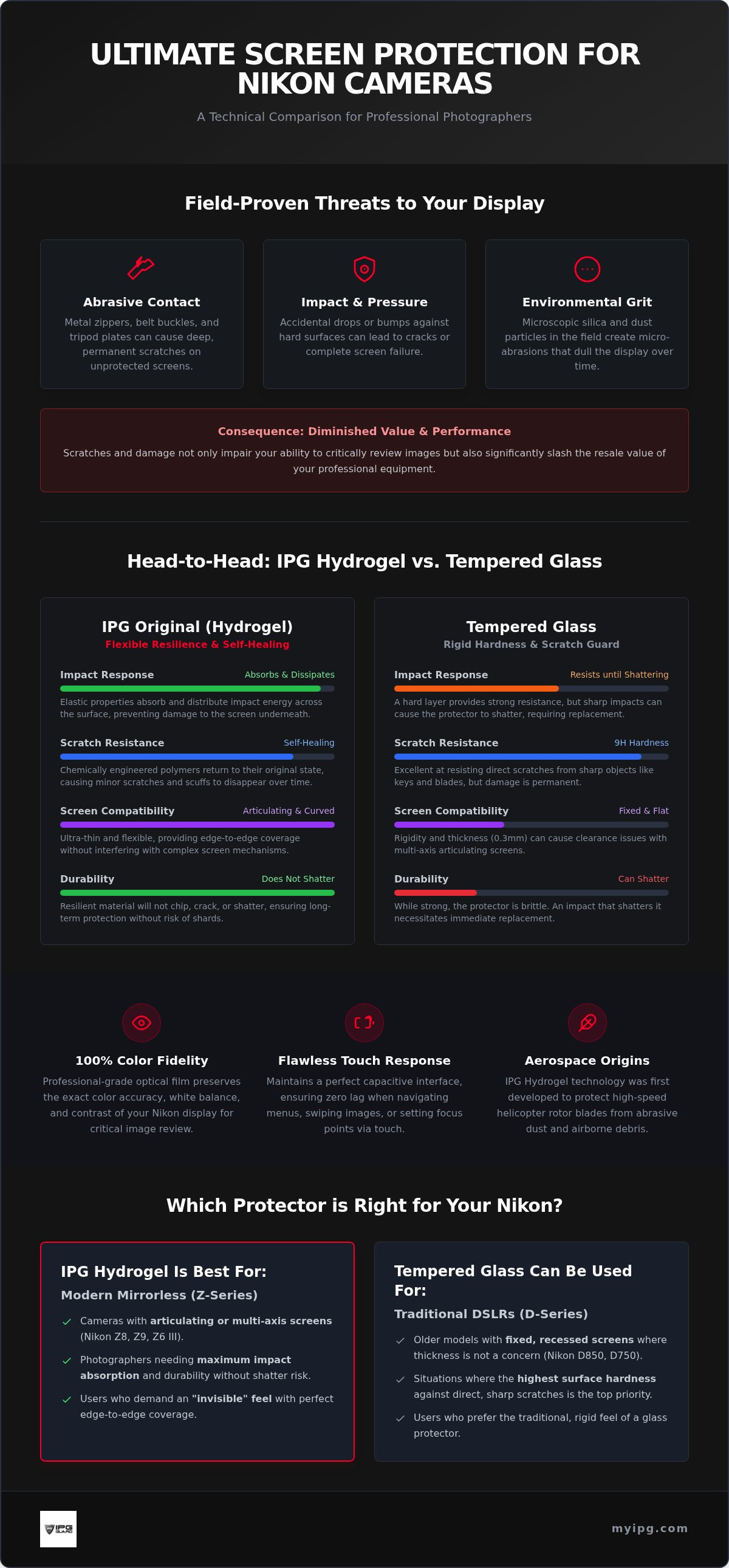
Professional Nikon cameras are built for endurance. Yet, the rear display remains a critical point of failure. Modern photography demands high-resolution, color-accurate feedback that only a pristine LCD can provide. Relying on a "bare screen" philosophy is a gamble that rarely pays off in the field. Environmental grit, silica, and metallic hardware are often harder than the factory-installed glass, leading to micro-abrasions that dull your view over time. A dedicated nikon camera screen protector isn't just an accessory; it's a necessary safeguard for your primary interface.
Fieldwork presents a constant barrage of hazards. Metal zippers on camera bags, sharp tripod plates, and even the buttons on your own jacket can cause permanent damage during a hectic shoot. These aren't just cosmetic issues. Scratches are financial liabilities. When it's time to upgrade, a damaged rear display significantly slashes the resale value of your body. Keeping that glass in mint condition ensures your gear retains its value and professional integrity.
Fixed vs. Articulating Nikon Screens
The transition from fixed LCDs to the sophisticated multi-axis tilt mechanisms found on the Nikon Z9 and Z8 has complicated protection. Traditional Tempered glass solutions often present clearance issues. If a protector is too thick, it can prevent the articulating screen from seating flush against the camera body or cause mechanical stress on the hinges. Heavy glass also increases the likelihood of edge-peeling as the screen moves through its various axes. You need a low-profile solution that moves with the camera, not against it.
The Role of Touch Sensitivity
Modern Nikon workflows rely heavily on touch. Whether you're navigating the deep i-Menu, swiping through thousands of frames in playback, or tapping to set a focus point on a Z6 III, responsiveness is vital. Low-quality protectors often introduce a frustrating lag or "ghost touches" that disrupt your rhythm. A high-performance nikon camera screen protector must maintain a capacitive-friendly interface. It should feel invisible to your fingertips while providing a high-transparency barrier that doesn't shift the white balance or contrast of your display. Precision matters when you're making split-second creative decisions based on what you see on the screen.
Hydrogel vs. Tempered Glass: The Best Shield for Your Nikon
Choosing the right nikon camera screen protector involves a choice between two distinct philosophies: rigid hardness and flexible resilience. While many photographers reflexively reach for glass, the evolution of camera hardware suggests a more nuanced approach. Tempered glass provides a high level of surface hardness, often rated at 9H on the Mohs scale. This makes it excellent at resisting direct scratches from sharp objects. However, glass is inherently brittle. A sharp impact can cause it to shatter, potentially sending shards toward your expensive LCD and causing the very damage you sought to prevent.
Hydrogel represents the modern alternative for professional workflows. Instead of resisting force through rigidity, the IPG Original (Hydrogel) utilizes elastic properties to absorb and dissipate energy. This material doesn't crack, chip, or shatter. One of its most impressive features is the "self-healing" capability. Minor abrasions or "swirl marks" from cleaning cloths often disappear within hours as the chemically engineered polymers return to their original state. This ensures your nikon camera screen protector remains clear over years of heavy use without the need for frequent replacements.
Why IPG Original (Hydrogel) Leads for Cameras
The IPG Original (Hydrogel) was born from aerospace technology. It was initially developed to protect high-speed helicopter rotor blades from abrasive dust and debris. This same level of industrial-grade protection is now available for your Nikon Z-series. Its ultra-thin profile is its greatest asset. Unlike thick glass, it doesn't interfere with the tight tolerances of articulating screens. It provides edge-to-edge coverage that follows the exact contours of your display, including recessed areas that glass simply cannot reach. If you want a shield that feels like it isn't there, exploring hydrogel options is the logical next step for your kit.
When to Consider Tempered Glass
Tempered glass still has a place, particularly for older DSLR models like the Nikon D850 or D750. These cameras often have fixed, recessed screens where the added thickness of a 0.3mm glass layer isn't a mechanical hindrance. The 9H hardness rating provides peace of mind in high-impact environments where the screen might take a direct hit from a tripod leg or heavy gear. But for mirrorless users, the limitations are clear. Glass can prevent "flip-out" screens from closing properly. It adds unnecessary weight to a lightweight setup and is prone to edge-chipping during the constant movement of a multi-axis tilt mechanism. For modern Nikon bodies, the flexibility of hydrogel usually outweighs the static hardness of glass.
Preserving Optics: Light Filtration and Color Fidelity
Professional photography hinges on accurate feedback. When you're checking a histogram or verifying skin tones in the field, your LCD is your only source of truth. A poor-quality nikon camera screen protector can introduce a subtle shift in color temperature, often leaning toward a warm or yellow cast. This distortion makes it impossible to judge white balance accurately on-site. High-performance optical films are engineered to be spectrally neutral. They allow light to pass through without filtering specific wavelengths, ensuring that the rich colors produced by your Nikon sensor are exactly what you see on the display.
Optical clarity isn't just about transparency; it's about light transmission efficiency. Cheap plastics often scatter light, which reduces the perceived contrast of your images. This makes your shots look flatter on the screen than they actually are in the RAW file. A professional-grade protector maintains the native contrast ratio of Nikon's high-resolution panels, allowing you to make confident exposure decisions without second-guessing your gear.
The Zerodust Advantage for Clear Viewing
Maintaining display crispness is a technical challenge when you add an extra layer of material. The IPG Zerodust technology addresses this by using a multi-layer composition that minimizes internal reflections. It keeps images sharp and prevents the "fuzziness" often associated with generic matte protectors. This specialized layer offers several benefits for the working photographer:
- Fingerprint Resistance: Oleophobic treatments reduce smudges during heavy touch-screen use.
- Contrast Preservation: Keeps deep blacks and vibrant highlights looking natural.
- Edge Integrity: Prevents dust accumulation at the screen borders, keeping the view unobstructed.
These features ensure that your interface remains clean even during intense sessions of menu navigation or focus point selection. You don't have to choose between protection and a clear view of your work.
Shooting in Direct Sunlight
Outdoor photography often forces a compromise between visibility and battery life. Landscape and street photographers frequently crank their screen brightness to the maximum to combat glare. This drains the camera battery much faster. A nikon camera screen protector with anti-reflective properties solves this by diffusing harsh light before it hits the LCD. Modern coatings achieve a delicate balance. They reduce reflections significantly without the heavy graininess found in older matte finishes. You can keep your screen at a lower brightness setting and still see fine details in the shadows. This preserves the detail in your previews while extending your shooting time in the field.
Precision Installation for Nikon Articulating Screens
Installation is the moment where gear protection succeeds or fails. To achieve a factory-fresh finish, you must adopt a "Clean Room" strategy. Dust is your primary enemy. Applying your nikon camera screen protector in a humid environment, such as a bathroom after a hot shower, helps ground airborne particles. Before you begin, clean the LCD with a professional-grade microfiber cloth and an electronic-safe cleaning solution. Inspect the surface under a bright, raking light to ensure every speck of grit is gone. Even a single grain of silica can create a visible imperfection under the film.
Nikon Z-series cameras, particularly the Z8 and Z9, feature specific notch areas for sensors and complex multi-axis tilt mechanisms. Alignment must be surgical. For dry application, use the "hinge method" by securing one side of the protector with masking tape before peeling the backing. This ensures the film lands exactly where you intended. For wet application with IPG films, the specialized solution allows you to slide the protector into position, providing the perfect fit around the recessed edges of the articulating display.
Eliminating Bubbles and Dust
Trapped air is a common frustration, but it's easily managed with the right technique. Start from the center and work outward. If you encounter resistance, focus on removing air bubbles by using a squeegee or the edge of a credit card wrapped in a microfiber cloth. Apply firm, consistent pressure to push the air toward the nearest edge. For hydrogel materials, a final "cure" time is essential. Small, microscopic bubbles often disappear on their own within 24 to 48 hours as the material settles. Avoid using the camera heavily during this period to let the adhesive bond fully with the glass.
Maintenance and Long-Term Care
A high-quality shield requires minimal but specific care. Clean the surface regularly with a dry microfiber cloth to remove skin oils and environmental residue. Avoid harsh chemical solvents that can degrade the oleophobic coating or weaken the adhesive at the edges. You should replace your shield if you notice significant edge-lifting or deep gouges that interfere with your view. When it's time for a change, peel the film back slowly from one corner. Professional protectors leave zero residue, keeping your Nikon’s original glass in mint condition. To maintain this level of security for your kit, order your precision-cut Nikon shield from a specialist you can trust.
IPG Specialized Protection: The Ultimate Nikon Guardian
Selecting a nikon camera screen protector is a commitment to your craft. You've invested thousands in a high-performance body. You deserve a shield that matches that level of precision. IPG stands as the ultimate guardian because we treat every display with the meticulous care it requires. Our "Invisible" promise means your gear retains its original tactile feel and aesthetic profile. You get the security of industrial-grade film without the bulk or interference of generic alternatives. It's about stewardship over the tools that capture your vision.
Professional photography demands gear that performs under pressure. While other brands focus on prestige or high prices, IPG focuses on material innovation. Our films are engineered to disappear once applied, providing a seamless interface that doesn't distract from the image review process. You can trust that your display is safe from the abrasive grit of the field while maintaining the high-transparency capacitive interface your Nikon Z-series requires. For more insights on how we apply these standards to glass elements, explore our Ultimate Guide to Camera Lens Protection.
A Heritage of Protection
Our material technology didn't start in a consumer electronics lab. It began by protecting high-value automotive clusters and aerospace components. This heritage of durability informs every piece of professional Nikon glass we cover. Photographers choose IPG for their flagship bodies because they understand that preservation is a science, not an afterthought. We've spent years refining the balance between light filtration and impact resistance to ensure your LCD remains a reliable source of truth.
Choosing Your Specific Nikon Model
Compatibility is never a guessing game with IPG. We offer custom-cut solutions for the entire Nikon ecosystem. Whether you're shooting with the latest mirrorless Z6, Z7, and Z8 or relying on the proven performance of legacy D-series DSLRs, we have the exact fit. Even high-end Coolpix compacts benefit from our precision-engineered films. Each protector is measured to the millimeter to ensure it doesn't obstruct sensors or hinge movement.
- Nikon Z-Series: Precision-cut for the specific sensor notches and articulating edges of the Z8, Z9, and Z6 III.
- Nikon D-Series: Robust protection for legacy DSLR displays like the D850, D780, and D750.
- Coolpix Line: Specialized films for high-performance compacts, including the P1000 and P950.
Your workflow shouldn't be interrupted by ill-fitting accessories that peel or lag. Secure your investment and maintain your focus on the shot. Protect your Nikon today with a shield designed by the dedicated guardians of technology.
Secure Your Professional Legacy
Your Nikon is a precision instrument. It deserves a level of stewardship that matches its engineering. Protecting your primary interface doesn't have to mean sacrificing touch responsiveness or color fidelity. By selecting a high-performance nikon camera screen protector, you safeguard your gear against the unpredictable rigors of the field while maintaining the vibrant clarity required for critical image review. We've seen how aerospace-grade hydrogel technology provides a superior, self-healing barrier that outperforms traditional glass on modern articulating displays.
Investment in quality protection is an investment in your creative future. IPG offers crystal clear transparency for color-accurate editing and a custom-fit for all Nikon Z and D series models. Don't let environmental grit or accidental impacts compromise your workflow. It's time to equip your body with a shield that feels invisible but acts as a dedicated guardian. Secure Your Nikon Display with IPG Precision Shields today. Keep your focus on the shot and leave the protection to us.
Frequently Asked Questions
Do screen protectors affect the touch sensitivity of Nikon Z-series cameras?
High-performance protectors are engineered specifically to maintain the capacitive sensitivity of your Nikon Z-series display. You'll experience zero lag when navigating the i-Menu or selecting focus points. Our ultra-thin hydrogel material ensures that the electrical signals from your fingertips pass through the barrier without interference. This allows for the same rapid, tactile experience you expect from a bare screen while providing a necessary layer of protection against oils and grit.
Can I still close my articulating screen fully with a protector installed?
You can fully close and seat your articulating screen as long as you choose a low-profile solution. Thick, 0.3mm tempered glass can sometimes create clearance issues on multi-axis tilt mechanisms like those found on the Z8 or Z9. However, the IPG Original (Hydrogel) is thin enough to allow for a perfect flush fit. This ensures your display remains protected without putting mechanical stress on the hinges or preventing the screen from snapping back into place.
Will a screen protector change the color accuracy of my Nikon LCD?
A professional nikon camera screen protector is designed to be spectrally neutral, meaning it doesn't shift the white balance or contrast of your images. While cheap plastic films can introduce a yellow tint, our optical-grade materials ensure 100% color fidelity. This is critical for on-site photo review where you need to trust the skin tones and histograms you see on the display. Your creative eye remains accurate while the glass stays pristine.
How do I remove a Nikon screen protector without scratching the glass?
Removing a protector is a safe process that leaves zero residue on your Nikon glass. Simply use your fingernail or a thin plastic card to gently lift one corner of the film. Once you've broken the seal, peel the material back slowly at a 45-degree angle. High-quality adhesives are designed for clean removal, ensuring that the original LCD remains in mint condition. Never use metal tools or sharp blades, as these can permanently gouge the display.
Is hydrogel better than tempered glass for a camera that is used outdoors?
Hydrogel is generally superior for outdoor fieldwork because it absorbs impact rather than shattering. While tempered glass can crack when hit by a tripod leg or metal buckle, hydrogel utilizes elastic polymers to dissipate energy. It also features self-healing properties that make minor surface scratches disappear over time. This durability makes it the ideal nikon camera screen protector for landscape and street photographers who frequently face unpredictable environmental hazards and abrasive grit.
What should I do if I get a piece of dust under the protector during installation?
If you spot dust during application, don't panic. Gently lift the nearest corner of the protector using a piece of adhesive tape. Use a second piece of dust-removal tape to dab the particle off the sticky side of the film or the camera glass. Once the debris is removed, carefully lay the protector back down and squeegee out any new air bubbles. This "lift and dab" technique is the most effective way to achieve a flawless, bubble-free finish.
Does a screen protector help with glare when shooting in bright sunlight?
Specialized protectors significantly reduce glare by diffusing direct sunlight and minimizing reflections. This allows you to view your compositions clearly without needing to maximize your screen brightness, which preserves battery life during long shoots. While a standard high-gloss finish provides maximum clarity, our anti-reflective coatings strike a balance between detail preservation and visibility. You'll find it much easier to judge exposure and focus when shooting in harsh, midday light conditions.
Are IPG protectors compatible with the Nikon D850 and older DSLRs?
We provide precision-cut solutions for the entire Nikon ecosystem, including legacy DSLRs like the D850, D780, and D750. Even though these cameras feature fixed or simpler tilting screens, they still require protection from the same field hazards as mirrorless bodies. Each protector is measured to the exact dimensions of the specific model's LCD, ensuring edge-to-edge coverage. Whether you shoot with a modern Z-series or a classic D-series body, your professional display remains fully safeguarded.