

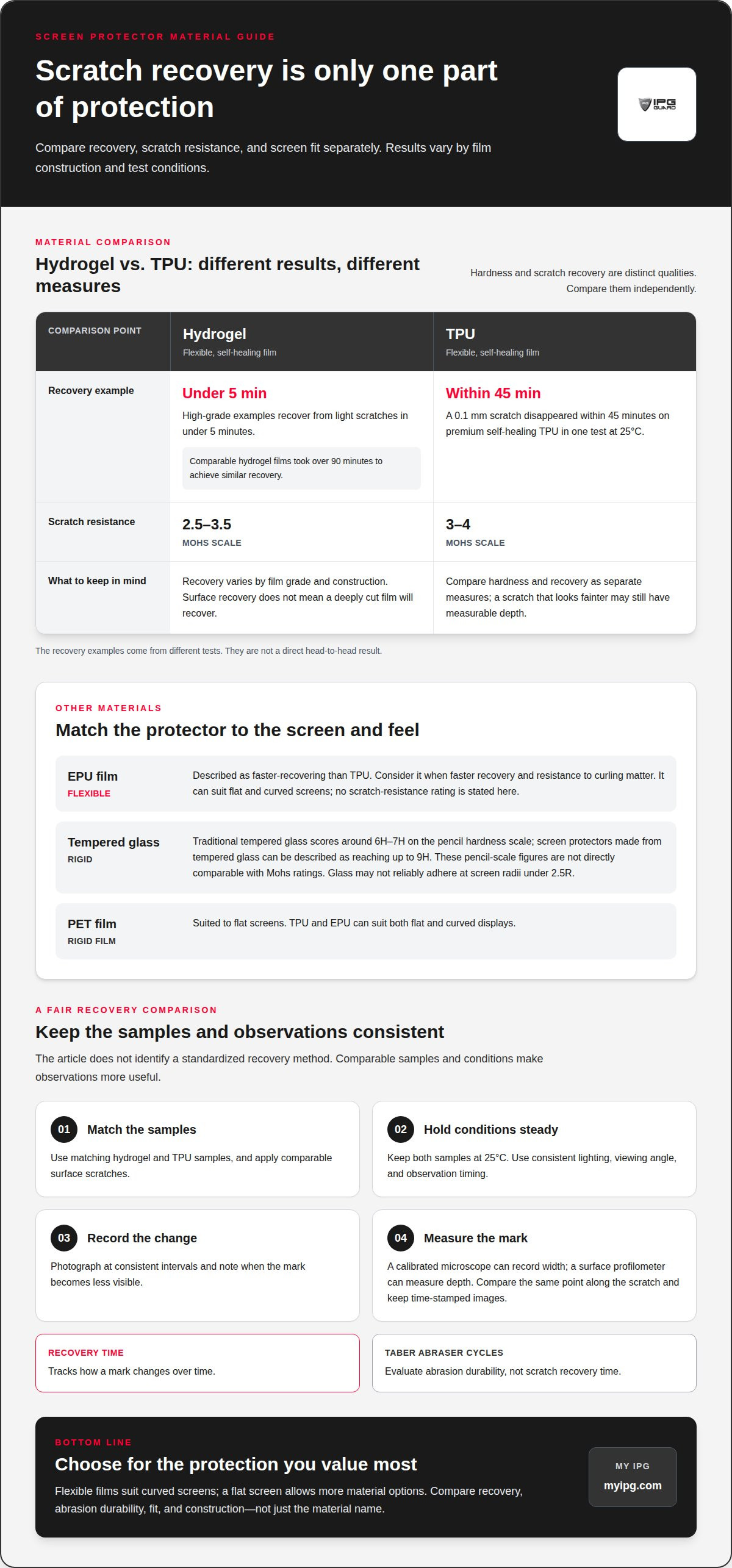
The film that recovers from scratches faster isn’t automatically the better screen protector. In a hydrogel film vs TPU film scratch recovery test, high-grade hydrogel recovered from light scratches in under 5 minutes, while a separate test found a 0.1 mm scratch on premium self-healing TPU disappeared within 45 minutes at 25°C. Scratch resistance varies by film, so the right choice depends on the protection you value most.
It makes sense to focus on scratch recovery: small marks can distract from a screen you use all day. But recovery speed is only one part of the comparison, and results depend on the film’s material and construction. A shallow mark may fade; deeper damage may not.
This guide compares hydrogel and TPU recovery and abrasion durability, then puts both in context with EPU film and tempered glass. You’ll learn which option may suit flexible or curved screens, when a firmer protector may better fit your priorities, and what to consider before choosing protection for a device you want to keep looking its best.
Key Takeaways
- Choose by the kind of protection you need: self-healing films handle light surface marks, while tempered glass offers a different, firmer feel.
- Scratch recovery and abrasion durability measure different things; learn how to weigh both before choosing a film.
- Match the protector material to your screen’s shape, especially if it’s curved or foldable.
- Compare hydrogel, TPU, EPU, and tempered glass with a practical decision guide for your device and daily use.
- Understand how scratch depth and test conditions affect recovery, so you can set realistic expectations for self-healing films.
Which material should I choose for mobile screen protection?
Choose by balancing recovery from light scratches with scratch resistance and fit. A hydrogel film vs TPU film scratch recovery test can help compare recovery, but results depend on film grade and consistent test conditions.
Hydrogel Film Scratch Recovery
High-grade hydrogel screen protectors can recover from light scratches in under 5 minutes. Comparable hydrogel films took over 90 minutes to achieve similar recovery, showing how much results can differ between film constructions. Hydrogel’s stated scratch-resistance range is 2.5-3.5 on the Mohs scale. Recovery helps with surface marks, not damage that cuts deeply through the film.
TPU Film Scratch Recovery
Self-healing TPU can reduce the visibility of surface abrasions over time. In a test at 25°C, a 0.1 mm scratch on premium self-healing TPU disappeared within 45 minutes. Hardness and scratch recovery are distinct qualities, so compare them separately when choosing a screen protector. Treat hardness and recovery time as separate measures when comparing mobile screen protection.
Scratch Recovery Test Methods
Taber Abraser cycle testing evaluates abrasion durability, not scratch recovery time. For a practical comparison, use matching hydrogel and TPU samples, apply comparable surface scratches, and keep both at 25°C. Photograph each at consistent intervals and lighting. A hydrogel film vs TPU film scratch recovery test is useful only when the samples and observation conditions are comparable.
The information here does not identify a standardized recovery method. Keep scratch size, temperature, viewing angle, and timing consistent, then record when each mark becomes less visible. Taber Abraser cycles can assess abrasion resistance, but they do not show how quickly a scratch fades.
Scratch Width and Depth Measurements
Measure each scratch before and after recovery using the same imaging setup. A calibrated microscope can record its width, while a surface profilometer can measure its depth. Compare readings at the same point along the mark and keep time-stamped images. A scratch that looks fainter may still have measurable depth, so appearance alone cannot establish complete recovery.
Hydrogel and TPU films do not have one universal price in the U.S. Material grade, coating, pre-cut format, and device fit all affect the product. Compare equivalent protectors rather than relying on the material name alone.
| Film | Scratch recovery | Scratch resistance | Comparison point |
|---|---|---|---|
| Hydrogel | Under 5 minutes for high-grade examples; comparable films took over 90 minutes | 2.5-3.5 Mohs | Recovery varies by construction |
| TPU | 0.1 mm scratch disappeared within 45 minutes at 25°C in one test | 3-4 Mohs | Compare recovery and hardness separately |
| EPU | Described as faster-recovering than TPU | No rating stated here | Consider recovery speed and curling resistance |
Choose hydrogel or TPU for flexible, self-healing surface protection; consider EPU when faster recovery and resistance to curling matter most.
Tempered glass, TPU hydrogel, and EPU film material differences
Material affects how a screen protector fits, feels, and handles surface wear. Tempered glass is rigid, while TPU is flexible; EPU film can also suit flat and curved screens. PET is another rigid-film option, but its fit differs: it suits flat screens, while TPU and EPU suit both flat and curved displays. Match the protector’s structure to the screen before comparing coatings or clarity.
Tempered glass is the firm option in this comparison. Traditional tempered glass scores around 6H-7H on the pencil hardness scale, and screen protectors made from tempered glass can be described as reaching up to 9H. Those figures use the pencil hardness scale, not Mohs, so don’t compare them directly with a Mohs rating. The practical distinction is material: glass forms a rigid layer, while TPU and EPU films can flex over a curve.
Screen shape can make that flexibility decisive. For a flat display, PET film, tempered glass, TPU, or EPU may fit the material criteria. For a curved display, the available material comparison favors TPU or EPU, since PET is suited to flat screens and glass may not reliably adhere at screen radii under 2.5R. That threshold is a fit consideration, not a scratch-resistance rating. A curved-edge phone is a clear example where flexibility deserves priority.
Coating performance depends on more than the film name. Surface energy, coating formula, and production setup affect compatibility, so two TPU films can behave differently under a coating. A hydrogel film’s surface finish can also vary by construction. Compare the complete film-and-coating combination, not just labels such as “tempered,” “hydrogel,” or “EPU.” Clarity is part of the assessment, but no material name alone guarantees a particular optical result.
Use the device shape and your preferred screen feel to narrow the choices. A flat screen gives you more material options; a curved screen makes flexible TPU or EPU films practical candidates. Choose tempered glass when you specifically want a rigid protector, and compare its hardness rating on the stated pencil scale. For a flexible film option, explore hydrogel screen protection as one candidate, then weigh fit, coating, and clarity together.
Abrasion-cycle durability
A scratch recovery test tracks how a mark changes; abrasion-cycle testing tracks repeated surface wear. A Taber Abraser applies repeated abrasion, then the coating is assessed for permanent wear. Top-tier self-healing coatings can withstand over 20,000 Taber Abraser cycles before showing permanent wear. That figure describes those coatings, not every hydrogel, TPU, or EPU film.
Use cycle results to compare resistance to repeated contact, not to predict a screen protector’s lifespan. One Taber Abraser cycle is a test unit, not a day of mobile phone use. A result above 20,000 cycles therefore doesn’t mean a film lasts a set number of days or years. Daily wear also depends on contact surfaces and handling.
Flexibility and abrasion resistance answer different questions. TPU and EPU films can suit curved screens, while rigid glass has a different fit and feel. A flexible film may follow a curved surface, but that does not prove its coating resists abrasion better. Compare abrasion results separately from shape compatibility and scratch-recovery behavior.
For a useful comparison, test hydrogel, TPU, and EPU samples under the same Taber Abraser conditions. Keep the setup, abrasive contact, and assessment method consistent across samples. Record when permanent wear first appears rather than comparing one film’s cycle total with another film’s recovery time. This separates repeated-wear resistance from self-healing speed.
Interpret the results in light of the screen-protection need. A curved phone display, for example, needs a suitably flexible protector, while a flat screen allows more material choices. If the surface faces frequent rubbing, abrasion-cycle performance matters more. If light marks are the main concern, assess recovery separately. Neither measure replaces the other.
Coating quality matters, too. A Taber Abraser result applies to the tested coating and film construction, not every product with the same material label. TPU films can have different coatings, and hydrogel and EPU products can also vary in construction. Assess the complete protector rather than assuming “self-healing” guarantees the same abrasion performance.
Use these questions to read a durability claim:
- Does the result describe Taber Abraser cycles or scratch recovery time?
- Does it identify the tested coating and film construction?
- Was the same test setup used for each material being compared?
A result over 20,000 cycles signals strong abrasion performance for the tested top-tier self-healing coating. Choose a flexible film for curved-screen fit, then weigh its abrasion evidence separately from scratch recovery and overall screen protection.
Scratch recovery time at 25°C
Temperature sets a useful control for comparing recovery times. In one test at 25°C, a 0.1 mm scratch on premium self-healing TPU disappeared within 45 minutes. High-grade hydrogel protectors have recovered from light scratches in under 5 minutes, while comparable hydrogel films took over 90 minutes for similar recovery. These results show variation, not a guaranteed outcome for every mobile device.
Don’t treat those figures as a direct head-to-head result. The 45-minute TPU result identifies a 0.1 mm scratch and a temperature of 25°C. The hydrogel results describe different film grades and recovery outcomes. Without identical scratch dimensions and testing conditions, the figures cannot establish that one material always heals faster. Film construction matters alongside the material name.
Recovery is most relevant to shallow surface damage. Self-healing mechanisms typically work on surface-level abrasions less than 0.1 mm deep. A deeper cut may remain visible because it extends beyond the layer that can recover. For a mobile phone, this distinction helps set expectations: fading of a fine mark is different from restoring material removed by a deep scratch.
To compare two films meaningfully, control the test conditions:
- Keep hydrogel and TPU samples at 25°C during the comparison.
- Make comparable surface scratches, recording each scratch’s initial width and depth.
- Start timing immediately after scratching and use the same observation intervals for both samples.
- Record when each mark fades, and compare the measurements with its starting condition.
This process distinguishes recovery from changes in appearance alone. A scratch, for example, may look less noticeable under different lighting without measurably recovering. Use consistent lighting, viewing angles, and measurement positions at each observation. Keep the original readings so later comparisons reflect changes in the film, not a shifted camera or viewpoint.
Hardness and recovery time also answer different questions. A hardness rating describes scratch resistance, while a recovery test tracks what happens after a scratch forms. Neither measure alone describes overall screen protection. For phones, weigh fit and surface durability alongside recovery, especially if the screen faces frequent contact.
At 25°C, the reported results range from under 5 minutes for high-grade hydrogel to 45 minutes for a 0.1 mm scratch on premium TPU. Comparable hydrogel films took over 90 minutes. Use those examples as reference points, then prioritize tests that match the film grade, scratch size, temperature, and device use you care about.
How do hydrogel screen protector films recover from scratches?
A hydrogel film may make a shallow surface mark less visible as its flexible surface settles after contact. This is surface recovery, not repair of the phone display underneath. A mark fading in the protector does not mean the screen itself has healed or that removed material has returned.
Self-healing behavior applies mainly to surface-level abrasions typically less than 0.1 mm deep. A light scuff may deform the film’s outer layer without cutting through it, allowing the mark to become less pronounced. A deeper cut damages more of the material, so the film may retain a visible line. Scratch depth is therefore a key factor in interpreting recovery.
Hydrogel results vary by film grade. High-grade protectors have recovered from light scratches in under 5 minutes, while comparable films took over 90 minutes to achieve similar recovery. These examples show why the word “hydrogel” alone cannot predict a specific result. Film construction and scratch depth affect the outcome, and a quick visual check doesn’t measure whether the surface has fully recovered.
TPU also uses a self-healing surface, but the reported recovery examples differ. Premium TPU recovered from a 0.1 mm scratch within 45 minutes at 25°C. EPU film is described as improving on TPU recovery speed and offering stronger resistance to curling. Those material distinctions help frame a comparison, but they don’t make a deeper cut recoverable.
For a practical observation, follow the same sequence for each film:
- Record the film type and grade before testing.
- Inspect the surface and note the scratch’s starting appearance and depth.
- Keep samples under the same temperature and lighting conditions.
- Photograph each mark at consistent intervals, then compare its visibility and measured depth.
That sequence separates apparent healing from changes in scratch dimensions. A scuff, for example, may look faint from one angle yet remain measurable under consistent magnification. Keep the viewing angle and measurement point the same for each image. Avoid using a fingernail or another object to test recovery, since that can add damage to the film.
Hydrogel suits users who value a flexible film and recovery from light surface marks. TPU offers another flexible self-healing option, while EPU is positioned for faster recovery and reduced curling. For a screen protector choice based on hydrogel material, explore hydrogel screen protection and consider how the film’s surface behavior fits your device.
My IPG: IPG Original (Hydrogel) Screen Protector
IPG Original (Hydrogel) Screen Protector offers a hydrogel option for flexible screen protection. As the comparison above shows, recovery results depend on film grade and scratch conditions, not the material name alone. Choose hydrogel if it fits your screen-protection preference; it is not a substitute for tempered glass if you specifically want a rigid protector.
For a more complete device setup, My IPG also offers iPhone and Samsung screen protectors, along with a phone camera lens protector. Match each protector to the part of your device you want to cover, keeping screen and camera-lens needs distinct.
For help choosing a screen protector, contact My IPG.
Make your next screen-protection choice with confidence
Use a hydrogel film vs TPU film scratch recovery test as one input, then match the protector to your device and priorities. Consider whether you prefer a flexible film, a rigid screen layer, or protection tailored to a specific part of your phone. Separating these needs makes it easier to choose without treating scratch recovery as the only measure that matters.
My IPG offers IPG iPhone screen protector and IPG Samsung screen protector options, as well as an IPG Phone camera lens protector. Choose the protection that fits the device you want to safeguard, then visit My IPG to find the right option.
Discuss your screen protection needs with My IPG, and move forward with a choice that suits your everyday use.
Frequently Asked Questions
How do TPU films recover from scratches?
Self-healing TPU films can make light surface marks less visible as the film’s surface recovers. For example, one test at 25°C found a 0.1 mm scratch on premium TPU disappeared within 45 minutes. That result applies to the tested film and conditions, not every TPU protector. For a useful comparison, judge the mark under consistent lighting and avoid treating a deeper cut as a recoverable scuff.
What is the difference between self-healing and scratch resistance in hydrogel and TPU films?
Self-healing describes how a surface mark changes after it forms; scratch resistance describes how readily the material gets marked. Hydrogel is rated 2.5-3.5 Mohs, while TPU is rated 3-4 Mohs. Those ranges don’t indicate recovery speed. For example, a film can resist some scratches yet still show a mark, while another may recover from a light mark after contact.
What test conditions affect scratch recovery, including scratch depth, temperature, and recovery time?
Scratch depth, film grade, temperature, and observation timing all shape the result. Self-healing mechanisms typically work on surface abrasions less than 0.1 mm deep, and a premium TPU test at 25°C recorded recovery of a 0.1 mm scratch within 45 minutes. For an apples-to-apples comparison, use matching film grades, keep samples at the same temperature, and photograph them at consistent intervals.
How do hydrogel and TPU films compare in hardness, clarity, durability, and touch feel?
TPU’s stated scratch-resistance range is 3-4 Mohs, compared with 2.5-3.5 Mohs for hydrogel. High-end self-healing TPU films are reported to maintain light transmission above 92% and haze under 1.5%; clarity still depends on the specific film and coating. TPU is positioned for essential protection and a bare-device feel. Top-tier self-healing coatings can withstand over 20,000 Taber Abraser cycles before permanent wear appears.
What are the risks and limitations of scratch testing phone screen protector films?
Scratch testing can permanently damage a sample, and results apply only to the film grade and conditions tested. Do not make a test mark on a protector already installed on a phone, since testing could compromise the protection you rely on. Use a separate film sample for comparisons, keep the scratch method consistent, and remember that visual fading does not prove the surface has returned to its original condition.