

Could your $2,000 NIKKOR lens actually perform better without that "protective" piece of glass you just screwed onto the front? It's a question that haunts every professional photographer. You want absolute security for your gear, yet you refuse to compromise on the razor-sharp resolution Nikon is known for. The fear of scratches is real. So is the frustration of ghosting and flare caused by low-grade materials. You need a solution that acts as a silent guardian, not an optical obstacle.
We understand the weight of your investment. This guide helps you master the art of selecting a nikon camera lens protector that preserves every detail of your image. You've likely felt the confusion between traditional UV filters and modern adhesive protectors designed for high-clarity displays. We'll clear the fog. You'll learn how to achieve physical security with zero impact on resolution. We'll explore the science of 99.9% light transmission and the precision-cut technology required for 2026's elite hardware. From high-transmission Arcrest II glass to specialized hydrogel shields for your camera's interface, we'll ensure your setup is rugged, reliable, and ready for any environment. Let's secure your vision.
Key Takeaways
- Safeguard your long-term financial and artistic investment by preventing environmental micro-scratches on delicate Nikon coatings.
- Master the selection of a nikon camera lens protector that achieves near-perfect light transmission to eliminate ghosting and flare.
- Evaluate your specific shooting environment to choose between traditional screw-on glass and modern precision-cut protective films.
- Learn the technical steps to identify your lens mount and thread diameter for a secure, zero-impact fit on your professional gear.
- Discover the benefits of hydrogel material science and specialized films in maintaining the integrity of high-value camera displays.
The Stewardship of Glass: Why Your Nikon Optics Need Protection
Your Nikon lens is more than a collection of glass elements. It's a high-precision optical instrument designed to capture light with absolute fidelity. For the professional photographer, these lenses represent a significant financial and artistic investment. A single scratch on the front element can compromise thousands of dollars in gear. While a lens cap provides security in your bag, the most critical moments of vulnerability happen when the cap comes off. This is where a dedicated nikon camera lens protector becomes essential. It acts as a primary defense against the unpredictable nature of field work. It's about maintaining the integrity of your vision.
The emotional weight of gear management is often overlooked. When you're in the middle of a high-stakes shoot, you shouldn't be worried about a stray branch or a gust of wind. You should be focused on the composition. A high-quality protector provides the peace of mind required for creative freedom. It transforms your lens from a fragile artifact into a rugged, reliable tool. You become a better steward of your equipment by adding a secondary layer of defense that sacrifices itself to save the primary glass.
The Financial Reality of Lens Repair
Repairing professional Z-series glass is a costly endeavor. Replacing a front element often requires a complete teardown by specialized technicians. These service fees often reach substantial amounts, not including the downtime while your gear is at a service center. Beyond the immediate cost, resale value is a major factor. The used market is unforgiving. Even microscopic imperfections in the coating can drop the value of a lens significantly. Think of your protector as an insurance policy. It's a small investment that preserves the long-term equity of your kit. It ensures that when it's time to upgrade, your gear remains in "mint" condition.
Environmental Hazards for Photographers
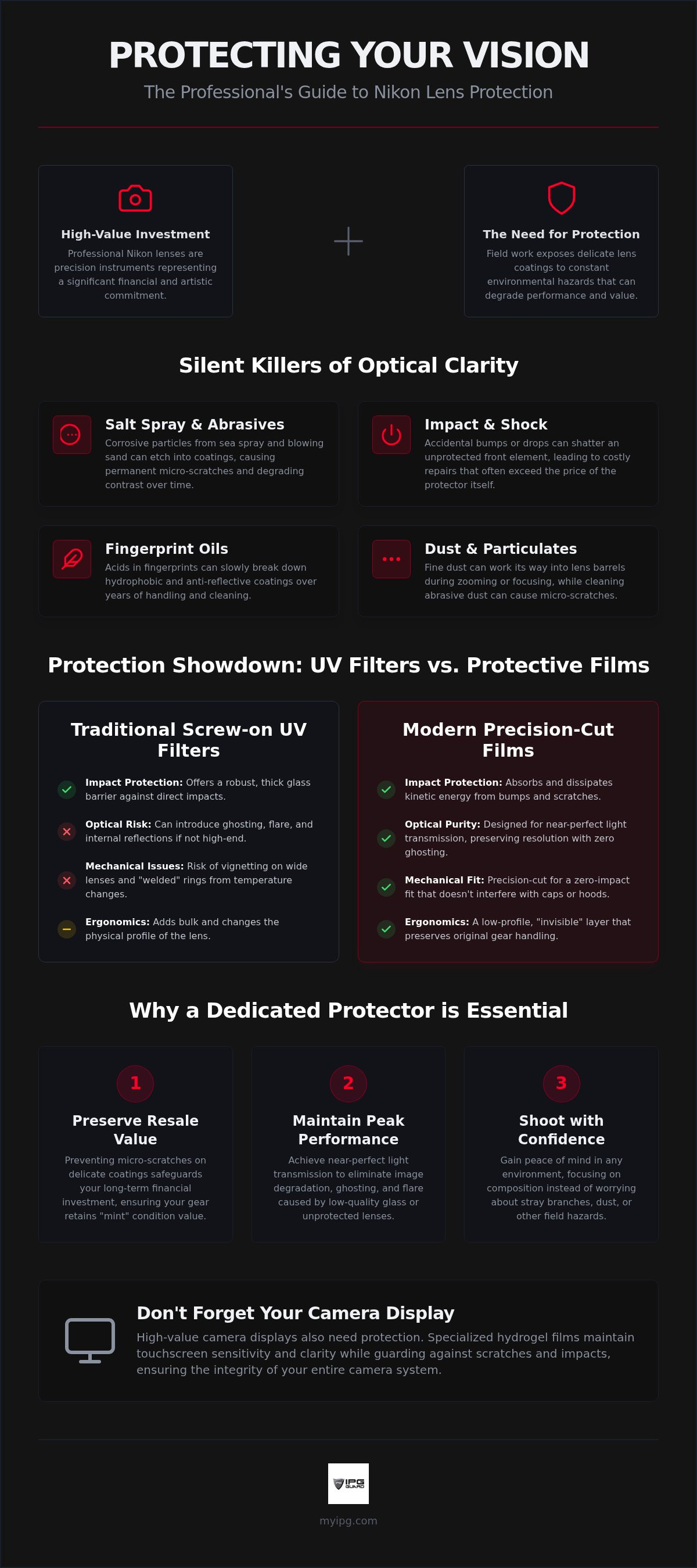
Modern Nikon optics feature advanced fluorine and nanocrystal coatings. These are durable, but they aren't invincible. Environmental factors like blowing sand or salt spray act as abrasives. Over time, repeated cleaning of these particulates causes micro-scratches that degrade contrast. While traditional photographic filters offer a layer of glass, modern precision-cut films provide a low-profile alternative that absorbs kinetic energy. These hazards are silent killers of optical clarity.
- Salt Spray: Corrosive particles that can etch into coatings if not removed immediately.
- Impact Damage: A protector can absorb the shock of a bump or drop, preventing the front element from shattering.
- Fingerprint Oils: Acids in fingerprints can slowly break down hydrophobic layers over years of use.
- Dust Ingress: Fine particulates that can work their way into the lens barrel during focus or zoom adjustments.
A nikon camera lens protector ensures that the first contact is always with a replaceable layer. You gain the confidence to shoot in harsh conditions without hesitation. Whether you're in a dusty studio or on a windswept coast, your glass stays pristine. Protecting your gear isn't just about safety; it's about performance.
Comparing Nikon Protection: UV Filters vs. Protective Films
Deciding how to shield your glass is one of the oldest debates in photography. For decades, the industry relied on screw-on UV filters as the default safety measure. Today, material science offers a more integrated approach through precision-cut protective films. Both paths aim to preserve your optics, but they operate on different mechanical principles. Choosing the right nikon camera lens protector requires understanding how each affects your workflow, optical path, and gear ergonomics.
The Mechanics of Screw-on Filters
Screw-on filters provide a physical glass barrier between your lens and the world. They are easy to swap but come with optical trade-offs. Adding a secondary glass element can introduce internal reflections. If the filter lacks high-end multi-coating, you risk ghosting in high-contrast scenes. There are also mechanical risks. Stacking filters often leads to vignetting on wide-angle Z-mount lenses. Even worse, temperature fluctuations can cause metal filter rings to expand and contract. This often results in "welded" filters that are nearly impossible to remove without specialized tools. While they offer robust impact protection, they change the physical profile of your lens and can occasionally interfere with the secure fit of original Nikon lens hoods.
The Rise of Precision-Cut Protective Films
Modern professionals are shifting toward thin-film technology. Using advanced materials like hydrogel and optical polymers, these protectors adhere directly to the surface. They eliminate the air gap found in screw-on filters. This reduces light refraction and maintains the native profile of your gear. For gimbal and drone operators, weight is a critical factor. A heavy brass filter can throw off the balance of a sensitive stabilizer. Precision-cut films provide essential security without the bulk. They don't just cover the front element; they extend protection to the lens barrel and sensitive rear displays. Check out The Ultimate Screen Protector Guide for a deep dive into total device coverage.
Material science is the differentiator. Tempered glass offers high hardness but can be brittle under specific stress points. Hydrogel is self-healing and excels at absorbing micro-impacts and resisting scratches. These films are engineered for maximum light transmission. They ensure that your nikon camera lens protector stays invisible to the sensor. If you value a streamlined setup, consider a precision-engineered shield that preserves your lens's original ergonomics. You get the security of a barrier with the performance of naked glass. It's about protecting the tool without hindering the craft.
The Optical Clarity Debate: Does a Protector Affect Your Shots?
High-resolution sensors, like the 45.7MP stack in the Nikon Z9, are notoriously unforgiving. They demand that every photon reaches the sensor without interference. If you use a low-quality nikon camera lens protector, the sensor captures the deficiency immediately. You'll see a drop in resolution and a softening of micro-contrast. Professional optics deserve better than standard glass. The technical solution lies in high-end multi-layer coatings. These advanced treatments allow close to 99.9% of visible light to pass through, ensuring that rich detail and contrast remain intact. You shouldn't have to sacrifice sharpness for the sake of safety.
Ghosting and flare are the primary enemies of the protection-minded photographer. These optical artifacts occur when light bounces between the protector and the lens's front element. Cheap filters often lack the necessary anti-reflective (AR) treatments, leading to blurry highlights and reduced dynamic range. Modern coatings use specialized vapor deposition to create multiple layers that cancel out reflections. Color neutrality is equally vital. Your protector shouldn't act as a warming filter or introduce a subtle color cast. It must stay invisible to your camera's white balance, preserving the natural color science of your NIKKOR glass.
Minimizing Refraction and Internal Reflection
The air gap in traditional screw-on filters creates two extra surfaces for light to reflect. This causes internal bounce and potential loss of micro-contrast. Direct-adhesion protectors, such as those using advanced hydrogel, eliminate this gap entirely. They bond directly to the glass surface. This reduces refraction and keeps the optical path clean. Light transmission efficiency in 2026 optics is defined by the ability to pass photons through multiple layers without scattering or absorption loss. By removing the air interface, you ensure your nikon camera lens protector doesn't degrade the native performance of your professional optics.
Durability vs. Transparency
There's a delicate balance between material thickness and optical performance. Thicker materials offer better impact absorption but can introduce diffraction, especially at smaller apertures. My IPG focuses on "Preservation Without Compromise." This means using specialized films that are thin enough to be optically transparent yet tough enough to stop micro-scratches from dust and sand. It's about precision-cut engineering that matches the exact curvature of your lens. This meticulousness ensures that resolution remains high from center to corner. Learn more about this philosophy in The Ultimate Guide to IPG Phone Camera Lens Protectors. You get high-clarity results that preserve the integrity of your professional gear. Don't let your protector be the weakest link in your imaging chain.
Selecting the Right Shield for Your Specific Nikon Model
Generic solutions fail professional gear. Your NIKKOR Z lenses and legacy F-mount optics have unique physical profiles that demand precise fitment. A mismatched nikon camera lens protector can lead to vignetting or mechanical interference with your lens hood. To ensure total preservation, you must move beyond thread size and consider the specific ergonomics of your glass. Follow this methodical selection process to secure your kit.
- Step 1: Identify Mount and Thread Diameter. Verify the exact millimeter rating on the inside of your lens barrel or cap. High-end Z-mount S-line lenses often require 82mm or 95mm diameters.
- Step 2: Evaluate Your Shooting Environment. Studio work favors high-transmission thin films for maximum clarity. Extreme outdoor environments, such as coastal or desert locations, require ruggedized barriers to resist abrasive sand and corrosive salt spray.
- Step 3: Choose Material Based on Impact Risk. Opt for tempered glass for heavy-duty front-element protection. Use specialized hydrogel for curved elements or surfaces requiring energy-absorbing flexibility.
- Step 4: Verify Hood and Cap Compatibility. Ensure the protector profile is slim enough to allow the original bayonet-mount lens hood to click into place securely.
Protection for the Nikon Z-Series
The Nikon Z-series represents a new era of optical design. These lenses feature larger diameters and, in the case of high-end S-line models, integrated OLED information panels. Standard filters don't cover these sensitive electronic displays. You need a comprehensive strategy that includes edge-to-edge coverage for curved front elements and dedicated shields for the lens-body displays. Precision-cut protectors ensure that the information remains legible in bright light while staying safe from scratches. This tailored approach maintains the streamlined aesthetic of the Z-system without adding unnecessary bulk.
Specialty Protection for LCDs and Viewfinders
The rear LCD is often the most vulnerable part of your camera body. While you focus on the glass, the screen is constantly exposed to buckle scratches, skin oils, and accidental bumps. Maintaining touch-screen sensitivity on models like the Nikon Z6 and Z7 series is critical for rapid focus point selection. High-clarity hydrogel films provide a seamless interface that preserves tactile response. These protectors also feature anti-glare properties, making it easier to compose shots in direct sunlight. Don't leave your primary interface exposed. Protect your entire setup with a precision-cut Nikon gear shield that guards every square millimeter of your investment.
The My IPG Difference: Precision-Cut Protection for Nikon Gear
My IPG stands as the dedicated specialist and guardian of your technology. We recognize that your Nikon gear represents a lifetime of creative pursuit and significant financial commitment. This is why we reject the "universal" approach. Every nikon camera lens protector we produce is the result of meticulous engineering and precision-cut technology. We tailor each shield to the exact physical dimensions of your professional optics. This ensures a fit that generic alternatives simply can't match. It's about stewardship. We handle your gear with the same care you do.
Our performance-focused design respects the intricate mechanics of your lenses. We focus on the details that matter to working pros. This includes maintaining the balance of your gear for gimbal work and ensuring that lens hoods click into place without resistance. Application is rapid and efficient. We've refined the process to eliminate the frustration of air bubbles or misalignment. When the time comes for a replacement, our films provide zero-residue removal. Your glass stays perfect. No sticky traces. No damage to delicate coatings.
Material Excellence in 2026
Innovation drives our material science. Our ProActive technology is specifically designed to meet the rigorous demands of modern high-resolution imaging. We utilize a specialized material register that prioritizes both light filtration and physical durability. Hydrogel is at the heart of this revolution. It's an adaptive material with self-healing properties. Micro-scratches from environmental dust or cleaning wipes don't stay permanent. The material's molecular structure allows it to recover, maintaining a clear optical path for your sensor. Our technical specifications ensure that light transmission remains at the highest possible levels. We protect your gear without becoming a barrier to your creativity.
Join the Community of Protected Photographers
Professional photographers across the globe rely on My IPG to safeguard their high-end Nikon systems. From rugged landscape shooters to high-stakes studio professionals, our community values the peace of mind that comes with elite protection. We are more than a provider; we are a trustworthy partner in maintaining the integrity of your personal devices. Our commitment to stewardship ensures your creative tools are always ready for the next shot. Don't leave your investment to chance. Secure your Nikon gear with My IPG protection and experience the standard in optical safety. Your vision is worth the best defense.
Secure Your Creative Legacy
Your Nikon optics are more than professional tools; they're the gateway to your artistic vision. We've explored how the transition from traditional glass filters to modern precision-cut films allows you to maintain absolute optical fidelity. In 2026, the choice isn't between security and quality. It's about integrating a silent guardian that respects the high-resolution demands of your sensor. By understanding material science and the mechanics of light transmission, you can now operate in the harshest environments without the lingering fear of permanent front-element damage.
Choosing a nikon camera lens protector is a final, critical step in your professional workflow. It ensures that your gear remains as capable on its last shoot as it was on its first. Trusted by photographers worldwide, My IPG provides the specialized durability your glass requires. Don't let environmental hazards or accidental impacts dictate the lifespan of your optics. Safeguard your Nikon investment with My IPG precision protection. Step into the field with the confidence that your gear is shielded by the industry standard in optical safety. Your vision deserves nothing less than total preservation.
Frequently Asked Questions
Do Nikon camera lens protectors cause lens flare?
High-quality nikon camera lens protector options minimize flare by using advanced multi-layer coatings that allow approximately 99.9% light transmission. Flare occurs when light reflects between the protector and the front element. While low-grade filters often introduce ghosting and blurry highlights, professional-grade shields are engineered to be optically invisible. Ensuring your protector has vapor-deposited anti-reflective treatments is the best way to maintain high contrast and rich detail in high-stakes shooting environments.
Can I use a lens protector and a lens hood at the same time?
You can use a lens protector and a hood simultaneously if the protector features a slim-profile design. Precision-cut films and low-profile glass filters are engineered to sit flush against the lens barrel, allowing the bayonet-mount hood to click into place without mechanical interference. This dual-layer approach provides the ultimate defense against both physical impacts and stray light. Always verify that your specific protector doesn't exceed the outer diameter of the lens thread.
How do I install a lens protector without getting dust underneath?
Successful installation requires a controlled, dust-free environment and meticulous preparation. Begin by cleaning the lens surface with a high-quality microfiber cloth and specialized optical solution. Use a dust-removal sticker to lift any remaining microscopic particulates before application. For adhesive protectors, the "hinge method" helps maintain alignment. Applying the shield in a humid environment, like a bathroom after a hot shower, can also reduce airborne dust that might settle during the process.
Will a tempered glass protector affect the autofocus performance of my Nikon?
A professionally engineered nikon camera lens protector won't interfere with the autofocus performance of your Z-mount or F-mount system. Modern Nikon cameras use phase-detection and contrast-detection sensors that look through the glass to find focus. As long as the protector maintains high optical clarity and zero distortion, the camera's ability to track subjects remains unchanged. Using precision-cut materials ensures that the sensors receive a clean signal without the refraction issues found in low-quality glass.
How often should I replace my Nikon camera lens protector?
Replace your protector whenever you notice visible surface scratches, pitting, or degradation of the hydrophobic coating. While high-durability materials like hydrogel feature self-healing properties for micro-abrasions, deep impacts that compromise optical clarity require a fresh shield. Professionals often swap their protectors every twelve to eighteen months as part of a routine maintenance schedule. This ensures that your primary glass remains shielded by a layer that offers maximum light transmission and peak performance.
Is a hydrogel protector better than a UV filter for impact protection?
Hydrogel protectors excel at absorbing and dispersing kinetic energy from minor impacts, whereas traditional glass UV filters are prone to shattering. While a glass filter provides a rigid barrier, the flexible nature of hydrogel allows it to cushion the lens surface against bumps and scratches. For photographers working in extreme outdoor environments, the energy-absorbing properties of hydrogel offer a more resilient solution that won't leave shards of broken glass against your delicate front element.
Does the protector leave a sticky residue when removed?
High-quality precision-cut protectors use advanced adhesives that ensure a secure bond without leaving any sticky residue upon removal. These materials are designed for long-term maintenance, allowing you to peel back the shield to reveal pristine glass underneath. If you ever need to upgrade your gear or replace a worn protector, the surface will remain clean and ready for a new application. This zero-residue technology is essential for preserving the resale value of your professional Nikon optics.
Will a lens protector fit under my original Nikon lens cap?
Your original Nikon lens cap will fit securely over a slim-profile protector. Whether you use a precision-cut film or a low-profile screw-on filter, these accessories are designed to stay within the tolerances of the lens barrel's outer rim. This ensures that your gear remains fully compatible with all original Nikon accessories, including snap-on caps and soft pouches. Maintaining this compatibility is a core focus of performance-oriented design, allowing for a streamlined and highly functional equipment setup.