
Direct sunlight can instantly transform an advanced TFT cockpit into a blinding, unreadable mirror at highway speeds. Selecting the right anti-glare film for motorcycle display protection isn't just a cosmetic upgrade; it's a vital safety measure that shields your vision and guards your machine's high-value electronics.
Every rider knows the tension of squinting through harsh glare to verify speed or navigation, all while worrying that gritty road dust and wash chemicals will permanently scratch delicate cluster plastics. Your instrument panel demands specialized stewardship that eliminates distracting specular reflections without dulling modern digital resolution.
In this guide, you'll master how to eliminate blinding dashboard reflections and protect your motorcycle TFT cluster with the right anti-glare film. We break down the differences between flexible hydrogel and rigid glass, evaluate optical diffusion properties, and provide step-by-step guidance to achieve a durable, bubble-free installation that withstands the elements season after season.
Key Takeaways
- Understand why factory TFT acrylic lenses create dangerous specular reflections and wash out critical navigation under bright sunlight.
- Discover the optimal light transmission and haze balance needed when selecting an anti-glare film for motorcycle display readability.
- Compare the practical differences between flexible hydrogel, rigid tempered glass, and matte PET across vibration resistance and edge contouring.
- Master a step-by-step wet installation protocol to eliminate airborne grit, prevent edge lifting, and secure a flawless, bubble-free fit.
- Learn how precision-engineered vehicle cluster covers defend delicate electronics from chemical etching, wash abrasions, and road debris.
Why Motorcycle Displays Suffer from Blinding Sun Glare
Modern motorcycle cockpits have evolved rapidly. Full-color thin-film transistor (TFT) instrument clusters replace analog needles, packing high-resolution telemetry, maps, and engine modes into compact screens. Yet, factory assemblies routinely feature high-gloss acrylic lenses. These ultra-smooth surfaces create an aggressive mirror effect. Under dynamic riding conditions, changing angles of incidence turn ambient sunlight into an intense focal beam directly into your eyes, washing out speedometers and navigation prompts completely.
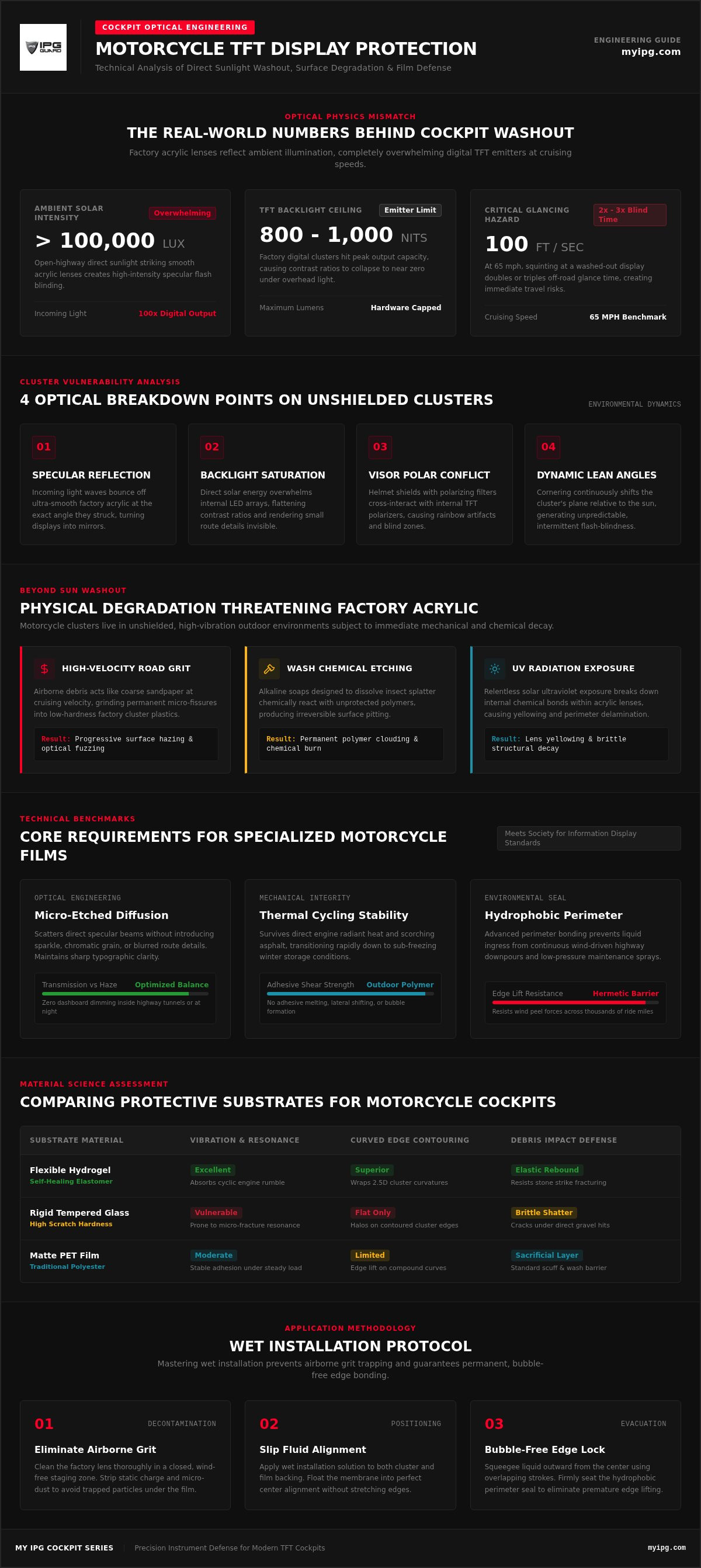
Cockpit safety depends entirely on rapid data retrieval. At 65 mph, your motorcycle covers nearly 100 feet per second. Squinting at a washed-out display doubles or triples your glance time off the road, creating an immediate hazard. Adding an engineered anti-glare film for motorcycle display protection neutralizes specular glare, preserving essential visibility without compromising the integrity of delicate instrument panels.
The Optical Physics of Direct Sunlight Washout
Specular reflection occurs when incoming light waves bounce off a smooth surface at the exact angle they struck. Sunlight can exceed 100,000 lux on open highways, while high-end bike displays generally cap backlight output between 800 and 1,000 nits. The mathematical mismatch is brutal. Ambient brightness overwhelms the digital emitter completely.
- Backlight saturation: Extreme overhead daylight drowns out LED luminance, flattening contrast ratios to near zero.
- Polarized visor conflict: Helmet shields with polarizing filters cross-interact with internal TFT polarizers, causing rainbow artifacts, blind zones, and heavy color shifting.
- Dynamic lean angles: Cornering shifts the cluster's plane relative to the sun, generating unpredictable, intermittent flash-blindness mid-turn.
Cockpit Exposure Risks Beyond Visual Glare
Visibility represents only half the battle; physical vulnerability completes it. Motorcycle clusters inhabit an unforgiving environment far harsher than enclosed car cabins. Factory acrylic lenses feature low surface hardness, leaving them open to rapid physical degradation from routine riding conditions.
Airborne grit acts like coarse sandpaper at cruising velocity, grinding micro-fissures into the plastic face. Aggressive bike washes strip bug splatter, but alkaline soaps etch unprotected polymers permanently. Worse still, relentless ultraviolet radiation breaks down internal chemical bonds, triggering yellowing, hazing, and eventual delamination. Installing a dedicated anti-glare film for motorcycle display defense provides an essential sacrificial barrier, preserving high-value instrumentation against premature optical decay.
Key Criteria When Evaluating Motorcycle Anti-Glare Films
Selecting an anti-glare film for motorcycle display use requires assessing physical performance criteria that generic consumer screen protectors never encounter. A motorcycle cockpit subjects display shields to continuous vibration, high-velocity particulate impacts, and intense environmental cycling. Prioritizing correct optical diffusion alongside resilient chemical formulation ensures your panel remains readable and physically protected across thousands of miles.
Matte Diffusion vs. Display Resolution Retention
Every anti-glare finish relies on micro-surface texturing to scatter incident light rays. Coarse matte films diffuse ambient glare easily, but excessive surface roughness causes sparkle, chromatic grain, and blurred route details. Premium motorcycle films use precision micro-etching. This scatters direct sunlight while preserving crisp dashboard typography and fine navigation routes.
Technical publications from the Society for Information Display emphasize balancing haze values against overall transmission to prevent perceptual display degradation. Aim for films delivering high total light transmission, preventing dashboard dimming inside highway tunnels or during pitch-black night riding.
Weather Resistance, Adhesion, and Thermal Stability
Cockpit electronics experience violent thermal swings. Direct engine radiating heat and blistering summer asphalt quickly elevate cluster surface temperatures, followed by rapid cooling in sub-freezing winter storage. Standard consumer glues liquefy, shift, or form perimeter bubbles under this stress.
- Thermal cycling tolerance: Outdoor-grade adhesives resist delamination caused by repeated heating and freezing intervals.
- Hydrophobic edge sealing: Specialized bonding agents withstand wind-driven highway downpours and low-pressure rinse cycles without lifting at the borders.
- UV-stable carrier polymers: Integrated ultraviolet inhibitors stop internal yellowing and adhesive clouding during prolonged seasonal sun exposure.
Chemical and Scratch Tolerance
Motorcycle clusters face aggressive chemical contaminants daily. Stray fuel vapor during fill-ups, airborne chain lube mist, and acidic bug residue quickly erode untreated plastic finishes. A resilient anti-glare film for motorcycle display cockpits acts as a robust sacrificial shield against these caustic elements.
Opt for elastomeric constructions with self-healing capabilities that actively absorb flying road grit rather than allowing microscopic scour marks to accumulate during cleaning. For riders seeking a comprehensive breakdown of impact thresholds and core material structures, reviewing the ultimate screen protector guide offers practical testing benchmarks. If you need proven defense tailored specifically for demanding vehicle cockpits, exploring precision shields from My IPG helps secure your setup with durable, purpose-built protection.
Material Comparison: Matte PET, Hydrogel, and Tempered Glass
Choosing the correct anti-glare film for motorcycle display protection requires balancing three competing variables: optical diffusion, impact absorption, and physical curvature tolerance. Generic phone protectors prioritize vertical drop survival on flat glass. Motorcycle cockpits, however, face high-frequency engine vibration, curved bezels, and direct projectile strikes from road debris. Each core material behaves differently when subjected to open-cockpit dynamics.
Performance Matrix of Motorcycle Display Films
Quantifying how each substrate handles specular reflection involves standards like the Information Display Measurements Standard (IDMS), which defines how surface treatments scatter incident illumination. Evaluating real-world durability requires looking closely at mechanical behavior under continuous wind sheer and thermal stress.
| Metric | Matte PET | Tempered Glass | Flexible Hydrogel |
|---|---|---|---|
| Glare Diffusion | Excellent (Coarse micro-etch) | Moderate (Topical coating) | Superior (Sub-micron texture) |
| Impact Dissipation | Low (Punctures easily) | Brittle (Cracks under point loads) | High (Elastomeric dispersion) |
| Curved Bezel Fit | Rigid (Edge halos likely) | Flat only (Lifts on contours) | Flawless (3D perimeter wrap) |
| Shatter Hazard | None | Elevated (Sharp cockpit shards) | None |
Rigid 9H tempered glass resists minor scratches from keys, but it introduces major drawbacks on two wheels. Road grit fired from a truck tire concentrates heavy kinetic energy into a single focal point, frequently shattering rigid glass panels. In a collision or gravel impact, fragmented glass shards around your handlebars present a real safety liability.
The Case for Flexible Hydrogel and Hybrid Films
Modern motorcycle dashboards rarely feature perfectly flat surfaces. Recessed digital clusters, round cafe-racer dials, and curved widescreen TFT assemblies cause rigid glass protectors to lift at the edges, letting moisture and fine grit creep underneath.
Flexible hydrogel solves this interface problem entirely. Its ductile thermoplastic polymer matrix conforms precisely across subtle display curves and perimeter bevels. When high-velocity gravel strikes the surface, the film's rubber-like elastomeric properties absorb and redistribute kinetic force across the material, preventing shock transmission to the fragile TFT beneath. Self-healing polymer chains also close up surface scuffs over time, keeping the anti-glare film for motorcycle display readability consistently smooth. For insights into how flexible polymer shields compare across diverse automotive screens, review our car screen protector buying guide.
Step-by-Step Installation Guide for Motorcycle Displays
Applying an anti-glare film for motorcycle display performance requires a controlled approach. Unlike applying a screen guard to a smartphone on a clean kitchen table, bike installations happen in mechanical environments filled with chain lube mist, airborne grit, and tight clearance angles behind handlebars. Precision technique guarantees an invisible, factory-grade barrier that resists high-speed wind shears.
Pre-Installation Cockpit Preparation
Never attempt installation outdoors or in a breezy driveway. Move the motorcycle inside an enclosed, draft-free garage to minimize floating dust. If your bike features a low-slung touring or sport windscreen, loosen the mounting bolts and tilt the screen forward. Clearing this physical obstruction grants straight-on hand access to recessed gauge housings.
Wipe down surrounding triple clamps, handlebar risers, and inner fairing panels with a damp microfiber cloth before touching the instrument cluster. Eliminating static dirt from adjacent hardware prevents debris from shedding onto the wet acrylic lens during positioning.
Precision Application and Bubble Removal
Achieving a bubble-free finish comes down to deliberate surface chemical prep and systematic fluid evacuation. Follow this methodical workflow:
- Decontaminate the cluster surface: Mist the factory lens with a dedicated screen cleaner or a 70% isopropyl alcohol dilution. Wipe thoroughly using a pristine, lint-free microfiber cloth to remove oily road film, grease fingerprints, and residue.
- Perform a dry test fit: Align your anti-glare film for motorcycle display instruments without removing the protective backing. Check edge margins and button cutouts. Anchor the top perimeter using low-tack masking tape to create a fixed hinge.
- Expose the adhesive matrix: Peel away the protective backing smoothly. If you are using a flexible hydrogel shield, mist the adhesive face lightly with installation slip solution to temporarily neutralize tackiness, allowing effortless micro-adjustments.
- Squeegee outward: Rest the film onto the display. Starting at the center axis, execute firm, overlapping squeegee strokes outward toward the bezels. Push all fluid and trapped air pockets directly into the perimeter margins.
Microscopic moisture hazing under flexible films typically dissipates through natural vapor transmission within 24 to 48 hours of curing. To equip your machine with precision-cut coverage engineered to survive harsh highway environments, find your custom motorcycle cluster protector at My IPG today.
Engineered Cockpit Protection: Upgrading Your Ride with My IPG
A motorcycle's digital cockpit is its mission control. When you invest in advanced TFT dashboards, guarding that visual interface against outdoor degradation becomes paramount. Off-the-shelf, universal trim-to-fit plastic sheets leave irregular, hand-cut edges that quickly lift when hammered by 70 mph highway airflow. Precision-engineered coverage delivers an exact perimeter seal, preserving critical cockpit legibility without compromising display aesthetics.
My IPG develops custom digital templates calculated specifically for motorcycle instrument panels. These multi-layer shields combine optical-grade light diffusion with resilient physical protection, allowing you to ride directly into midday glare without losing your tachometer or GPS directions.
Dedicated Protection for High-Value Instrument Clusters
Replacing an original equipment manufacturer (OEM) digital display assembly is painfully expensive. Dealership replacements often run deep into four figures for parts and labor, turning minor rock chips or chemical clouding into costly headaches. Treating your cluster to a purpose-built anti-glare film for motorcycle display instruments acts as a protective shield, preserving the pristine condition of your bike's underlying electronics and securing trade-in value.
V-twin and cruiser riders face unique cockpit geometry. For instance, dedicated options like the My IPG Camera Lens Protector for Harley Cluster Display protector provide millimeter-accurate digital patterns that align cleanly around bezel borders. Laser-guided CAD manufacturing ensures uniform coverage, resisting the engine vibration and edge peeling that plague generic films.
Long-Term Cockpit Maintenance for Motorcycle Enthusiasts
Caring for your protected instrument cluster requires minimal effort once a high-grade film is properly cured. Maintain your screen's clarity and surface resilience with these regular practices:
- Routine cleaning: Use a clean, water-dampened microfiber cloth to wipe away road dust. The sacrificial barrier absorbs friction, eliminating the fear of scouring soft acrylic lenses underneath.
- Prompt debris clearing: Remove acidic bug splatter and fuel residues promptly after long tours to keep light-diffusing matte micro-textures performing at peak efficiency.
- Safe detailing: Clean freely during regular bike washes without worrying about harsh soaps etching the native instrument cluster.
Defending sensitive vehicle electronics demands proven stewardship. To safeguard your machine's gauges with precision-engineered shields, explore the full protective lineup at My IPG.
Secure Your Cockpit for the Road Ahead
Blinding midday reflections shouldn't compromise your road safety or pull your eyes away from highway traffic. Equipping your machine with a high-performance anti-glare film for motorcycle display clarity transforms harsh specular reflections into soft, readable telemetry. It simultaneously creates a resilient sacrificial barrier, defending soft factory acrylic lenses against flying gravel, chemical washes, and abrasive cleaning cloths.
Your digital instrument cluster is among the most vital, costly components on your bike. It warrants deliberate stewardship. Selecting durable protective films engineered to endure extreme road conditions prevents permanent hazing, delamination, and four-figure dealer replacement bills. Precision computer-cut fitment for complex digital displays guarantees that your shield hugs every subtle bezel curve without peeling under heavy crosswinds.
Take control of your cockpit vision and defend what matters on two wheels. Shield your motorcycle display against glare and road debris with My IPG and ride into the sun with absolute confidence.
Frequently Asked Questions
Will an anti-glare film make my motorcycle TFT display look blurry or pixelated?
No, a premium anti-glare film for motorcycle display use won't cause blurriness or pixelation. High-grade shields utilize microscopic surface etching that diffuses specular glare while maintaining crisp text sharpness. Cheap matte films with coarse graining can introduce visual noise, but precision-engineered motorcycle films preserve fine digital gauge details and vibrant colors without dulling contrast.
Can I install an anti-glare screen protector on a motorcycle cluster with curved edges?
Yes, but you must choose flexible hydrogel rather than rigid tempered glass. Modern gauge clusters often feature contoured bevels or subtle 2.5D curves. While stiff glass lifts at perimeter edges, flexible hydrogel wraps smoothly across non-flat plastic faces, ensuring tight edge adhesion that resists wind shear and moisture intrusion.
Will high-pressure motorcycle washing cause the protective film to peel at the edges?
Direct blasts from a high-pressure washer nozzle can lift any protective film border. While automotive-grade adhesives resist rain downpours and low-pressure rinses, you shouldn't spray concentrated water jets directly at cluster seams. Clean your instrument area gently using low-pressure water or a soft damp microfiber towel to maintain long-term bonding.
How does an anti-glare display film perform when riding with a polarized helmet visor?
Quality anti-glare films actually reduce the rainbow artifacts and blackouts caused by polarized visors. By scattering surface reflection, the matte micro-texture softens the harsh phase shifts between your helmet shield and the TFT polarizer. This diffusion creates a more uniform viewing angle, keeping your navigation and tachometer readable regardless of your head position.
Can I remove the anti-glare film later without leaving sticky adhesive residue behind?
Yes, you can remove quality films cleanly without damaging underlying gauge plastics. Premium protective films rely on dry or wet-mount optical adhesives that release cleanly when peeled at an acute angle. If slight tackiness remains around the borders, a light wipe with a 70% isopropyl alcohol dilution dissolves it instantly without harming the acrylic lens.
Does an anti-glare film protect my digital motorcycle speedometer against rock chips?
Yes, flexible multi-layer films offer substantial defense against flying road debris. High-grade elastomeric hydrogel disperses the kinetic energy of gravel strikes, absorbing impacts that would otherwise pit or crack delicate factory cluster lenses. This durable barrier protects your high-value instruments from costly physical damage during daily highway rides.