

A decal that improves a car’s visibility may do nothing to protect its paint. That distinction matters when comparing protective vinyl decals for cars: reflective vinyl, standard decorative vinyl, and paint-protection film are designed for different jobs.
It’s easy to assume that any tough-looking vinyl offers both safety and surface protection. The right choice depends on your goal, the vehicle, and where the material will be placed. This guide explains what reflective decals can and can’t do, how they differ from paint-protection films and standard vinyl, and what to consider when checking fit, durability, installation, and removal.
Vehicle-specific decals can also support a focused personalization goal. My IPG’s automotive options include Tesla Model 3 and Model Y door handle decals, Honda wheel center-cap decals, and a Volkswagen front emblem decal. Compare products by their intended purpose, then choose one for the detail you want to personalize.
Key Takeaways
- Choose protective vinyl decals for cars based on their job: improving visibility, adding graphics, or shielding a surface.
- Reflective performance, weather resistance, UV resistance, and removability are separate material attributes, not interchangeable promises.
- Before applying a decal, define your goal, confirm dimensions, check surface compatibility, and follow product-specific directions.
- Vehicle-specific details, such as door-handle or wheel center-cap decals, serve a different purpose from general reflective safety graphics.
Protective Vinyl Decals for Cars: What Does Reflective Safety Mean?
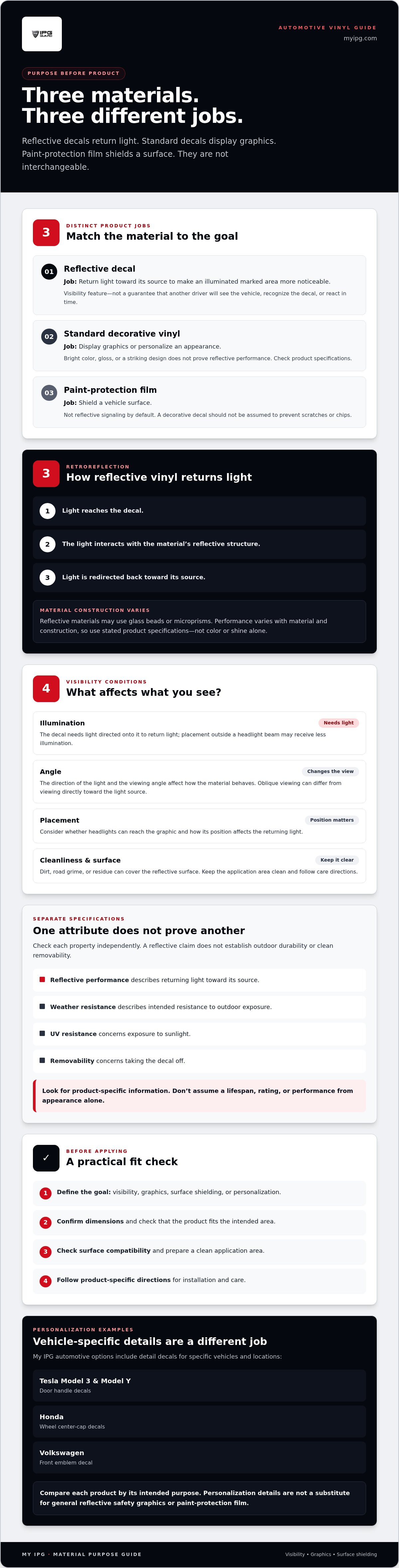
The word “protective” can describe different goals. You may want a graphic that stands out in headlights, a film that shields painted panels, or a decal that personalizes a specific vehicle detail. These products aren’t interchangeable. Reflective decals return light for visibility; standard decals display graphics; paint-protection film shields a surface. Start by identifying the job, then compare products against that goal.
A reflective decal uses a surface designed to send light back toward its source. This is called retroreflection. Light from a vehicle’s headlights can return toward the driver rather than scattering in many directions. The effect can make a marked area more noticeable under illumination, but it doesn’t guarantee another driver will see the vehicle or respond in time. The Retroreflective Sheeting overview explains the underlying technology and its uses.
Reflective decals versus ordinary car stickers
A bright color, glossy finish, or striking design doesn’t prove that a sticker is reflective. Ordinary colored vinyl can look vivid in daylight without having retroreflective properties. Look for product specifications that explicitly identify reflective performance rather than relying on appearance or the word “vinyl.”
Visibility also depends on where the graphic sits, the direction and strength of the light, the viewing angle, and the product’s specifications. A decal outside the headlight beam may receive less illumination, while a graphic viewed from an oblique angle may behave differently from one facing the light source. Consider placement and stated performance together.
Visibility graphics versus films that protect paint
Reflective material serves a visibility purpose. Paint-protection film is intended to shield a vehicle’s surface. It isn’t reflective signaling by default, and a decorative decal shouldn’t be assumed to prevent scratches or chips simply because it covers paint. Surface protection depends on choosing a product designed for that purpose.
Keep the surface in mind, too. An exterior graphic and a film fitted to an interior display face different conditions and protect different things. For vehicle screens, the car screen protector buying guide covers a separate kind of targeted protection for infotainment systems.
- Reflective decal: Choose it when returning light toward its source is the goal.
- Standard decal: Choose it for a graphic or personalized appearance, without assuming reflective performance.
- Paint-protection film: Choose it for surface shielding, not as a substitute for a visibility graphic.
Protective vinyl decals for cars aren’t one universal solution. Separate visibility, paint care, and personalization before you buy. That distinction helps match the material to the result you want.
How Reflective Vinyl Decals Work and What Affects Their Performance
Retroreflection sends light back toward the area it came from. On a car, light from an approaching vehicle’s headlights can be redirected toward the driver, making an illuminated marked area more noticeable. It doesn’t guarantee that a driver will see the decal, recognize it, or react in time. Treat it as a visibility feature, not a promise of safety.
Reflective materials use different constructions to return light. Some sheeting uses glass beads; other designs use microprisms. The Federal Highway Administration’s overview of How Reflective Sheeting Works explains these approaches in the context of sign materials. Decal performance varies with material and construction, so rely on specifications that explicitly describe reflective properties rather than judging by color or shine.
What happens when light reaches reflective vinyl?
Light reaches the decal, interacts with its reflective structure, and is redirected back toward its source. This differs from ordinary reflection, where light scatters in multiple directions. The visible result depends on the material, the light source, and the angle between the light, decal, and observer. Don’t assume all reflective products perform alike or that a particular graphic will be visible from a set distance.
Reflective performance depends on the material and the viewing conditions. Check product documentation for stated reflective properties and intended use. A reflective label or appearance alone doesn’t tell you how the material will perform in a particular installation.
Which conditions can affect visibility and wear?
Even a reflective surface needs light to return. Visibility can change with illumination, viewing angle, and placement. A decal positioned where headlights rarely reach may not serve its intended purpose. Dirt, road grime, or residue can also cover the surface and interfere with light reaching its reflective elements. Keep the application area clean and follow the product’s care instructions.
Consider visibility separately from other material properties. Outdoor or weather resistance describes how a product is intended to withstand exposure; UV resistance concerns exposure to sunlight; removability concerns taking the decal off. None of these attributes, by itself, proves reflective performance. Likewise, a reflective claim doesn’t establish how a decal will hold up outdoors or whether it can be removed cleanly. Look for product-specific information rather than assuming a lifespan or rating.
- Illumination: The decal needs light directed onto it to return light.
- Angle and placement: Position changes how light reaches the material and returns to an observer.
- Cleanliness and surface condition: Dirt or an unsuitable application surface can affect the installed decal.
- Separate specifications: Evaluate reflectivity, weather resistance, UV resistance, and removability individually.
For a defined personalization goal rather than a reflective safety graphic, explore My IPG’s vehicle-specific automotive decals, including options for select Tesla, Honda, and Volkswagen details.
Reflective Decals, Standard Vinyl, or Paint-Protection Film: How to Compare
Compare materials by function, not by how thick, glossy, or substantial they look. A colored decal may cover paint, but coverage alone doesn’t make it a paint-protection product. Reflective performance and surface shielding depend on the product’s design and specifications. There’s no universal “best” choice: the right one fits your goal, placement, and vehicle surface.
| Material | Primary purpose | Visibility | Surface coverage | Selection considerations |
|---|---|---|---|---|
| Reflective decal | Make a marked area more noticeable when illuminated | Designed to return light; performance varies by product and conditions | Usually applied to a defined area or graphic | Look for stated reflective properties and consider placement and viewing angle |
| Standard vinyl decal | Display a graphic, message, or decorative detail | Don’t assume it reflects light unless specifications say so | Depends on the decal’s shape and dimensions | Match design, size, surface, and intended use |
| Paint-protection film | Shield a vehicle surface | Not intended as a reflective safety signal by default | Depends on the film and area it’s designed to cover | Choose a product explicitly made for surface protection |
Which material fits your primary goal?
Start with the outcome. For visibility, choose a product whose documentation identifies reflective properties. A bright color or shiny finish isn’t proof. For branding or personalization, focus on the graphic, its dimensions, and how it will sit on the intended panel. For paint shielding, select a film described for that protective purpose rather than relying on a decorative sticker.
This goal-first approach keeps protective vinyl decals for cars from becoming a catch-all label. A product’s name or appearance can’t substitute for specifications. Read claims as separate attributes: a graphic may be weather-suitable without being reflective, and a reflective decal isn’t automatically protective film.
How placement and vehicle surface change the decision
Check the target area before choosing a size or material. A smooth, flat panel differs from a curved emblem, textured trim, or a door handle that’s touched frequently. Surface shape and condition can affect how well a decal fits and adheres, depending on its construction and application directions. Exposure to dirt, sunlight, and regular handling also matters. Measure the area to avoid edges extending onto a seam, contour, or neighboring surface.
Keep vehicle exterior graphics separate from films made for electronic displays. They protect different surfaces and have different fit requirements. For a vehicle’s infotainment screen, the screen protector guide focuses on display protection, not exterior decal selection.
Before buying, write down the goal, identify the exact placement, measure the available area, and compare those details with the product’s intended use. This helps match the material to the job without treating gloss, color, or thickness as proof of performance.
How to Choose, Apply, and Care for Car Vinyl Decals
A careful choice starts before the decal reaches the vehicle. Define the job, match the material and dimensions to the intended area, then follow the product’s application and care instructions. These checks help avoid a mismatch, especially on curved, textured, or frequently handled areas.
A five-step checklist before buying
- Define the goal. Decide whether you want increased visibility, decoration, branding, or surface protection. These goals call for different product attributes. Don’t expect a graphic decal to shield paint or a protective film to provide reflective signaling.
- Choose material for that goal. For a visibility-focused graphic, look for product specifications that identify reflective performance. For decoration or branding, focus on the design and intended placement. For paint shielding, choose a product explicitly made as protective film.
- Confirm dimensions. Measure the intended area and compare it with the decal size. Account for nearby edges, seams, curves, and trim so the graphic fits the specific vehicle detail without covering areas you want to leave clear.
- Inspect the placement. Consider the surface shape, texture, condition, and how often the area is touched or exposed. Check that the product is designed for that surface and intended use. Placement matters for both fit and function.
- Follow product directions. Read the application and care instructions before beginning. Surface preparation, installation conditions, and aftercare can differ by product, so don’t substitute general advice for the maker’s directions.
Application and care without avoidable damage
Prepare the vehicle surface as the decal instructions direct. If they call for cleaning and drying, follow those steps before applying the graphic. Dust, residue, or a surface in poor condition can interfere with the result. Don’t assume every vinyl decal uses the same application method or tolerates the same conditions.
Paint condition deserves attention, too. Existing damage, wear, or prior repairs may affect how a surface responds to an applied decal or its later removal. For drivers seeking to restore their finish or prepare exterior surfaces properly, professional care from Insta Tints Canada can help ensure the vehicle's surface is clean and well-maintained. Removal method matters; avoid pulling at a decal without following product-specific directions, since the outcome can depend on both the material and the surface beneath it. No universal temperature range, waiting period, or removal technique applies to every product.
For protective vinyl decals for cars, keep the product’s purpose and care requirements clear from the start. A visibility claim, outdoor-use claim, and removable design are separate considerations. Review the relevant product information and follow its instructions for application and ongoing care.
For a defined vehicle-detail goal, explore My IPG automotive decals, including options for Tesla Model 3 and Model Y door handles, Honda wheel center caps, and Volkswagen front emblems.
My IPG Automotive Decals: Find a Vehicle-Specific Detail
A vehicle-specific decal is designed for a particular detail on a particular vehicle. That makes it different from a general reflective safety graphic, whose purpose is to return light toward its source. My IPG’s automotive decal options focus on defined vehicle placements, giving you a practical starting point when your goal is personalizing a door handle, wheel center cap, or front emblem.
Keep the intended result clear. These are vehicle-detail decals, not substitutes for reflective graphics or paint-protection film. Product names identify the application, but don’t assume reflectivity, surface protection, material properties, or installation features unless the product listing states them.
Choose a decal for the detail you want to personalize
Start with the part of the vehicle you want to update. My IPG offers the IPG Tesla Model 3 / Model Y door handle decal, the IPG Decal Honda Center Cap Overlay Wheel Tire Decals, and the IPG Volkswagen Front Emblem Logo. Each option is for a different vehicle detail, helping narrow your choice by placement rather than by a general graphic style.
- Door handle: The Tesla option is identified for Model 3 and Model Y door handles.
- Wheel center cap: The Honda option is a center-cap overlay wheel tire decal category.
- Front emblem: The Volkswagen option is a front emblem logo decal.
Match the product category to your intended result
Think about where the decal will sit and what you want to personalize. Door-handle, wheel-center-cap, and front-emblem applications are distinct placements, not interchangeable labels. Choose the category that corresponds to the detail you have in mind, then review the product listing for vehicle fit and product details.
If your goal is nighttime visibility, keep that decision separate. A vehicle-specific decal name doesn’t establish reflective performance. Look for a product whose specifications explicitly describe the visibility properties you need. Likewise, don’t treat a decal applied to a vehicle detail as paint-protection film unless it is described as a product designed for surface shielding.
This distinction helps you choose: select a vehicle-detail decal for targeted personalization, and evaluate reflective graphics or protective films by their own specifications. Avoid guessing from a product’s appearance or placement. Let the vehicle and intended area guide your selection.
Ready to focus on a specific vehicle detail? Explore My IPG automotive decals and find the category that matches your personalization goal.
Choose the Detail You Want to Make Your Own
Focus on one vehicle detail and decide what you want it to achieve. A clear goal makes it easier to narrow the options, review product details, and select a decal for that specific spot. Think beyond the graphic itself: a good fit starts with the vehicle and the area you want to personalize.
My IPG’s vehicle-specific options include a Tesla Model 3 and Model Y door handle decal, Honda wheel center-cap decals, and a Volkswagen front emblem decal. These are targeted personalization choices, distinct from reflective safety graphics. Keep that distinction in mind as you explore protective vinyl decals for cars, and use each product listing to guide your selection.
Explore My IPG automotive decals and find a vehicle-detail option that fits your next personalization goal. Choose thoughtfully, and make the detail feel like it belongs to your car.
Frequently Asked Questions
Are all car vinyl decals reflective?
No. Vinyl describes a broad material category, not a guaranteed reflective property. Treat a decal as reflective only when its product specifications identify reflective performance. Color, gloss, or a bright appearance alone doesn’t show that it returns light toward its source. Before choosing protective vinyl decals for cars, compare the stated material and intended use with your goal rather than judging by how the decal looks in daylight.
Can protective vinyl decals prevent scratches on car paint?
Not by default. A decorative or visibility decal shouldn’t be relied on to prevent scratches, even if it feels thick or covers the paint. A graphic on a door panel, for example, may change its appearance without providing the surface shielding you need. Check the product’s stated purpose and coverage. If scratch protection is the priority, choose a product specifically described for that function, not one selected for its color or design.
Can I put a vinyl decal over existing paint-protection film?
Possibly, but compatibility depends on the specific decal adhesive, film surface, vehicle finish, and removal requirements. A decal that adheres to bare paint may behave differently over a film. Before layering products, review the instructions for both and look for guidance on applying one over the other. If preserving the underlying layer matters, follow the manufacturers’ directions for the exact materials involved.
Will removing a car decal damage the paint?
It can, depending on the paint’s condition, adhesive, time in place, and removal method. A decal over chipped or aging paint may pose a different risk from one on a sound finish. Follow the product’s removal instructions, and avoid aggressive tools or chemicals unless the decal and vehicle guidance permits them. Don’t assume every decal comes off without residue or that removal is paint-safe in every situation.
How long do protective vinyl decals last on a car?
There’s no single lifespan that applies to every decal. Material, application, sunlight, weather exposure, washing, surface condition, and care all influence wear. Use the product’s own durability information rather than a generic estimate. If visibility is important, remember that wear may affect reflective performance differently from the decal’s physical condition. Review those claims separately, and follow the care directions to avoid adding unnecessary stress during washing or maintenance.
Can reflective car decals replace lights or legally required reflectors?
No. Don’t treat an aftermarket decal as a replacement for vehicle lights or required safety equipment. Rules for decal placement can vary by location and vehicle setup, so check the requirements that apply where you drive. Keep original lights and reflectors unobstructed, and don’t place graphics where they interfere with visibility. Reflective material may help make a marked area more noticeable under some conditions, but it can’t guarantee that others will see your car.
Ready to personalize a vehicle detail? Explore My IPG automotive decals to find an option for a Tesla door handle, Honda wheel center cap, or Volkswagen front emblem.