

The "official" seal on a box doesn't always mean superior defense. You just spent a small fortune on a flagship device, and the manufacturer suggests their basic plastic film is the gold standard. It isn't. When asking are phone manufacturer screen protectors worth it, the answer lies in the gap between retail profit margins and genuine display stewardship. Most OEM shields are designed for mass production efficiency, not for the long-term survival of your high-value screen.
It's frustrating to watch a brand-new device develop edge chips or micro-scratches on glass that was marketed as "unscratchable." We understand the need to protect your investment with precision. This 2026 performance guide promises to show you why specialized materials like IPG Original hydrogel outperform factory options. You'll learn how to achieve true edge-to-edge coverage for curved displays and discover cost-effective materials that actually heal themselves. We will break down the technical specifications of advanced films and help you select a dedicated guardian for every screen in your life, from your smartphone to your vehicle's navigation display.
Key Takeaways
- Identify the limitations of official accessories and why mass-produced rigid glass often fails to protect high-value curved displays.
- Evaluate the technical data to decide are phone manufacturer screen protectors worth it when compared to specialized, energy-absorbing alternatives.
- Discover the benefits of IPG Original (Hydrogel) self-healing technology for maintaining long-term display integrity and edge-to-edge coverage.
- Extend professional-grade stewardship to all your tech, from Tesla and BYD automotive screens to industrial Snap-on and Autel diagnostic tools.
- Achieve a perfect, bubble-free application every time using ZeroDust installation technology designed for precision home use.
The OEM Myth: Why Factory Screen Protectors Often Fall Short
The "official" badge on a box is often a marketing shield, not a physical one. Most major smartphone brands view accessories as high-margin add-ons designed to pad quarterly earnings. They don't engineer these protectors with the same rigor as the device itself. Instead, they rely on mass-produced, low-cost templates that prioritize shipping speed over display stewardship. When evaluating are phone manufacturer screen protectors worth it, you're often paying a premium for a logo rather than material performance. Your device is a high-value asset. It requires a dedicated guardian, not a generic retail afterthought.
The Margin vs. Performance Gap
Manufacturers maximize profit by bundling basic protection. These factory-grade accessories usually consist of thin PET films or standard tempered glass. While these screen protector materials offer a baseline level of scratch resistance, they lack advanced energy-absorption properties. Specialized alternatives, like My IPG Original films, focus on material science to provide self-healing capabilities that OEM plastic simply cannot match. Factory production lines are optimized for "one-size-fits-most" efficiency. This leads to gaps in coverage and leaves the most vulnerable parts of your hardware exposed to daily wear and tear.
Common Failures of Manufacturer Glass
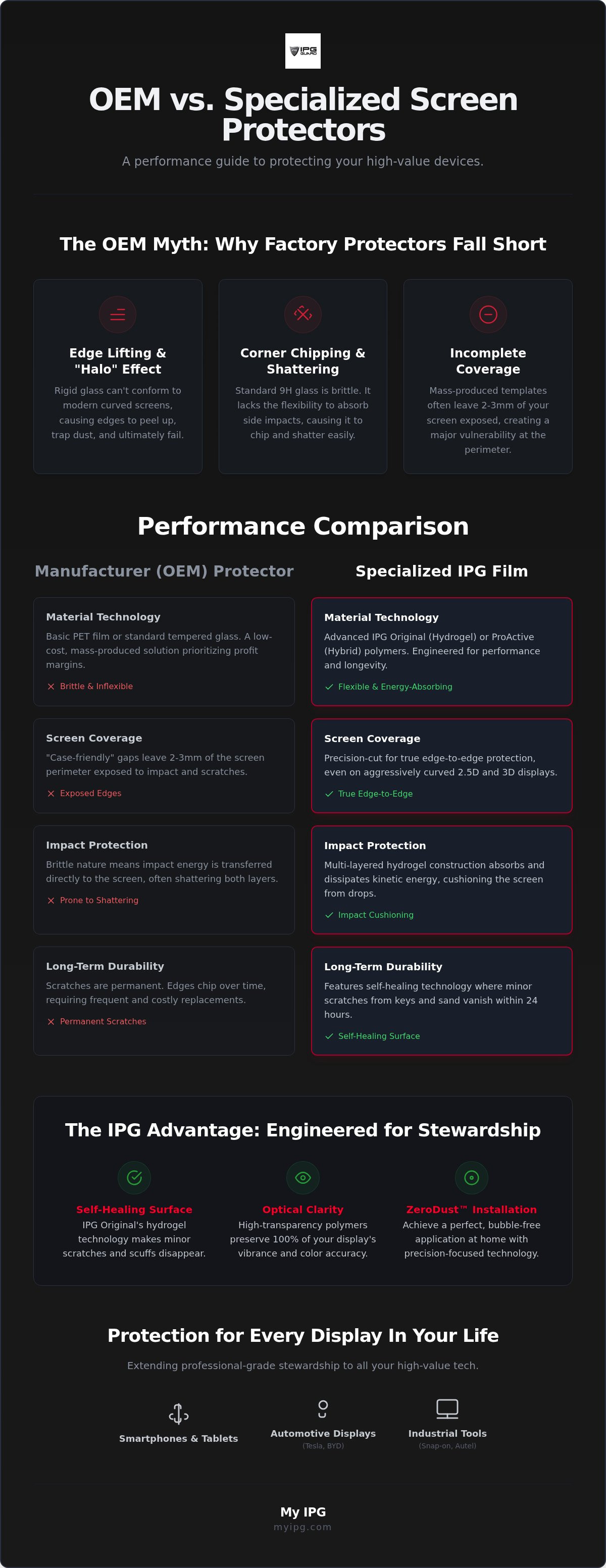
Rigid glass is the standard OEM choice; however, it's fundamentally flawed for modern hardware. Modern flagship displays feature subtle curves and complex geometries that rigid factory glass struggles to hug. This mismatch results in the "halo effect," where a white border of unadhered adhesive traps dust and debris. These gaps eventually lead to total adhesion failure. Consider the most common issues with manufacturer-supplied glass:
- Edge Lifting: Brittle glass peels away at the corners because it cannot maintain a bond on curved surfaces.
- Corner Chipping: Standard 9H glass lacks the flexibility to survive side impacts; it shatters rather than absorbs.
- Poor Tolerances: Mass-market shields often leave 2-3mm of exposed screen at the perimeter to ensure they fit a wider variety of generic cases.
Stewardship means preserving the integrity of your technology for the long haul. Generic retail shields provide a false sense of security. They protect against minor scuffs but fail during a critical drop. Specialized films are engineered to act as a sacrificial layer; they absorb the kinetic energy that would otherwise shatter your expensive OLED panel. Don't settle for the minimum viable product provided in the box. Choose a solution built for precision and preservation.
Specialized Protective Films: Exploring Hydrogel and ProActive Tech
The core difference lies in flexibility. Hydrogel is a polymer-based film that absorbs energy rather than cracking. This allows the material to dissipate kinetic force, acting as a buffer for your high-value OLED or LCD panel. It's the difference between a ceramic plate and a rubber mat. One breaks under pressure; the other adapts.
The Benefits of IPG Original Hydrogel
IPG Original provides a level of protection that factory-supplied accessories simply cannot match. Its primary advantage is the self-healing property. Minor micro-scratches from pocket sand or keys don't remain permanent marks. Instead, the material's molecular memory allows it to return to its original state, often making scratches vanish within 24 hours. This keeps your display looking pristine for years, not weeks.
- Impact Cushioning: Multi-layered construction absorbs shocks that would shatter rigid glass.
- Optical Clarity: High-transparency polymers preserve display vibrance and color accuracy.
- True Coverage: Precision-cut designs offer edge-to-edge display coverage, even on the most aggressive 2.5D and 3D curved screens.
Why ProActive is the Hybrid Future
For users who demand the tactile feel of glass without the fragility, IPG ProActive is the solution. It's a hybrid material that delivers 9H hardness in a flexible, shatter-proof format. This technology is specifically engineered for high-resolution displays where clarity is paramount. It bridges the gap between traditional films and tempered glass.
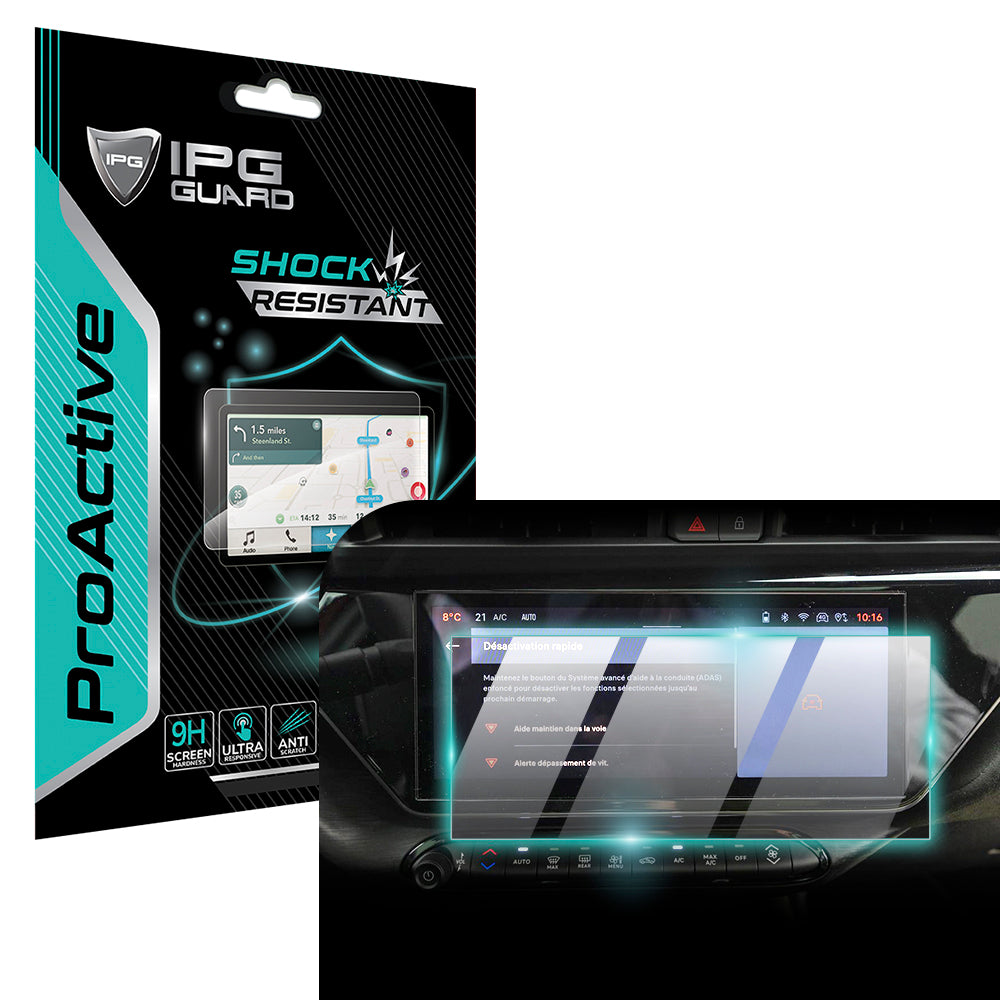
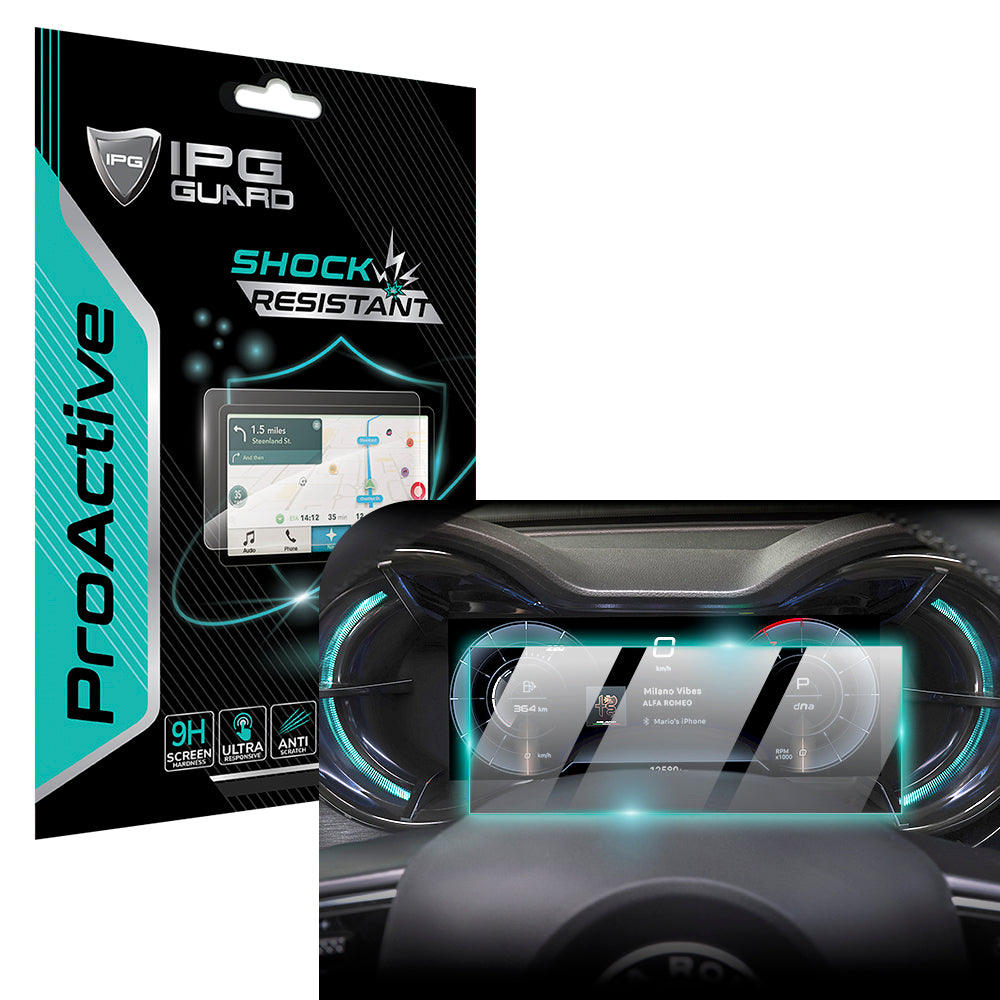
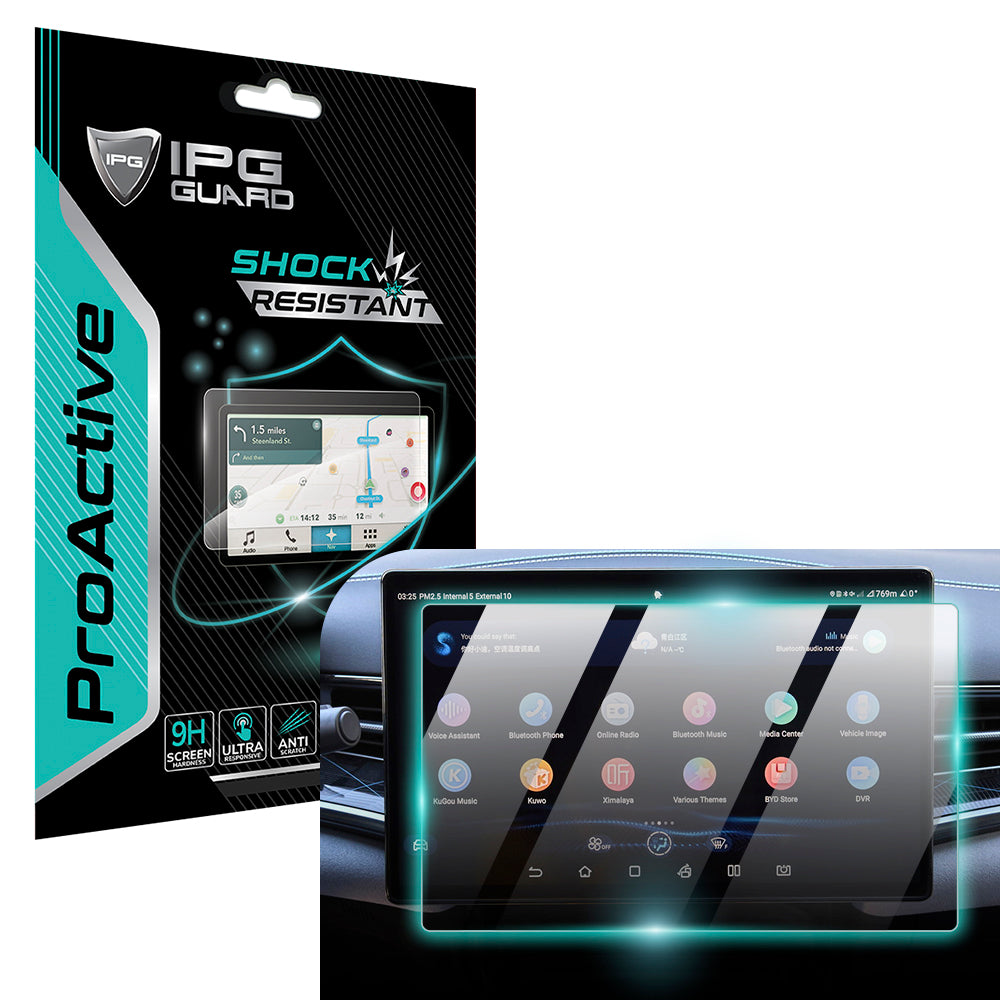
This hybrid approach is vital for more than just smartphones. In automotive environments, like the 15.6-inch displays in the BYD Seal, safety is the priority. ProActive films provide anti-shatter protection, ensuring that if a screen is struck, it remains in one piece. This prevents hazardous shards from becoming projectiles. If you've asked are phone manufacturer screen protectors worth it for your vehicle or professional tools, the answer is found in these hybrid materials. For those who value this meticulous level of safety, investing in IPG ProActive tech is the ultimate act of stewardship over your technology.
Performance Comparison: Specialized Alternatives vs. Manufacturer Glass
Evaluating raw performance data reveals a stark reality. When asking are phone manufacturer screen protectors worth it, look at the failure rate of rigid materials under stress. Rigid glass shatters on contact. It transfers kinetic energy directly to your expensive display. In contrast, energy-absorbing hydrogel acts as a crumple zone. It dissipates force across its molecular structure. Brittle glass fails. Precision films endure. This fundamental difference in physics determines whether your screen survives a drop or requires a costly replacement.
Biometric compatibility is another critical failure point for standard OEM glass. Modern flagship devices utilize ultrasonic in-display fingerprint sensors. Thick, rigid factory shields often create an air gap or density barrier that prevents consistent recognition. IPG films are engineered for maximum conductivity and minimal thickness. They maintain 100% touch sensitivity. Your device responds instantly. No missed scans. No frustrated retries. This level of precision is essential for professional-grade hardware where speed and reliability are non-negotiable.
Durability and Edge Protection
Edge chipping is the most common complaint with manufacturer-supplied glass. These shields are cut with generic tolerances that leave the perimeter of your screen exposed. Once a tiny crack forms at the edge of rigid glass, the structural integrity is compromised. It will spiderweb across the entire surface. Specialized IPG films utilize a flexible composition that cannot chip or crack. Because modern screen protectors must adapt to curved edges, our precision-cut designs wrap around the display geometry. This provides a seamless bond that generic factory shields simply cannot achieve. A specialized alternative often outlasts three or four standard glass protectors.
User Experience: Touch and Sight
High-end protection should be invisible. Specialized materials use advanced oleophobic coatings that repel oils and moisture more effectively than basic OEM glass. This reduces fingerprint smudges and keeps the display clear during heavy use. In high-light outdoor environments, glare reduction becomes a safety feature. Whether you are checking a marine GPS on open water or a diagnostic tool in a bright workshop, visibility is paramount. Specialized films preserve 100% display vibrance while cutting down on harsh reflections. This ensures your high-resolution panels remain legible and responsive in every condition, from the office to the industrial floor. Don't let a low-quality factory film degrade your visual experience.
Beyond Phones: Protecting Every Display in Your Life
At My IPG, we understand that stewardship isn't limited to what you carry in your pocket. High-value screens exist in your car, your workshop, and on your wrist. When people ask are phone manufacturer screen protectors worth it, they often overlook the fact that the same mass-market logic applies to every "official" accessory. Generic factory films for marine GPS or automotive displays prioritize low production costs over specialized durability. Replacing an infotainment system or a marine navigation unit can cost thousands, making a basic retail film a risky gamble. Your technology deserves a dedicated guardian that understands the specific environmental stresses of each niche. Mass-produced plastic covers don't account for the unique chemical exposures or thermal variations these specialized devices face daily.
Automotive and EV Display Care
Modern EVs like the Tesla Model 3/Y and BYD Seal rely on massive, high-resolution central hubs. These screens are exposed to constant UV radiation and extreme cabin temperatures that can cause standard adhesives to bubble or peel. Installing specialized car screen protectors is vital for preventing permanent micro-abrasions from cleaning and repetitive touch. Beyond the screen, custom-fit decals for door handles and emblems preserve the exterior finish of your vehicle against road debris. Precision-cut protection ensures your car's interior remains as pristine as the day it left the showroom, maintaining both visual appeal and resale value.
Professional and Industrial Tool Protection
In a professional workshop, a cracked screen means expensive downtime. Industrial diagnostic tools from Snap-on and Autel feature complex displays that must withstand grease, caustic chemicals, and physical impacts. A Snap-on Triton or Apollo requires heavy-duty shielding to maintain clarity in harsh fluorescent lighting. The high-resolution displays of Autel MaxiSYS diagnostic systems are particularly sensitive to the grit and grime of a busy garage. They demand high-transparency films that won't interfere with touch responsiveness while wearing heavy work gloves. Protecting these assets is a matter of professional reliability. Chemical resistance is a critical requirement; specialized films prevent brake fluid or industrial degreasers from etching into the display surface and ruining your diagnostic visibility.
Wearables and Outdoor Gear
Your outdoor gear faces the most aggressive conditions. Whether it's a Garmin Descent during a deep-sea dive or a Harley-Davidson cluster display on the open highway, standard protection isn't enough. These screens need salt-resistant, anti-glare films that stay bonded through heavy vibration and moisture. While you might start with an iPhone screen protector guide for your daily carry, true stewardship means extending that same logic to your cameras and wearables. When you realize are phone manufacturer screen protectors worth it for your mobile device, the same protective logic should apply to your specialized outdoor equipment. Preserving the optics of your Canon or Nikon gear ensures your investment holds its value through every adventure.
If you're ready to secure every screen in your ecosystem with precision-engineered films, explore our full catalog of specialized protection today.
The IPG Advantage: Precision Protection Engineered for Stewardship
True stewardship requires more than just a sacrificial layer. It demands a perfect, microscopic fit. When you ask are phone manufacturer screen protectors worth it, you're really asking if a generic, mass-produced product can protect a unique, high-value asset. IPG rejects the one-size-fits-all mentality. We've developed precision-cut technology for over 10,000 device models. This ensures every sensor, speaker, and curved edge receives exact coverage. Our engineering team analyzes the specific geometry of each device to prevent the edge-lifting and "halo effects" common with OEM glass. This isn't just manufacturing; it's a commitment to preserving the tools you rely on every day. We prioritize global device compatibility so no piece of technology is left vulnerable to the elements.
ZeroDust and Easy Installation
The biggest barrier to effective protection is a poor application. Bubbles and dust specks aren't just unsightly; they compromise the physical bond between the film and the glass. Our ZeroDust auto-removal tempered glass tray revolutionizes the home installation experience. It automates the critical alignment and dust-removal steps that often lead to failure. The tray secures the device in a fixed position, while the integrated film removes surface particles immediately before the protector is applied. The result is a seamless, bubble-free look that rivals high-end factory finishes. You don't need to be a professional technician to be a dedicated guardian of your technology. This system empowers you to apply professional-grade protection in seconds, ensuring your display remains flawless, responsive, and fully functional under any conditions.
The Complete Protection Catalog
Our expertise extends across the entire electronic ecosystem, providing a shield for every point of interaction. Modern mobile sensors are incredibly sensitive and prone to micro-abrasions. Because of this, IPG Phone camera lens protectors are essential for maintaining optical clarity without compromising autofocus or low-light performance. We also offer specialized IPG Privacy Screen Protectors to secure your sensitive data from prying eyes in public spaces. From Lowrance marine GPS units to industrial Autel diagnostic tablets, our catalog provides a tailored solution for every high-value screen in your professional and personal life. Don't settle for the compromises of mass-market retail or the question of are phone manufacturer screen protectors worth it. It's time to choose performance and material innovation over simple convenience. Upgrade your device protection with IPG today and experience the security that comes from expert craftsmanship.
Elevate Your Standard of Display Stewardship
True protection requires a dedicated specialist. We offer precision-engineered fits for over 10,000 device models, ensuring that every display in your ecosystem remains flawless. Whether you're safeguarding an industrial diagnostic tool or your daily carry smartphone, you deserve a guardian that understands material durability. Take the next step in preserving the integrity of your high-value items. Secure your displays with precision-cut IPG protection today. Your tech is ready for the long haul. Let's keep it that way.
Frequently Asked Questions
Are third-party screen protectors better than manufacturer ones?
Yes, specialized third-party alternatives offer superior material performance and precision. While asking are phone manufacturer screen protectors worth it, consider that OEMs often bundle basic plastic or brittle glass to maximize profits. Specialized providers like IPG focus on stewardship, using advanced polymers that provide better impact absorption and edge-to-edge coverage. These materials are engineered for durability across more than 10,000 device models, ensuring a precision fit that factory-supplied accessories simply cannot match.
Will a hydrogel screen protector protect against drops?
Yes, hydrogel films are specifically engineered to dissipate kinetic energy during a drop. Unlike rigid tempered glass that shatters upon impact, the flexible polymer structure of IPG Original acts as a sacrificial buffer. It absorbs and spreads the force of the hit, preventing the energy from reaching your high-value display panel. This resilience makes it a superior choice for protecting against the accidental impacts of daily life while maintaining a slim profile.
Do screen protectors interfere with ultrasonic fingerprint sensors?
Most high-quality specialized films do not interfere with biometric sensors. Rigid, thick manufacturer glass often creates a density barrier that blocks ultrasonic waves, leading to failed scans. IPG films are engineered for maximum conductivity and minimal thickness, ensuring 100% compatibility with in-display fingerprint sensors. You maintain the security of your device without sacrificing the speed or reliability of your biometric authentication, which is essential for modern flagship hardware.
Can I install a specialized screen protector myself without bubbles?
You can achieve a professional, bubble-free installation using the ZeroDust technology system. This innovation automates the alignment and cleaning process, removing surface particles immediately before the protector is applied. The integrated tray secures your device, ensuring a perfect fit every time. This eliminates the frustration of traditional manual applications and the common question of are phone manufacturer screen protectors worth it when they lack such precise, user-friendly installation tools for home use.
Why do manufacturer glass protectors chip so easily at the edges?
Edge chipping occurs because rigid glass lacks flexibility and is cut with loose tolerances. Manufacturers often leave a gap at the perimeter to ensure their shields fit a wide variety of generic cases. This exposed edge is highly vulnerable to side impacts. Once a micro-crack forms in brittle glass, it quickly spiderwebs across the entire surface. Specialized films avoid this failure by using flexible materials that wrap around the display geometry and bond securely.
Are there screen protectors for car navigation and industrial tools?
Specialized protection is available for a vast range of high-value electronics beyond smartphones. We provide precision-cut shields for Tesla and BYD navigation screens, ensuring anti-glare visibility and scratch resistance. For professional environments, we offer heavy-duty protection for Snap-on and Autel diagnostic tools that must survive chemical exposure. Our catalog also includes salt-resistant films for Lowrance fishfinders and Garmin wearables, extending stewardship to every high-resolution display in your professional and personal life.
How do I remove a screen protector without damaging the display?
Removing an old shield is a straightforward process that won't harm your hardware. Start at one corner and use a fingernail or a thin plastic card to gently lift the edge. Once you have a grip, peel the material back slowly at a low angle. IPG Original and ProActive films use advanced adhesives that leave zero residue on your display. This ensures your screen remains in pristine condition, ready for its next layer of precision-cut protection.
What is the difference between IPG Original and IPG ProActive?
The primary difference lies in the material composition and specific protective goals. IPG Original is a hydrogel-based film featuring self-healing technology that allows micro-scratches to vanish within 24 hours. It is ideal for curved displays. IPG ProActive is a hybrid material that delivers 9H hardness in a flexible, shatter-proof format. It provides the tactile feel of glass with the durability of a film, making it perfect for high-resolution automotive displays and modern mobile screens.