

What if the glass meant to save your flagship smartphone is the very thing ruining your sunset shots? It's a valid concern for any creator. You need to shield those protruding 4mm camera islands from permanent damage, yet you constantly ask: do camera lens protectors affect photo quality? The anxiety over ghosting in night photos or a loss of clarity is real. A single lens replacement can cost over $200 in 2026, making protection essential, but not at the expense of your art.
We understand the weight of this choice. Your gear represents a significant investment that requires expert stewardship. This article reveals the technical truth about how light interacts with protective layers. Discover how to maintain 100% photo integrity while utilizing a high-performance sacrificial shield. We focus on results, ensuring your hardware stays pristine without sacrificing sharpness or color accuracy.
We'll examine the optical science behind ANSI Z80.1-2025 standards and why multi-layer coatings are vital for light transmission rates over 99%. Learn how to choose optical-grade glass that eliminates distortion and follow our guide for a perfect, bubble-free installation. It's time to secure your lenses with professional confidence.
Key Takeaways
- Master the 99% rule. Learn how professional-grade glass achieves near-perfect light transmission for invisible protection.
- Address the core concern: do camera lens protectors affect photo quality? Identify the technical causes of ghosting and flash flare.
- Evaluate material properties. Contrast the impact resistance of tempered glass with the ultra-hard surface of sapphire crystals.
- Neutralize the hidden enemies of sharpness. Discover why precise installation is the most critical factor in preventing haze and moisture buildup.
- Protect your investment. Maintain 100% photo integrity while safeguarding the resale value of your high-end iPhone or Samsung hardware.
The Physics of Protection: Understanding Light Transmission
Protecting your lens isn't just about blocking scratches. It's about managing the journey of every photon that enters your camera. Light Transmission Rate (LTR) is the critical metric here. It measures the exact percentage of light that successfully penetrates the protective layer to reach your phone's sensor. When users ask, do camera lens protectors affect photo quality, they are usually reacting to low-LTR materials that dim the image or muddy the details.
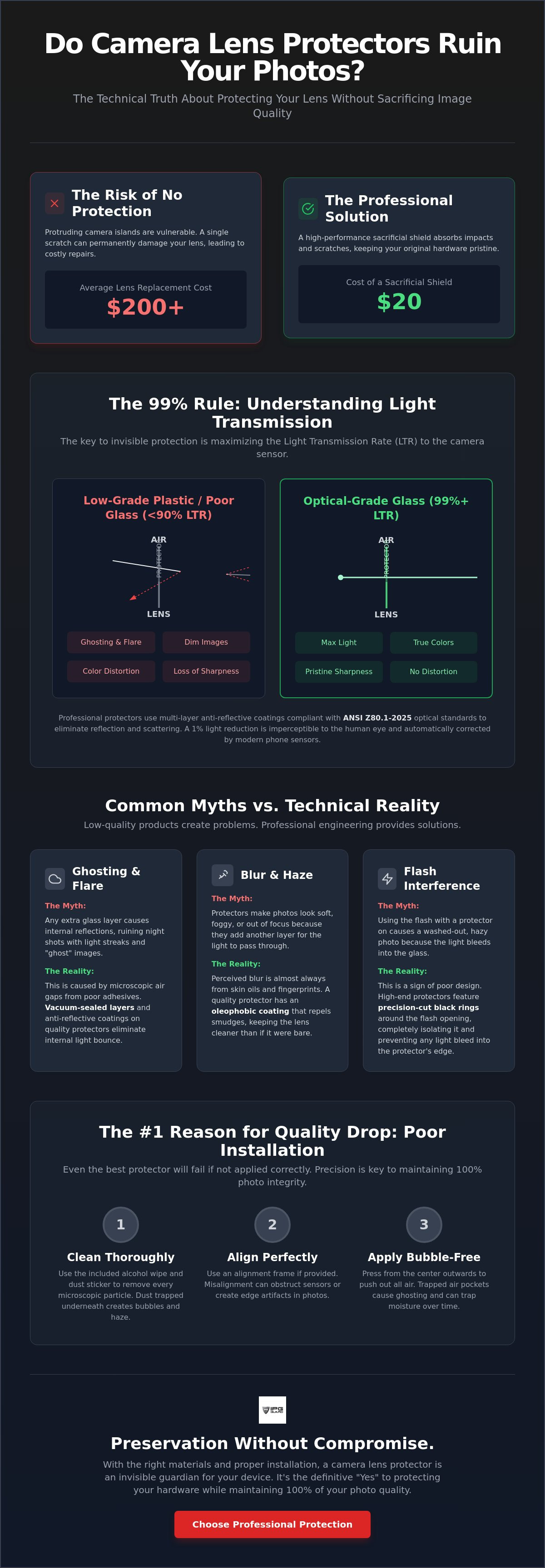
Professional-grade glass follows the 99% rule. By achieving a transmission rate of 99% or higher, the protector becomes effectively invisible to the sensor. This high performance depends on understanding The Physics of Light Transmission. When light moves from air into glass, it naturally wants to bend or reflect. This is the refractive index at work. High-quality shields use specialized coatings to ensure light moves through the barrier without bouncing back or scattering, preserving the original intent of your shot.
Think of this hardware as sacrificial protection. You're installing a professional guardian over your device. At My IPG, we view this as a calculated decision to replace a $20 shield instead of facing a $500 repair bill for a shattered lens assembly. This proactive stewardship ensures your hardware remains pristine while your images stay professional.
Why 1% of light loss is imperceptible to the human eye
The human eye perceives light on a logarithmic scale. We don't notice small linear changes in brightness. A 1% reduction in photons is mathematically measurable but visually non-existent to the naked eye. Modern smartphones also use powerful Image Signal Processors (ISP). These chips automatically compensate for microscopic filtration by adjusting exposure and gain in real time. While standard glass might block 10% of light, a My IPG Camera Lens Protector for iPhone Samsung Tempered glass maintains that 99% threshold. You get total security without any change to your exposure settings.
Refractive index matching: Keeping the light straight
Light diffraction happens when rays hit an uneven surface and scatter. This is why cheap plastic protectors ruin your photos. They lack the structural integrity to keep light paths straight. We utilize ultra-thin profiles to minimize the distance light travels through the glass. This reduces the chance for diffraction to occur. Optical clarity is the absence of light scatter within the material. By matching the refractive index of the protector to your phone's original lens, we ensure light travels in a predictable, straight line. This precision is how we answer the question: do camera lens protectors affect photo quality? With the right materials, the answer is a definitive no.
Common Myths: Flare, Ghosting, and the 'Blur' Factor
Misconceptions often cloud the truth about camera safety. You've likely heard that adding a layer of glass creates a foggy mess or ruins night shots. This isn't a failure of the concept. It's a failure of low-grade manufacturing. When exploring do camera lens protectors affect photo quality, we must distinguish between optical-grade shields and cheap plastic covers. True performance comes from precision engineering, not just a clear sticker.
Ghosting happens when light reflects between the protector and the lens. This occurs when poor adhesives create microscopic air gaps. High-quality tempered glass from My IPG uses vacuum-sealed layers to eliminate this bounce. Research into the impact on image quality shows that professional filters have a negligible effect on sharpness and color. We apply these same professional standards to our mobile hardware protection.
Flash flare is another common complaint. This happens when the LED flash leaks light into the side of the protector glass, washing out the image. We solve this with precision engineering. By isolating the flash, we ensure zero light bleed. Often, perceived "blur" is simply a fingerprint smudge. Modern lenses are magnets for skin oils. Our oleophobic coatings repel these contaminants, keeping your vision clear. Don't worry about your LiDar or TOF sensors either. These infrared systems penetrate clear glass without interference. For those who refuse to compromise, a My IPG Phone camera lens protector provides the ultimate invisible defense.
Solving the Night Photo Ghosting issue
Night photography demands perfect light management. Ghosting occurs when bright sources, like streetlights, reflect off the inner surface of a protector. We utilize advanced anti-reflective (AR) coatings to neutralize these reflections. Our precision fit ensures the protector sits flush against the lens housing, leaving no room for internal light bouncing. A visual comparison shows that a My IPG-protected lens maintains the same deep blacks and sharp highlights as a raw lens, even in high-contrast low-light environments. We take stewardship of your night-time memories seriously.
Flash Flare: The 'Black Circle' design secret
The "foggy" look in flash photos is a design flaw found in generic protectors. To answer the question, do camera lens protectors affect photo quality, you have to look at the cutouts. We use a specialized "Black Circle" design around the lens openings. These black rings act as light absorbers, preventing the LED flash from traveling through the glass substrate and into the lens. This isolation is critical for maintaining color accuracy and contrast when the flash fires. Our precision-cut protectors ensure that your flash and lens remain two separate entities, just as the manufacturer intended.
Material Matters: Tempered Glass vs. Sapphire vs. Hydrogel
Material choice is the foundation of image integrity. It dictates how light enters your lens assembly. If the material is too soft, light scatters. If it's too thick, your camera's focus shifts. To answer the question of do camera lens protectors affect photo quality, we must analyze the physical properties of the three primary contenders: tempered glass, sapphire, and hydrogel. Each material interacts with light differently at a molecular level, and choosing the wrong one can turn a flagship sensor into a blurry mess.
Tempered glass remains the industry gold standard for optical protection. It strikes the perfect balance between impact resistance and transparency. At My IPG, we utilize high-silica glass that mimics the properties of your phone's original lens. This allows for maximum light throughput and a 9H hardness rating that withstands daily abrasions. It's a professional-grade barrier that stays invisible to the sensor while acting as a reliable sacrificial layer.
Sapphire crystals offer incredible scratch resistance. They're nearly impossible to mark with standard metal tools. However, they come with a technical trade-off. Sapphire has a higher refractive index than standard glass. This can lead to increased reflections and a loss of contrast in bright light unless expensive coatings are applied. It's a premium choice, but it requires meticulous engineering to avoid ruining your shots.
Optical-Grade Tempered Glass: The Professional's Choice
High-end smartphones deserve high-end shields. Our manufacturing process involves ultra-clear, high-silica glass. This material offers superior transparency compared to standard soda-lime glass found in budget alternatives. We also integrate advanced oleophobic coatings. These layers repel skin oils and smudges that would otherwise cloud your sensor. It's about maintaining that "day-one" clarity for the life of your device. When you use a My IPG Phone camera lens protector, you're choosing a material designed for performance, not just survival.
Why Hydrogel is for screens, not for lenses
While a Hydrogel vs. Glass comparison makes sense for displays, hydrogel is a poor fit for optics. Soft films often create an "orange peel" texture. This uneven surface causes light to bend unpredictably, leading to a noticeable drop in sharpness. Soft materials can also trap heat and moisture more easily than glass. Use hydrogel for your display, but stick to tempered glass for your camera hardware.
Precision matters. Refractive index matching is the secret to invisible protection. Light naturally bends when moving between different mediums. If the protector's index doesn't match the lens requirements, you get diffraction. Our My IPG Camera Lens Protector for iPhone Samsung Tempered glass is engineered to match these optical properties. This ensures light paths stay straight. No diffraction. No loss of detail. Just pure, protected imagery.
Installation: The #1 Reason for Quality Drop
Optical performance is only as good as the application. Even a professional-grade shield will fail if it's applied over a layer of grime or dust. When users ask do camera lens protectors affect photo quality, the culprit is rarely the glass itself. It's often the microscopic environment trapped beneath it. A single skin cell or a trace of fingerprint oil acts as a point of diffraction. This scatters incoming light, leading to a noticeable drop in contrast and sharpness. You aren't just applying a cover; you're sealing a precision optical system.
Trapped moisture is another silent performance killer. If you install your protector in a high-humidity environment, you risk "fogging." This happens when temperature shifts cause water vapor to condense between the layers, creating a permanent haze that ruins every shot. Alignment is equally critical. Modern multi-lens systems have tight tolerances. A misaligned protector, even by 0.5mm, can cause vignetting. This is where the edge of the protector glass enters the camera's field of view, resulting in dark corners or localized blurring at the edges of your frame.
Creating a "Zero-Dust" environment is the secret to a flawless result. Professional installers don't just "wipe and stick." They follow a methodical decontamination process to ensure the hardware remains pristine. To guarantee a perfect bond without artifacts, use a specialized IPG Zerodust Screen Protector kit during your next application.
The 3-Step decontamination process
- Step 1: Chemical cleaning. Use an isopropyl alcohol wipe to dissolve skin oils and adhesive residue. This ensures the lens surface is chemically neutral before the bond occurs.
- Step 2: Static removal. Use dust-absorber stickers to catch "invisible" particles. These stickers use a low-tack adhesive to lift debris that a microfiber cloth might just move around.
- Step 3: Vacuum sealing. Apply the protector from the center outward. This allows the adhesive layer to bond progressively, pushing air to the edges and preventing pockets that cause "ghosting" effects.
Fixing common installation errors
Bubbles are the most common frustration. If you see a bubble directly over the lens element, don't ignore it. Use firm, steady pressure with a microfiber cloth to push the air toward the nearest edge. If you find a trapped dust particle, you can safely remove and re-align a glass screen protector by lifting it gently with a thin plastic tool. Just remember that every time you lift the glass, you increase the risk of introducing more debris. To minimize airborne particles, perform your installation in a bathroom after running a hot shower, as the steam helps ground floating dust. Following these steps is how you ensure that do camera lens protectors affect photo quality remains a question with a resounding "no" for your device.
Conclusion: Preservation Without Compromise
Choosing to secure your hardware shouldn't feel like a compromise. We've explored the physics of light transmission and debunked the myths surrounding flash flare and ghosting. The technical truth is simple. When you prioritize optical-grade materials and meticulous installation, the answer to do camera lens protectors affect photo quality is a definitive no. You're simply adding a professional sacrificial layer that stands between your expensive sensor and the unpredictable world.
Think about the financial logic. A flagship device is a thousand-dollar investment. A single hairline scratch on the lens element can slash its resale value by hundreds of dollars. By maintaining the integrity of your hardware, you're practicing smart device stewardship. You're ensuring that when it's time to upgrade your iPhone or Samsung, your trade-in value remains at its peak. Performance and protection aren't mutually exclusive; they're partners in preserving your creative legacy.
Stick with a specialist who understands these nuances. Avoid cheap plastics and poorly designed covers that ignore light paths. By selecting a high-silica, tempered glass shield, you ensure that every photon reaches the sensor exactly as intended. It's about achieving 100% photo integrity while providing the security your hardware deserves. Don't let the fear of a quality drop stop you from safeguarding your most valuable tool.
Why IPG is the Guardian of your Mobile Photography
We've dedicated our engineering to the meticulous protection of your optics. Our precision-cut technology is specifically designed for high-end hardware, including iPhone 17 Pro Max camera protectors. We don't just offer a cover; we offer a technical solution. With a 9H hardness rating and 99.9% transparency, our shields provide an invisible barrier against impact and abrasion. Our commitment to technical authority ensures that your professional photography remains uncompromised, shot after shot.
Take the Next Step in Device Stewardship
Your gear deserves the highest level of care. We invite you to explore our full catalog for comprehensive coverage that spans from your camera lens to your navigation display. Experience the confidence that comes with professional-grade hardware security. It's time to Equip your device with an IPG Phone camera lens protector today. Remember our 'Zero Dust' promise. It's our guarantee of a seamless, artifact-free user experience that keeps your focus on the art, not the equipment. Secure your vision now.
Secure Your Vision With Professional Precision
High-performance hardware requires a high-performance shield. The fundamental question of do camera lens protectors affect photo quality is answered by the material science behind the glass. By choosing optical-grade tempered glass with a 99.9% Light Transmission Rate, you ensure your sensor receives every detail without distortion. Our 9H hardness shields act as a dedicated guardian for your iPhone or Samsung flagship models, providing a sacrificial layer that maintains your device's pristine condition through every adventure.
Don't leave your creative investment to chance. Precision-cut engineering means your flash and sensors function exactly as the manufacturer intended. You can achieve total device stewardship without sacrificing a single pixel of clarity. This is about more than just avoiding scratches; it's about maintaining the professional standard of your mobile photography for the long term. Your lenses deserve a specialist's touch to stay sharp and secure.
Shop IPG Phone Camera Lens Protectors today to experience the perfect balance of security and performance. Capture your world with total confidence and zero compromise.
Frequently Asked Questions
Do camera lens protectors cause blurry photos?
High-quality protectors do not cause blurry photos. Blurriness is typically the result of fingerprint oils on the surface or the use of non-optical plastic materials that scatter light. Using a tempered glass shield with a high silica content ensures that light paths remain straight and sharp. Regular cleaning with a microfiber cloth maintains this day-one clarity for every shot you take.
Will a lens protector affect my phone's night mode or low-light performance?
Night mode performance remains unaffected when using protectors with advanced anti-reflective (AR) coatings. These coatings prevent light from bright streetlamps or signs from bouncing between the glass layers, which is the primary cause of ghosting artifacts. When readers ask, do camera lens protectors affect photo quality in low light, the answer depends entirely on the presence of these specialized light-management layers.
Can I use a camera protector with my existing phone case?
Most camera protectors are engineered to be compatible with standard phone cases. They feature slim profiles that fit within the camera island cutouts of popular protective shells. If your case has extremely tight tolerances, ensure you choose a protector with a thickness of 0.3mm or less to prevent interference. This allows for a layered defense strategy that covers both the body and the optics.
How do I know if my lens protector is made of high-quality glass?
High-quality glass is characterized by 9H hardness and a Light Transmission Rate (LTR) of 99% or higher. You can identify these by their resistance to metal scratches and the presence of a smooth oleophobic coating that repels water and oil. Professional-grade options will also specify the use of high-silica or aluminosilicate glass rather than standard soda-lime glass found in budget alternatives.
Does the flash work correctly with a lens protector installed?
The flash works perfectly as long as the protector uses a "Black Circle" design or precise cutouts. These black rings around the lens elements absorb stray light from the LED flash, preventing it from bleeding into the glass substrate. Without this isolation, flash photos may appear foggy or washed out. Precision engineering ensures your flash and lens remain optically separated for clear, high-contrast results.
What happens if dust gets trapped under the camera lens protector?
Trapped dust will cause localized blurring and light diffraction. Even a single microscopic particle can create a permanent "spot" or flare in your images by scattering incoming light before it reaches the sensor. If you notice debris after installation, you must remove the protector, clean the lens with a dust-absorber sticker, and re-apply a fresh shield in a controlled, steam-cleared environment.
Are lens protectors necessary if my case has a raised lip around the camera?
Lens protectors are essential even with a raised case lip because they defend against direct impact. A raised lip protects against flat surface drops, but it cannot stop a set of keys or a pebble in your pocket from striking the glass. Flagship lenses protrude up to 4mm, making them highly vulnerable. A dedicated shield provides a sacrificial layer that absorbs energy that would otherwise shatter the lens.
How often should I replace my camera lens protector to maintain quality?
You should replace your protector only if it becomes physically damaged or if the oleophobic coating has worn thin. A cracked protector can interfere with light paths and do camera lens protectors affect photo quality when structural integrity is lost. Most users find that a single high-quality glass shield lasts for the entire lifespan of their device, provided it remains free of deep abrasions or impact fractures.