


A decal can clarify where to press, but it can’t replace the handle’s movement or prevent frost from sticking it in place. A Tesla Model 3 door handle decal affects physical access if it obstructs the handle; it doesn’t serve as a keyless-entry device or an emergency release.
It’s reasonable to wonder whether an exterior decal could interfere with everyday entry, especially when flush handles are harder to use in freezing conditions. Placement matters: a well-fitted Tesla Model 3 door handle decal leaves the handle free to move, while frost remains a separate cold-weather challenge.
Here, you’ll learn how decals relate to keyless entry and handle operation, what to keep clear during application, and why flush handles can stick in frost. You’ll also see how to assess durability and decide whether a Tesla Model 3 door handle decal, a broader wrap, or protective film better fits your needs.
Key Takeaways
- Choose a decal made for your vehicle’s handle design, and keep the handle’s movement clear so the marking doesn’t obstruct opening.
- A decal can help passengers spot where to press, but it won’t prevent frost from sticking a flush handle in cold weather.
- Assess decal condition around frequently touched edges; commercial-grade clear vinyl is one material used for these decals.
- Compare a small decal, a broader vinyl wrap, and paint protection film by their coverage and purpose before choosing an approach.
- For a separate everyday protection need, My IPG’s IPG Phone camera lens protector is designed for phone camera lenses.
Do Tesla Model 3 door handle decals affect keyless entry or handle operation?
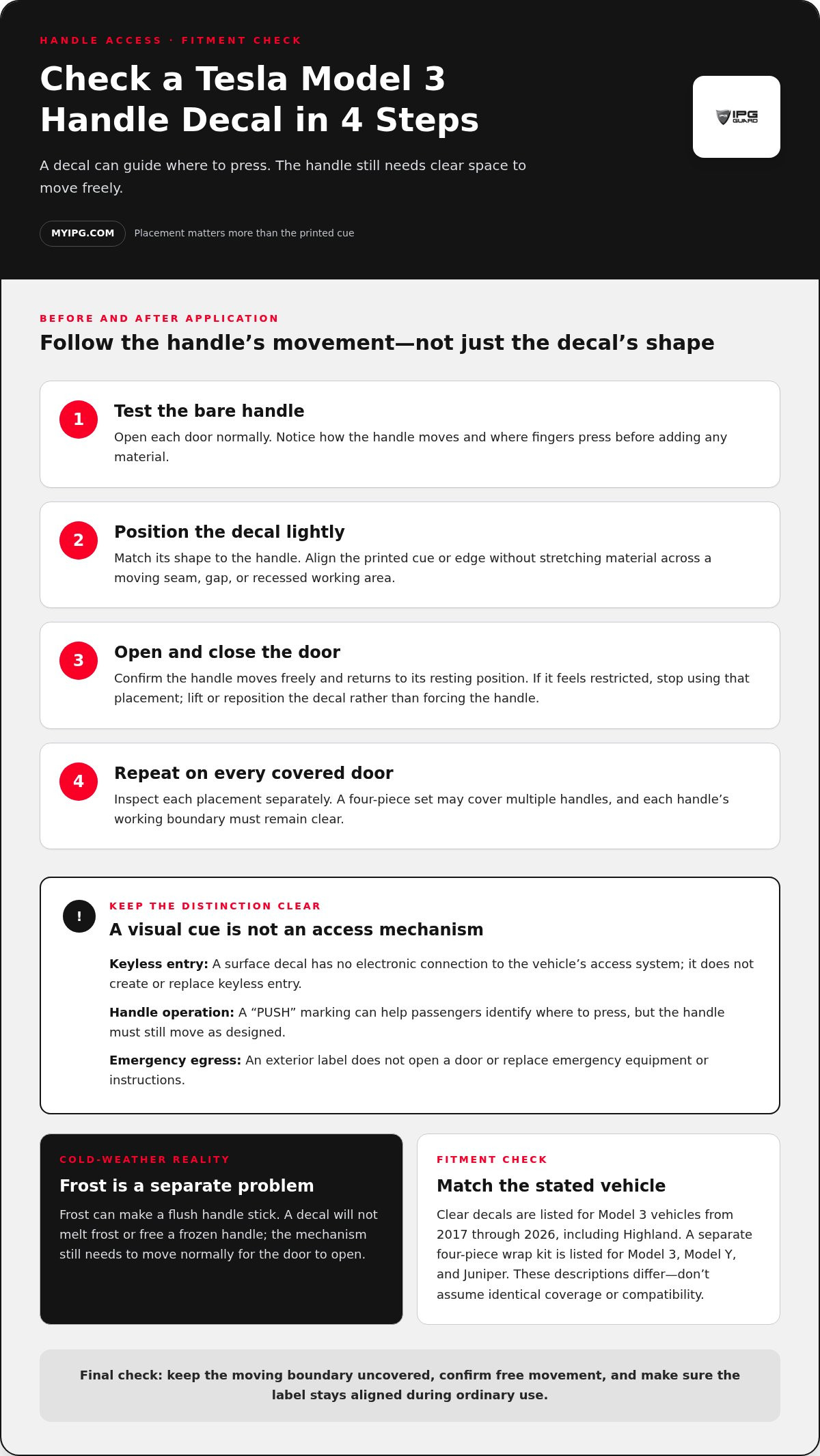
A surface decal doesn’t create or replace keyless entry. It has no electronic connection to the vehicle’s access system, so its role is limited to the handle area. The practical concern is physical: material placed over a moving edge or recessed section could interfere with the handle’s movement. Keep the working area clear, and treat any printed opening cue as guidance for passengers, not as a release mechanism.
Placement determines whether the decal remains a visual aid or becomes an obstruction. A clear decal printed with “PUSH” is intended to help passengers identify how to open the exterior handle. That cue is useful only if the handle can still pivot or move as designed. Before applying a Tesla Model 3 door handle decal, compare its shape with the handle, then avoid covering gaps, edges, or surfaces that move during opening.
Fitment matters because a close-looking accessory may be cut for a different handle shape. Clear decals are listed for Tesla Model 3 vehicles from 2017 through 2026, including Highland. A separate four-piece wrap kit is listed for Model 3, Model Y, and Juniper. These are different product descriptions, so don’t assume every decal uses the same coverage or fits every year. Match the product’s stated vehicle compatibility before installation.
Check the handle’s operation before and after applying a decal. This can help catch a placement problem before you use the car routinely:
- Test the bare handle. Open each door normally and notice how the handle moves and where fingers press.
- Position the decal lightly. Align its printed cue or edge without stretching material across a moving seam.
- Open and close the door. Confirm the handle moves freely and returns to its resting position.
- Repeat on all doors. A four-piece set may cover multiple handles, so inspect each placement separately.
If a handle feels restricted after installation, stop using that placement. Lift or reposition the decal rather than forcing the handle through resistance. A folded edge, shifted graphic, or material crossing a seam can change how the handle feels. For example, a “PUSH” label centered on the visible face may remain readable while leaving the handle’s moving boundary uncovered.
Cold weather adds a different access issue. Frost can cause Tesla Model 3 flush handles to stick in place, which is a mechanical obstruction rather than a keyless-entry failure. A decal won’t melt frost or free a frozen handle. If the handle is iced, don’t treat the printed cue as evidence that the mechanism is clear; the handle still needs to move normally before the door can open.
Decals don’t replace emergency egress equipment or instructions. An exterior label can show a passenger where to press, but it cannot open a door or explain every emergency procedure. Keep the distinction clear: a “PUSH” marking helps with everyday orientation, while access depends on an unobstructed, functioning handle. This matters most when a passenger is unfamiliar with Tesla’s flush-handle design.
After fitting, check the same doors during ordinary use. Confirm the label stays aligned, the handle remains free, and passengers can follow the marked push point without pulling at the decal. If a wrap covers more of the handle than a small cue, inspect its edges especially closely. Free movement, correct fitment, and an uncovered operating area are the practical checks that protect access. A properly positioned Tesla Model 3 door handle decal should not cross the handle’s moving boundary.
How durable are Tesla Model 3 door handle decals in sun, rain, and car washes?
A clear decal listed for Tesla Model 3 vehicles from 2017 through 2026, including Highland, is made from commercial-grade clear vinyl wrap. That material description identifies the film, not its guaranteed lifespan or resistance to every washing method. Sunlight, moisture, friction, and installation all influence its appearance over time. A Tesla Model 3 door handle decal also faces regular finger contact, so inspect its exposed edges during exterior care.
Sun exposure affects exterior surfaces, while a clear finish keeps the handle’s original appearance visible. A material description alone doesn’t establish how a film will look after long outdoor exposure. Surface preparation and placement matter: trapped dirt or moisture can affect the finish, while lifted edges may collect grime. For example, inspect the perimeter after washing rather than judging only the broad, flat center.
Rain reaches the handle directly, but water isn’t the only durability test. Repeated hand contact can rub the surface, and cleaning residue may remain around the handle’s recess. Use a soft cloth on the decal and nearby handle, then dry the edges. Avoid scraping an edge with a fingernail or hard tool. Pulling a lifted corner can enlarge the damaged area and expose more adhesive.
Car washes introduce different kinds of contact. Automated equipment may use moving brushes, cloth strips, water pressure, or cleaning agents. A hand wash lets you control pressure and direction, while an automated wash can repeatedly brush the handle area. Inspect your Tesla Model 3 door handle decal after washing. Look for visible changes such as:
- Raised edges: Check the perimeter where hands or wash materials may catch.
- Bubbles or wrinkles: View the film under direct light.
- Cloudiness or residue: Distinguish surface dirt from changes beneath the film.
- Movement: Confirm the decal remains in its original position.
After installation, follow the product’s application and care directions. Clean the handle surface before applying the film, and avoid trapping lint beneath the clear layer. Follow the instructions before exposing it to washing or heavy handling. This helps protect the bond at the edges, where water and repeated contact can reveal a weak application. Don’t use a sharp blade to trim material on the vehicle, as the paint sits immediately below the work area.
A simple inspection routine makes wear easier to spot. Check the film after its first wash, then include it in regular exterior care. Compare both sides of the handle. A loose edge or discoloration on one side may reflect where hands or wash equipment make more contact. Clean with gentle pressure and a soft cloth. If dirt sits along an edge, wipe across it instead of pushing debris underneath.
Durability depends on the film and how it is applied, cleaned, and exposed to contact. Commercial-grade clear vinyl wrap describes the material used for this decal, while edge condition offers a practical way to monitor wear. If you’re comparing coverage for your vehicle, explore vehicle handle decal options alongside these care factors. Regular inspection helps you spot changes early and decide whether the film still looks and sits as intended.
How do Tesla Model 3 door handle decals compare with vinyl wraps and paint protection film?
A small decal, a handle wrap, and paint protection film serve different purposes. A decal can add a visual cue or a localized finish, while a wrap covers a broader area for a more unified appearance. Paint protection film is selected for surface protection. These categories can overlap in material or coverage, so compare the actual shape and purpose of each piece. A Tesla Model 3 door handle decal is not automatically equivalent to a full handle wrap or protective film.
Start with coverage. A marking or small decal covers only part of the handle. A wrap can extend across more of its visible surface, changing the overall look and covering more paint. Paint protection film is also a surface layer, but its main purpose is to protect the underlying finish. For example, a driver seeking a visible “PUSH” cue needs a different result from someone looking to change the handle’s appearance.
Material descriptions are useful, but they don’t establish identical performance. A clear handle decal is described as commercial-grade clear vinyl wrap. That identifies its stated material category, not that it provides the same coverage or protection as every product sold as vinyl wrap or paint protection film. Check the product’s intended use and outline. A clear film for a handle may preserve the original color, while a colored wrap changes the handle’s appearance.
Frequent contact is a key distinction for door handles. One Model 3 owner reported that a custom wrap on standard handles was beginning to peel from frequent use, prompting him to try adhesive add-on handles. That example highlights a practical stress point: hands repeatedly touch and move around the handle. It doesn’t prove that all wraps peel, but it shows why edge placement and daily contact matter when comparing coverings.
Use these questions to choose based on purpose rather than material name:
- Need a visible instruction? Choose a marking that makes the push point clear without covering the handle’s moving area.
- Want a broader styling change? Compare the wrap’s coverage with the handle’s full visible shape and finish.
- Prioritize paint coverage? Look at how much painted surface the film covers, especially around contact areas.
- Expect frequent use? Inspect the edges and high-touch areas, where repeated finger contact can affect appearance.
Installation also affects the result. A small piece has fewer edges and covers less area, but precise alignment still matters. A larger wrap needs careful positioning across the handle’s contours. A protective film must sit smoothly over the area it is meant to cover. In each case, trapped dirt, wrinkles, or lifted edges can undermine the finish. Clean the surface and follow the material’s application directions before assessing the final appearance.
Vehicle fit is another deciding factor. A wrap listing may cover multiple Tesla models or model years, while another piece may be designed for a narrower fit. Compare the stated compatibility and outline with your specific handle. Don’t choose by appearance alone: a product that looks similar in a photograph may cover a different area or follow different contours.
For a practical decision, define your priority first: passenger guidance, styling, or paint coverage. Then compare material, shape, intended use, and fit. A decal is a focused choice for a small marking or surface detail; a wrap provides broader visual coverage; paint protection film centers on shielding the covered paint. Choose the layer that matches the job rather than expecting one option to perform every role.
Careful positioning and fitment checks help ensure proper installation. Check fitment before choosing a cover or decal: one Tesla Model 3 and Model Y door-handle cover listing specifies compatibility with Model 3 model years 2020-2023 and Model Y model years 2020-2024. Check the listing’s stated model-year compatibility before choosing a cover. Separately, the My IPG door-handle decal wrap kit is sold as a set of 4 and listed as compatible with Model 3, Model Y, and Juniper. Those listing details help distinguish a product’s stated fit from its material or coverage.
Cold-weather access is another practical consideration. A page describes punching the chunky part of a frozen Tesla Model 3 door-handle base with a knuckle to break the frost and open the door. This account concerns opening a frozen handle; it does not establish protective performance or recommend striking a decal or film. When choosing among coverings, consider whether the piece leaves access to the handle base and whether it stays secure around areas exposed to repeated contact. Fitment, intended use, and edge placement are useful checks alongside appearance.
My IPG: IPG Phone camera lens protector
My IPG’s IPG Phone camera lens protector offers a separate way to protect a device you carry every day. A handle decal addresses a vehicle surface; a camera lens protector is for a phone camera lens. Consider it when you want to add protection to your phone alongside the care you give your Tesla.
My IPG also offers IPG iPhone screen protector and IPG Samsung screen protector options. Choose the product category that matches the device and surface you want to protect. For phone camera lens protection, visit My IPG to explore the available option or contact the team.
Make your next fitment choice with care
Use your priorities to guide the final choice. A Tesla Model 3 door handle decal should suit the handle’s shape, leave its operation unobstructed, and match the finish you want to maintain. Think about how the car is used each day, including who needs to recognize the push point and how often the handle is cleaned. A careful fitment decision helps keep appearance and access working together.
For a decal suited to your vehicle, contact My IPG about your decals. My IPG also offers an IPG Phone camera lens protector, an IPG iPhone screen protector, and an IPG Samsung screen protector for separate device-protection needs. Choose the protection that fits what you value, then move forward with confidence.
Frequently Asked Questions
What is a Tesla Model 3 door handle decal?
A Tesla Model 3 door handle decal is an adhesive graphic or film applied to the exterior handle area. Depending on its design, it can mark a passenger’s push point or add a different finish to the handle. For example, a clear “PUSH” marking serves as a visual cue, while a broader wrap changes more of the visible surface. It’s an exterior accessory, not an electronic keyless-entry component.
What should I check before buying a Tesla Model 3 door handle decal?
Check the listed vehicle fit, the decal’s shape, its intended coverage, and your handle color. Some decals are offered for silver or black handles, so compare the product image with your car. Consider whether you want a small visual marking or a broader styling change. Before applying it, make sure the handle surface is clean and dry, then compare the decal’s outline with the handle’s seams.