
Why risk a $350 dealership bill and the technical headache of sensor recalibration just to change the color of your car's logo? Most drivers don't realize that prying off factory badges can disrupt the delicate 76 to 81 GHz radar sensors hidden behind modern radomes. You want a personalized aesthetic using custom car emblem overlays, but the fear of damaging paint or dealing with peeling, low-quality vinyl is a valid concern. You've invested heavily in your vehicle, and it's natural to be protective of its integrity.
This guide reveals how precision-cut film offers a high-performance alternative to permanent badge replacement. You'll discover how to achieve a "factory-plus" look while protecting your original branding from UV fading and rock chips. We'll break down the technical specifications of premium cast vinyl, explain why these non-metallic materials won't trigger ADAS malfunction codes, and provide a roadmap for a professional, bubble-free application that maintains its bond for over five years. It's time to transform your vehicle with the precision it deserves.
Key Takeaways
- Safeguard your vehicle’s factory finish while achieving a unique aesthetic with precision-cut custom car emblem overlays.
- Distinguish between premium cast vinyl and hydrogel materials to select the optimal protective barrier for your specific make and model.
- Avoid the high costs and technical risks of full badge removal by utilizing non-permanent, pressure-sensitive adhesive technology.
- Execute a professional-grade installation using a streamlined three-step workflow to ensure total surface adhesion and zero bubbling.
- Identify specialized fitment options for high-value brands like Tesla, Honda, and Volkswagen to maintain a cohesive, protected exterior.
What are Custom Car Emblem Overlays and Why Your Vehicle Needs Them?
Your vehicle’s branding is its signature. Custom car emblem overlays are precision-cut adhesive films engineered to fit exactly over your existing factory logos. They act as a sophisticated, protective skin. These overlays provide a dual-benefit solution that combines immediate aesthetic elevation with long-term physical preservation. Modern automotive design often leans toward "de-chroming" or "blacking out" accents to create a sleek, stealthy profile. Unlike permanent paint or liquid-wrap alternatives, these precision-cut films respect the original integrity of your vehicle. They are essential for leased or high-value vehicles where maintaining an unblemished OEM state is critical for future resale value.
Aesthetic Transformation Without the Permanent Commitment
Achieving a custom look doesn't require permanent modification. Overlays utilize advanced vehicle vinyl wrap technology to offer finishes like matte black, gloss black, or carbon fiber. This "factory-plus" approach enhances original design lines without the mess of plastic-dip or the irreversibility of paint. You gain total control over your vehicle's identity. If you decide to sell your car or return a lease, the film peels away cleanly. It leaves the factory chrome in showroom condition. It's a risk-free way to personalize your ride while keeping the underlying surface untouched.
Protection Against the Elements: UV, Salt, and Road Debris
Your emblems face a constant environmental assault. Sunlight, road salt, and grit cause factory plastic to yellow, crack, or pit over time. Custom car emblem overlays serve as a sacrificial guardian for these high-value components. The specialized film absorbs the brunt of external stress, acting as a buffer between your car and the world. This proactive maintenance ensures your branding remains as sharp as the day it left the factory floor.
- UV Shielding: High-grade films block harmful rays that degrade clear coats and plastic resins over time.
- Debris Barrier: The material absorbs the impact of grit and small stones, preventing permanent pitting on the emblem surface.
- Corrosion Resistance: Overlays seal the logo against winter road salts and harsh cleaning chemicals that can tarnish chrome finishes.
By absorbing these stresses, the overlay ensures the underlying branding remains pristine. It's a methodical investment in your car's longevity. You protect the financial and emotional value of your vehicle with a solution that is both high-performance and easily reversible.
Material Science: Deciphering Vinyl, Hydrogel, and Protective Films
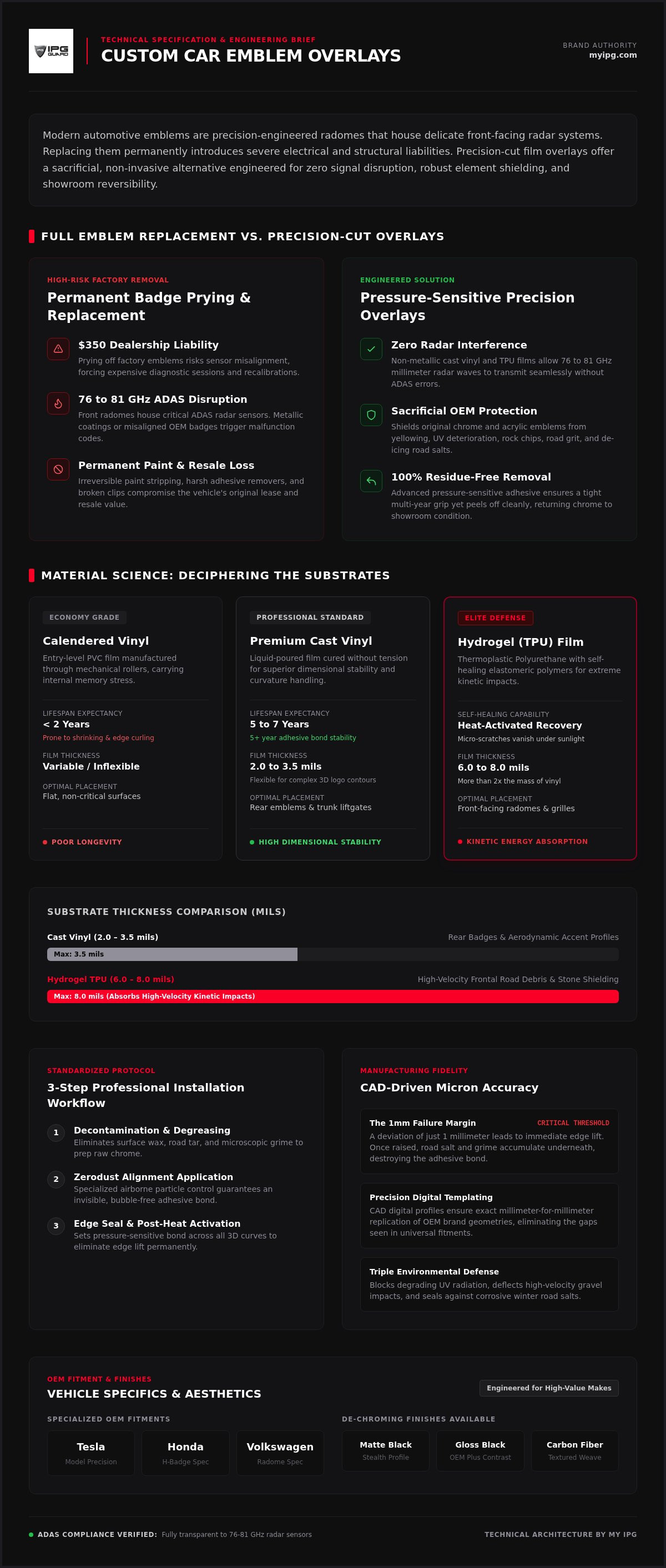
Performance starts at the molecular level. Custom car emblem overlays aren't simple stickers; they are engineered barriers designed for high-stress environments. The hierarchy of materials begins with economy calendered vinyl, which often shrinks or curls within two years. Professional-grade cast vinyl, however, offers a five to seven-year lifespan. It provides superior UV inhibitors and dimensional stability. Central to this performance is the adhesive technology. High-end films utilize pressure-sensitive adhesives that bond securely yet leave zero residue upon removal. This reversibility is a core factor when weighing the pros and cons of vehicle wrapping for long-term value preservation. You need a material that balances thickness for durability with flexibility for 3D contours.
High-Grade Outdoor Vinyl vs. Hydrogel Technology
Front-facing emblems require specialized defense. While standard outdoor vinyl excels on rear badges, front logos face constant high-velocity impacts from road debris. Hydrogel technology, or Thermoplastic Polyurethane (TPU), represents the elite tier of protection. These films feature self-healing elastomeric polymers. Small scratches or pits from road grit literally vanish when exposed to heat. Hydrogel is also significantly thicker, typically 6 to 8 mils compared to the 2 to 3.5 mils of standard vinyl. This extra mass absorbs kinetic energy, preventing the underlying factory logo from cracking. Our Zerodust application process ensures a pristine bond, creating a crystal-clear shield that remains invisible to the eye.
Precision Cutting: Why Micron-Level Accuracy Matters for Fitment
Fitment is the difference between a custom look and a cheap DIY project. We utilize CAD-driven digital templating to ensure every cut matches your vehicle's specific contours. A single millimeter of error leads to edge lift. Once an edge lifts, road salt and dirt accumulate underneath, eventually destroying the adhesive bond. Universal kits often fail because they ignore the subtle 3D curvatures of modern branding. Precision-cut overlays wrap exactly to the edge of the OEM housing, providing a seamless finish that looks like a factory option. This meticulousness ensures your vehicle's aesthetic remains sharp and professional. Explore our specialized automotive protective films to find the exact match for your vehicle's specifications.
Durability also depends on surface preparation. Before application, a 70% Isopropyl Alcohol and 30% distilled water mixture must strip all waxes and silicone sprays. This technical step ensures the pressure-sensitive adhesive can cure properly. By choosing materials with built-in air-release channels, you eliminate the risk of trapped bubbles. The result is a smooth, high-impact finish that guards your technology against the elements while maintaining total aesthetic control.
Custom Overlays vs. Full Emblem Replacements: A Strategic Comparison
Choosing between a physical badge swap and custom car emblem overlays is a matter of tactical risk management. A full OEM replacement often demands a financial commitment between $120 and $350 per emblem. This price doesn't just cover the plastic; it includes professional labor for adhesive removal and the high-stakes potential for ADAS recalibration. Modern front emblems often serve as radomes for 77 GHz radar sensors. Disturbing these mounting brackets can trigger system blind spots, malfunction codes, or expensive dealership visits. By contrast, precision-cut overlays provide a non-invasive, 100% reversible alternative. They protect your technical assets while delivering the exact aesthetic you desire without the mechanical liability of disassembly.
Cost-Effectiveness and Ease of Installation
Efficiency defines the overlay experience. A complete exterior set of custom car emblem overlays typically ranges from $60 to $95. This covers both front and rear branding for a fraction of the cost of a single factory replacement badge. The time investment is equally lean. While a professional emblem replacement can take over an hour of meticulous prying and adhesive cleanup, an overlay application is a "no-tool" process completed in minutes. It eliminates the risk of snapping plastic retention clips or scratching the surrounding clear coat. While you focus on the exterior, don't ignore the high-value technology inside your cabin. Consult our Car Screen Protector Buying Guide to ensure your infotainment system receives the same level of stewardship as your exterior branding.
Maintaining Resale Value: The Power of Reversibility
Resale value depends on the preservation of original equipment. Buyers in the secondary market prioritize a "stock" appearance. Permanent modifications, like painting or prying off badges, can raise red flags about the vehicle's history or sensor integrity. Overlays act as a protective vault. They shield the underlying chrome from rock chips and UV pitting for five to seven years. When it's time to trade in or return a lease, removal is simple and safe. Apply gentle heat to the film to soften the pressure-sensitive adhesive. Peel it back slowly to reveal a factory-fresh emblem that has been frozen in time. This strategy ensures you enjoy a custom look today without sacrificing your financial return tomorrow. It's the ultimate method for maintaining the integrity of your high-value investment.
The Perfect Fit: Choosing and Installing Overlays Like a Professional
Precision branding requires more than a steady hand. It demands technical preparation. To install custom car emblem overlays successfully, you must control the environment and the surface. Assemble your toolkit: a clean microfiber cloth, 70% isopropyl alcohol, and a heat gun or high-wattage hair dryer. Ambient temperature is critical. Adhesives perform best between 60°F and 90°F. If the surface is too cold, the bond won't cure. If it's too hot, the film becomes overly elastic and difficult to align. By following a methodical workflow, you ensure a factory-quality finish that lasts for years.
Identifying Your Specific Vehicle Model and Trim Specs
Compatibility is non-negotiable. Emblem dimensions often shift between model years, even within the same generation. For example, the fitment for a My IPG Volkswagen Front Emblem Logo on a MK7 differs from a MK8. Modern trims also integrate front-facing cameras or radar sensors directly into the badge housing. You must ensure your overlay is precision-cut to avoid obstructing these technical components. My IPG specializes in these micron-level fitments for brands like Honda and VW. We account for every 3D contour and sensor window before the film ever reaches your hands.
Pro-Level Installation: Eliminating Air Bubbles and Ensuring Adhesion
Follow the "Clean, Align, Press" workflow for a flawless result. First, strip all wax and road grime with the 70% alcohol solution. Once dry, align the overlay without applying heavy pressure. Use a center-out technique to sweep air toward the edges. This prevents trapped pockets that lead to bubbling. For complex curves, apply gentle heat to make the film conform to the emblem's geometry. This process mirrors the technical precision required for interior displays. Review The Ultimate Screen Protector Guide to master bubble-free application for every surface in your vehicle.
If you encounter corner lifting, it's usually a sign of "shape memory" in the vinyl. Post-heating is the solution. Use your heat source to bring the edges to approximately 180°F. This breaks the material's memory and sets the adhesive permanently against the emblem's edge. This final step is what separates a DIY sticker from a professional-grade modification. Browse our full catalog of precision-cut automotive decals to secure the perfect fit for your specific trim level and protect your branding today.
Elevate Your Vehicle with My IPG Precision-Cut Overlays
Your vehicle represents a significant financial and emotional investment. It is a complex machine of high-value technology and iconic branding. It deserves more than generic, thin-film stickers found on mass-market marketplaces. My IPG serves as the Guardian of Technology for your car. We bring decades of specialized experience in protecting sensitive electronic equipment to the automotive world. Our custom car emblem overlays are the direct result of this technical lineage. We don't just provide a color change. We provide a high-performance shield. By focusing on precision-engineered fitments for Tesla, Volkswagen, and Honda, we address the specific needs of owners who demand professional standards. This is technical stewardship for the modern driver.
Specialized Solutions for Volkswagen, Honda, and Tesla
A cohesive aesthetic requires meticulous attention to every surface. We offer tailored solutions that generic retailers often overlook. For the enthusiast, the IPG Volkswagen Front Emblem Logo provides a sharp, stealthy profile that perfectly complements European design lines. We extend this precision to your wheels with the IPG Decal Honda Center Cap Overlay Wheel Tire Decals. This allows for a consistent, professional look from the front grille to the center of your rims. Tesla owners benefit from our integrated ecosystem approach. Combine our emblem protection with IPG Tesla Model 3 / Model Y door handle decals to eliminate chrome accents entirely. These products work in tandem to create a unified, protected exterior that withstands the rigors of daily driving.
The My IPG Difference: Technical Stewardship for Your Car
Reliability is our baseline. Our history in protecting high-end devices means we understand material properties better than anyone in the restyling industry. We select films based on light filtration, kinetic energy absorption, and thermal stability. This technical authority ensures your custom car emblem overlays won't yellow, shrink, or peel under extreme UV exposure. We view your vehicle as a high-value asset that requires meticulous care. Our role is to provide the professional-grade tools for that preservation. This commitment to quality extends beyond your driveway. Explore our IPG Phone Camera Lens Protectors to bring the same level of protection to your mobile technology. Secure your investment. Personalize with confidence. Trust the guardian of your technology to keep your branding pristine.
Secure Your Aesthetic Legacy
Maintaining the integrity of your vehicle's branding is a matter of technical stewardship. You've learned how advanced custom car emblem overlays act as a sacrificial barrier, shielding factory chrome from UV degradation and road debris. By prioritizing professional-grade cast vinyl and hydrogel technology over cheap stickers, you ensure a bond that lasts over five years without risking paint damage or ADAS sensor interference. Reversibility remains your strongest asset. It allows you to explore modern "blacked out" aesthetics while preserving the pristine OEM finish for future resale.
My IPG applies the same meticulousness used for industrial gear and high-value EVs to every precision-cut kit. Whether you drive a Tesla, Volkswagen, or Honda, our micron-level accuracy guarantees a seamless fit that respects your car's complex technology. It's time to elevate your exterior with confidence and performance-driven protection. Shop Precision-Cut Car Emblem Overlays at My IPG today. Take control of your vehicle's identity and join the ranks of owners who refuse to compromise on quality.
Frequently Asked Questions
Do car emblem overlays damage the original paint or logo?
No, precision-cut overlays do not damage your vehicle's factory finish. These films use professional-grade, pressure-sensitive adhesives designed to bond securely without bonding permanently to the clear coat or chrome. They actually serve as a sacrificial layer, shielding the original logo from environmental hazards. When you decide to remove them, the underlying surface remains in its original showroom condition, free from scratches or chemical etching.
How long do custom car emblem overlays typically last?
High-performance cast vinyl overlays typically provide a service life of five to seven years on daily-driven vehicles. If your car is garaged, this lifespan can extend even further. Unlike cheap calendered stickers that shrink or curl within two years, these specialized automotive films feature built-in UV inhibitors to resist fading and edge lifting. Regular maintenance and avoiding high-pressure spray directly at the edges will maximize the longevity of your custom car emblem overlays.
Can I take my car through a car wash with emblem overlays installed?
Yes, you can safely use a car wash once the adhesive has fully cured, which usually takes 24 to 48 hours after installation. We recommend touchless car washes to avoid mechanical brushes that might catch on the edges of the film. If you use a pressure washer at home, keep the nozzle at least twelve inches away from the emblem. Avoid aiming high-pressure water directly at the film's perimeter to prevent premature edge lifting.
Are emblem overlays legal to use on my vehicle?
Custom car emblem overlays are generally legal because they don't alter the vehicle's structural identity or obstruct safety lighting and license plates. They simply modify the aesthetic of the existing manufacturer branding. However, you should ensure the overlay doesn't contain highly reflective or metallic materials if your front emblem houses a radar sensor. Most pure vinyl and hydrogel options are completely transparent to radio waves, ensuring your safety systems remain fully compliant.
What happens if I get air bubbles under my emblem overlay?
Air bubbles are usually the result of improper pressure during the center-out application phase. If you notice a small bubble, try using a hair dryer to warm the film and gently push the air toward the nearest edge. For stubborn pockets, a tiny prick with a fine sewing needle allows the air to escape without compromising the film's integrity. Choosing films with micro-air-release channels significantly reduces the risk of trapping air during the initial bond.
How do I remove an emblem overlay without leaving sticky residue?
Removal is a straightforward process that requires gentle heat from a heat gun or hair dryer. Warming the film softens the adhesive, allowing it to pull away cleanly from the chrome surface. Peel the material back slowly at a 45-degree angle. If any minor tackiness remains, a quick wipe with a microfiber cloth and a dedicated adhesive remover or isopropyl alcohol will restore the emblem to its factory-fresh state instantly.
Do emblem overlays interfere with front-facing safety sensors or cameras?
Non-metallic vinyl and hydrogel overlays do not interfere with 76 to 81 GHz millimeter-wave radar sensors or optical cameras. These materials are radio-transparent, meaning they allow safety signals for adaptive cruise control and emergency braking to pass through without significant attenuation. You must avoid overlays containing genuine metal flakes or thick chrome-finish foils on front-facing radomes. Our precision-cut kits are engineered to maintain the technical integrity of your vehicle's safety ecosystem.
Can I install emblem overlays in cold weather?
Installation in cold weather is not recommended because low temperatures prevent the pressure-sensitive adhesive from reaching its optimal bond strength. The ideal application range is between 60°F and 90°F. If you must install in winter, work inside a heated garage and use a heat source to warm the emblem surface before application. Post-heating the edges is mandatory in cold conditions to break the film's shape memory and ensure a permanent seal.