
Your AppleCare+ plan is a safety net for a shattered screen, but it is completely powerless against the micro-scratches devaluing your iPhone right now. You have likely noticed them under harsh light. Those hairline fractures in the factory oleophobic coating make a premium device feel worn. It is frustrating to realize that even the latest second-generation Ceramic Shield, while optimized for drop toughness, still yields to common quartz grit at a Mohs hardness level 6. Apple explicitly excludes these cosmetic abrasions from warranty coverage, leaving your investment vulnerable.
Learning how to protect iphone screen from scratches is about more than just aesthetics; it is about stewardship over a high-value asset. You want a clear, tactilely perfect interface without the nightmare of installation bubbles or reduced touch sensitivity. We promise to clarify the fine print of your warranty and provide the definitive methods for total display preservation. This guide explores advanced aerospace-grade thermoplastic polyurethane films, self-healing polymer properties, and precision-cut tempered glass. You will discover how to maintain a flawless surface and secure maximum trade-in value through professional-grade protection materials.
Key Takeaways
- Understand that AppleCare+ and standard warranties explicitly exclude cosmetic damage, meaning surface scratches won't qualify for a screen replacement.
- Master how to protect iphone screen from scratches by learning why Ceramic Shield glass remains vulnerable to common minerals like quartz sand.
- Evaluate the performance trade-offs between high-impact tempered glass and self-healing hydrogel films to find the right stewardship for your display.
- Adopt essential daily habits, including dedicated pocket storage, to eliminate the abrasive contact that ruins screen aesthetics and trade-in value.
- Explore how IPG's precision-cut shields and Zero Dust installation technology provide a seamless, professional-grade barrier for your high-value device.
Does AppleCare Cover Screen Scratches? The Fine Print Revealed
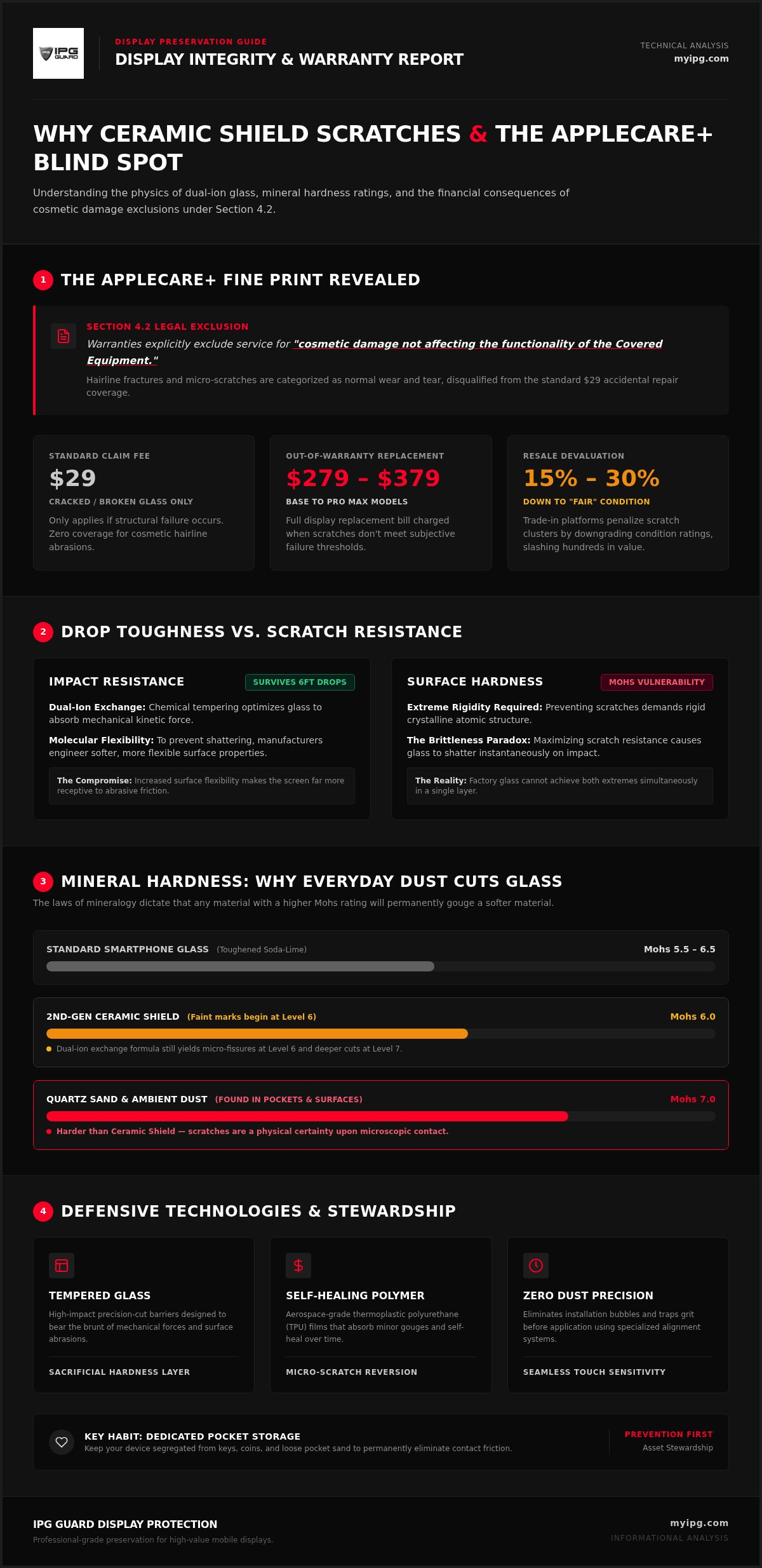
AppleCare+ is often viewed as a total safety net, but it has a significant blind spot. It does not cover cosmetic damage. If your screen is littered with hairline scratches but remains structurally sound, Apple will not repair or replace it under the standard $29 accidental damage fee. To Apple, these marks represent "normal wear and tear" and do not justify a warranty claim. This policy is a primary reason why learning how to protect iphone screen from scratches is essential for every owner who values a pristine device.
The science behind these abrasions is unforgiving. Most micro-scratches are caused by microscopic grit, specifically quartz sand found in pockets and on household surfaces. On the Mohs scale of mineral hardness, quartz sits at level 7. Since even the toughest second-generation Ceramic Shield glass begins to show faint marks at level 6 and deeper grooves at level 7, common environmental dust can easily gouge your display. Without a physical barrier, your screen is constantly losing its factory-fresh finish to invisible minerals.
Understanding the Cosmetic Damage Clause
Section 4.2 of Apple's legal terms is precise and restrictive. It explicitly excludes service for "cosmetic damage not affecting the functionality of the Covered Equipment." This category includes surface scuffs, minor dents, and the micro-abrasions that accumulate over months of use. While these marks don't stop the phone from working, they destroy its resale appeal. Major trade-in platforms often downgrade device valuations from "Flawless" to "Fair" for visible scratch clusters. This single category drop can slash your return by 15% to 30%, costing you hundreds of dollars when it's time to upgrade.
When Scratches Become a Functional Problem
There is a technical threshold where a scratch transitions from a cosmetic annoyance to a functional failure. Deep grooves that disrupt touch sensitivity or obstruct the precision of the Face ID sensors may qualify for service. However, this is a subjective determination made by a Genius Bar technician. Relying on this "loophole" is a high-stakes gamble. Understanding how to protect iphone screen from scratches before deep damage occurs is the only way to ensure your display remains perfect without staggering financial risks. If the damage is deemed purely cosmetic, you face out-of-warranty replacement costs ranging from $279 for base models to $379 for the Pro Max series.
The Science of Scratches: Why Ceramic Shield Isn't Enough
Apple's marketing emphasizes "toughness," but this technical term refers to impact survival, not surface hardness. When you research how to protect iphone screen from scratches, you must understand that the very properties making your screen shatter-resistant also make it vulnerable to abrasions. High-performance glass is a balance of competing priorities. Impact resistance requires a level of molecular flexibility, while scratch resistance requires extreme rigidity. You cannot have both in a single layer of factory glass.
The Mohs scale of mineral hardness determines what can physically cut a surface. Standard smartphone glass and toughened soda-lime surfaces generally sit between 5.5 and 6.5. Ceramic Shield, despite its advanced formulation, still exhibits visible marks at level 6 and deeper grooves at level 7. This is a critical vulnerability because quartz sand, the most common mineral in ambient dust and pocket grit, rates at a solid 7.0. If the abrasive material is harder than the display, a scratch is a physical certainty. No amount of careful handling can overcome the laws of mineralogy.
Drop Protection vs. Scratch Resistance
Glass manufacturers face a binary choice: brittleness or softness. Rigid glass resists scratches but shatters instantly upon impact. To ensure 2026 models survive a six-foot drop, engineers utilize chemical tempering to create a more flexible, "softer" surface. Ceramic Shield is a dual-ion exchange glass optimized for impact. While this keeps your screen in one piece after a fall, it leaves the surface susceptible to micro-fissures from everyday contact. This trade-off is documented in the AppleCare+ terms and conditions, which prioritize functional integrity over cosmetic perfection. Protection is a separate responsibility that falls on the owner.
Common Culprits in Your Pocket
Contrary to popular belief, your brass keys (Mohs 3.5) and copper coins (Mohs 3.0) are rarely the primary cause of damage. They simply lack the hardness to gouge the display glass directly. The true danger is "pocket sand," microscopic quartz particles trapped in fabric seams or on table surfaces. These particles act as industrial abrasives. Over months, thousands of tiny contacts accumulate into a visible haze that dulls screen clarity and reduces touch sensitivity. To prevent this cumulative degradation, consider a dedicated barrier like the IPG Original (Hydrogel) Screen Protector, which uses self-healing elastomers to absorb these mineral impacts before they reach your glass.
Comparing Screen Protection Technologies: Glass vs. Hydrogel
Selecting how to protect iphone screen from scratches requires a strategic match between material science and your daily environment. You need a solution that balances tactile clarity with structural defense. Modern protection has evolved beyond basic plastic films into specialized layers designed for specific threat profiles. Whether you prioritize impact survival or a seamless, "invisible" aesthetic, understanding these material properties is the first step toward effective stewardship of your device.
The Rise of Self-Healing Hydrogel
The IPG Original (Hydrogel) Screen Protector utilizes advanced thermoplastic polyurethane originally engineered for aerospace applications. Its elastomer chains are dynamic. When a micro-abrasion occurs from pocket grit or dust, the polymer physically "closes" the gap over time. This self-healing technology maintains a pristine surface without the brittle nature of traditional materials. It offers a bare-screen feel with zero added bulk, making it the ideal choice for the curved edges of the latest iPhone models. Consult our Ultimate Screen Protector Guide for a technical deep-dive into these material properties.
Tempered Glass: The Heavy-Duty Choice
Tempered glass remains the gold standard for high-impact environments. These protectors feature a 9H hardness rating. This technical specification measures the surface's resistance to a 9H pencil, signaling extreme rigidity against sharp objects. When your device suffers a significant fall, the protector acts as a sacrificial barrier. It shatters to dissipate kinetic energy, preserving the integrity of your factory display. This is a critical investment for users who frequently handle their phones in rugged conditions. Our IPhone Screen Protector Buying Guide provides further insights into selecting the ultimate shield for your specific model.
Dual-purpose solutions like the IPG Privacy Screen Protector offer a specialized layer of defense. These shields combine scratch resistance with micro-louver technology to block side-angle viewing. This ensures your sensitive data remains private in public spaces while the screen stays cosmetically perfect. Conversely, liquid screen protectors often fail to meet expectations. These are invisible chemical coatings that lack the physical mass required to cushion against impacts or deep gouges. They offer no removable layer, meaning any damage that penetrates the coating becomes permanent.
Maintenance is vital for longevity. Always follow the official iPhone cleaning guidelines to avoid damaging your protection. Use a soft, lint-free cloth and avoid harsh household chemicals. These substances can strip the oleophobic coating from both your protector and your original glass. Proper cleaning prevents the accumulation of oils and grit that can lead to micro-abrasions over time.
Daily Habits to Keep Your iPhone Screen Pristine
Physical barriers provide the primary defense, but consistent stewardship is what preserves a device for years. You must adopt a strict "phone-only" pocket policy. Never share this space with keys, loose change, or abrasive paper receipts. Even if metal objects don't gouge the glass directly, they carry microscopic grit that acts as a grinding paste against your display. Mastering how to protect iphone screen from scratches requires this disciplined separation of your high-value technology from environmental contaminants.
Safe Cleaning Techniques
Disinfection requires technical precision. Use 70% isopropyl alcohol wipes or a specialized electronic screen cleaner to maintain hygiene. Avoid harsh household detergents, window cleaners, or abrasive soaps. These substances strip the micron-thin oleophobic coating from your display. Once this oil-repellent layer is compromised, the glass becomes "sticky," attracting more fingerprints and grit. Use a clean, lint-free microfiber cloth for all surface maintenance. Wipe in a single, consistent direction. Circular scrubbing motions can trap a single grain of sand and drag it across the surface, creating a permanent "comet tail" scratch. Never use paper towels, napkins, or t-shirts. These materials contain wood-pulp fibers and synthetic threads that act like fine-grit sandpaper on your screen.
Environment Awareness
Identify high-risk zones before damage occurs. The beach and the gym are two of the most dangerous environments for unprotected glass. Sand is almost entirely quartz, which is hard enough to cut through factory glass. Gym floors are covered in metallic dust and abrasive lifting chalk. If you enter these areas, store your phone in a dedicated protective sleeve or a sealed bag compartment. Observe the "Face-Up" rule at all times. Placing your phone screen-down on a table or counter is a high-stakes gamble. Even a clean-looking surface can harbor microscopic minerals that gouge the display under the weight of the device. Use a case with a raised bezel to provide an air gap, but remember that it's not a substitute for a physical screen guard. Grit often accumulates inside the edges of your case. Remove the case weekly to wipe away trapped particles. This prevents grit migration, where trapped minerals move from the case to the screen, causing edge-pitting and micro-abrasions.
Maintain the integrity of your display with a professional-grade barrier. Secure your device with an IPG iPhone screen protector to ensure total preservation against daily wear.
Why IPG is the Guardian of Your iPhone Investment
IPG operates as a dedicated specialist in the preservation of high-value electronics. Our approach centers on precision engineering. Each film is custom-cut to the exact micron of your specific model. This ensures a fit that disappears onto your display, maintaining the original industrial design of your iPhone. When considering how to protect iphone screen from scratches, you need a solution that respects the device's aesthetics while providing a robust physical barrier. Our IPG Zerodust Screen Protector line utilizes an advanced alignment system. It eliminates the variables of human error. No bubbles. No trapped grit. Just a seamless, factory-fresh finish that lasts for the life of your device.
Performance remains the absolute priority. The invisible advantage of IPG technology lies in its advanced light filtration and material properties. We maintain 100% touch sensitivity for a lag-free user experience. We preserve 100% color accuracy without the yellowing or distortion found in inferior films. Your interaction with the device remains pure. The screen behaves as if it were bare, yet it is shielded by aerospace-grade materials originally engineered for high-velocity aviation protection. This is the hallmark of a true guardian of technology.
Total Device Stewardship
Protecting the display is only the start of your stewardship journey. Your iPhone's optical system is equally vulnerable to environmental grit and surface contact. Scratches on a lens can ruin the clarity of every photograph and degrade the performance of your sensors. We provide specialized iPhone camera lens protectors to ensure your high-resolution optics remain pristine. Our commitment to material science extends beyond the pocket to every screen in your life. If you manage multiple high-value displays, explore our Car Screen Protector Guide to safeguard your vehicle's infotainment system with the same professional-grade materials.
The IPG Installation Guarantee
The IPG Original (Hydrogel) Screen Protector offers a unique settling process that sets it apart from standard films. While traditional protectors trap air permanently, our hydrogel settles over a 24-hour period. This allows micro-bubbles to dissipate naturally through the breathable polymer matrix. It creates a flawless, molecular bond with the glass. We approach every customer with a guardian mindset, providing a lifetime replacement warranty for the lifespan of your device. We understand the high financial and emotional value of your personal technology. Protect your iPhone today with IPG's advanced shields and secure the future of your investment.
Secure Your Legacy of Perfection
Your iPhone is a precision instrument that requires active stewardship. We have established that manufacturer warranties offer no refuge for cosmetic damage. Factory glass remains scientifically vulnerable to ambient minerals found in every pocket and on every surface. Maintaining maximum trade-in value and visual clarity depends entirely on your choice of physical barriers. Mastering how to protect iphone screen from scratches is the final step in securing your high-value investment against inevitable daily wear.
Join thousands of tech enthusiasts worldwide who rely on our advanced self-healing hydrogel technology to maintain a factory-fresh display. We provide 24/7 technical authority support to assist you in every step of the device preservation process. Do not leave your screen's integrity to chance. Secure your iPhone display with IPG's precision-cut protectors and enjoy the confidence of total device security. Your technology deserves a dedicated guardian. Act now to preserve the perfection you value most. Your future self will appreciate the foresight of a flawless, scratch-free screen.
Frequently Asked Questions
Does AppleCare cover scratches if they are deep?
AppleCare+ does not cover scratches regardless of their depth if they are deemed cosmetic. Section 4.2 of Apple's legal terms explicitly excludes damage that does not affect the device's functionality. Unless the scratch interferes with touch sensitivity or is part of a larger crack, you will be required to pay the full out-of-warranty replacement price. This policy is why learning how to protect iphone screen from scratches is a critical financial priority for every owner.
Will a screen protector hide existing scratches on my iPhone?
A high-quality screen protector can significantly mask existing micro-scratches. The adhesive layer, especially in hydrogel films like the IPG Original (Hydrogel) Screen Protector, flows into the tiny grooves of the glass. This changes how light reflects off the surface, making light abrasions virtually invisible to the naked eye. While it won't physically repair the glass, it restores a smooth tactile feel and visual clarity. Deep gouges may remain slightly visible under direct light.
Is Ceramic Shield scratch-proof or just shatter-proof?
Ceramic Shield is engineered for impact toughness rather than total scratch resistance. While it survives drops effectively, it still shows marks at level 6 on the Mohs scale. Common minerals like quartz sand rate at level 7, meaning they can easily gouge the surface during daily use. Apple prioritizes flexibility to prevent shattering, which inherently makes the glass slightly softer. You should treat it as shatter-resistant but still highly susceptible to everyday mineral abrasions.
Can I use toothpaste to remove scratches from my iPhone screen?
Never use toothpaste or other household abrasives on your display. Toothpaste contains mild abrasives that might smooth out plastic but will permanently strip the micron-thin oleophobic coating from your iPhone glass. This leaves your screen feeling "sticky" and more prone to fingerprints and further damage. There is no safe way to buff scratches out of glass without compromising its structural integrity. Prevention remains the only scientifically sound strategy for maintaining a pristine display surface.
How often should I replace my iPhone screen protector?
Replace your protector whenever you notice visible cracks, deep scratches, or peeling edges. Even if the protector is intact, the oleophobic coating usually wears down after six to twelve months of heavy use. If your finger no longer glides smoothly or fingerprints become difficult to wipe away, the shield's effectiveness is compromised. IPG offers a lifetime replacement warranty, allowing you to maintain a perfect barrier without additional investment as the material naturally ages over time.
Does a screen protector affect Face ID or the front camera?
A precision-cut protector will not interfere with Face ID or camera performance. IPG shields are engineered with advanced light filtration to ensure 100% transparency. This allows the TrueDepth camera system to function without distortion or lag. Ensure your installation is free of dust and bubbles by using the IPG Zerodust Screen Protector alignment system. Proper placement is essential to keep the sensors unobstructed while providing total surface defense for the entire display area.
What is the best material for iPhone scratch protection in 2026?
Self-healing hydrogel is the superior choice for daily scratch defense. Its thermoplastic polyurethane chains physically close over micro-abrasions, maintaining a flawless finish that tempered glass cannot match. For users in high-impact environments, 9H tempered glass provides the necessary sacrificial layer to prevent shattering. Both materials play a vital role in how to protect iphone screen from scratches. Your choice should depend on whether you prioritize a seamless aesthetic or maximum impact absorption.
Does removing a screen protector damage the screen's coating?
Removing a screen protector will not damage the factory oleophobic coating if you use the proper technique. High-quality shields use silicone-based adhesives that leave no residue and don't bond permanently to the glass. To remove it safely, lift one corner gently with a fingernail or a thin plastic card. Pull it away slowly at a low angle to avoid putting unnecessary stress on the display. This process is safe and allows you to refresh your protection whenever necessary.