
Your high-end diagnostic scanner is a precision instrument. It's also the most vulnerable tool in your bay. One slipped wrench or a splash of caustic fluid can turn a vital data stream into an unreadable mess. Installing a professional scratch resistant screen for workshop tools is about more than avoiding scuffs; it's about stewardship of your most valuable assets. You've likely seen cheap films peel under shop heat or fail to register touch when you're wearing heavy gloves. It's a compromise that costs you time and clarity.
We believe in protecting the tools that power your business. This 2026 guide shows you how to safeguard your Snap-on Triton or Autel MaxiSYS MS919 without sacrificing display performance. We'll examine the material properties of high-grade hydrogel and tempered glass. You'll discover how to maintain surgical touch precision while ensuring your screens survive grease, chemicals, and daily impact. It's time to stop worrying about your hardware and focus on the repair.
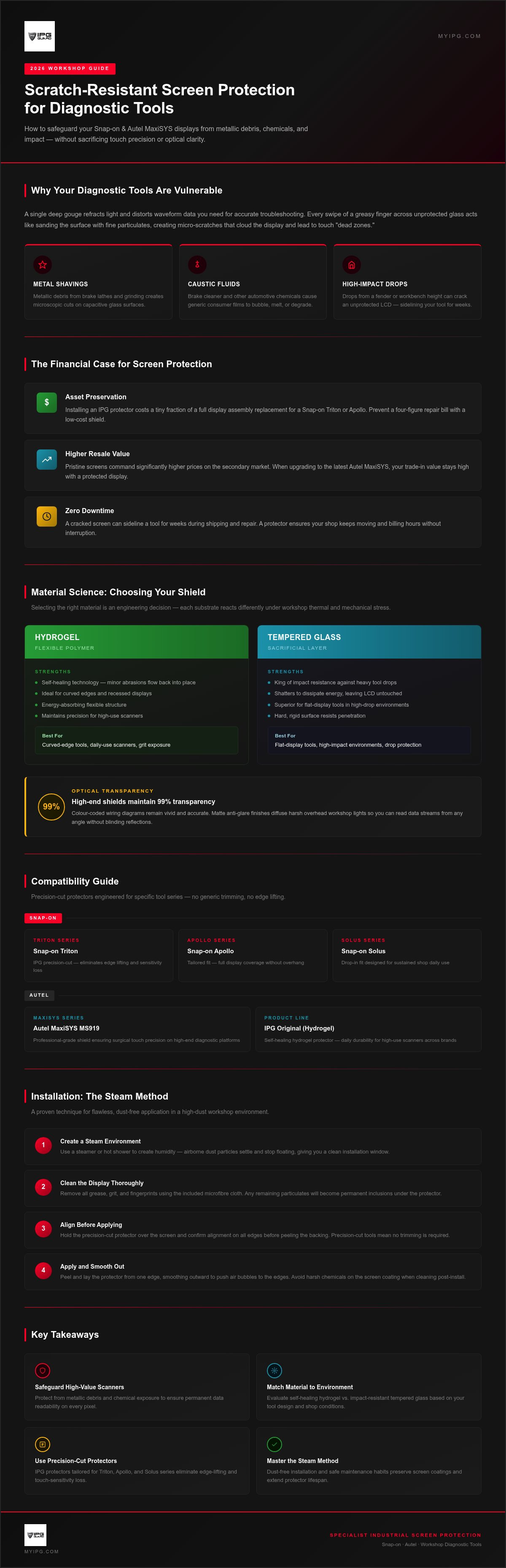
Key Takeaways
- Safeguard your high-value diagnostic scanners from metallic debris and chemical exposure to ensure permanent data readability.
- Select the optimal scratch resistant screen for workshop tools by evaluating the self-healing properties of hydrogel against the impact resistance of tempered glass.
- Eliminate edge-lifting and sensitivity loss with precision-cut IPG Snap on Screen protectors tailored for the Triton, Apollo, and Solus series.
- Master the "Steam Method" for flawless, dust-free installation and adopt maintenance habits that avoid damaging screen coatings with harsh chemicals.
Why Your Workshop Diagnostic Tools Need Professional Screen Protection
A single deep gouge on your diagnostic tablet does more than look bad. It refracts light and distorts the waveform data you need for accurate troubleshooting. In a busy shop, hazards are everywhere. Metal shavings from a brake lathe, caustic fluids like brake cleaner, and high-impact drops from a fender are daily realities. A high-quality scratch resistant screen for workshop tools is the only barrier between your investment and a total display failure.
Generic consumer films often fail in these settings. They bubble under intense shop heat or melt when exposed to common automotive chemicals. Industrial-grade protection is different. It relies on advanced hardness and scratch resistance principles to maintain optical clarity while resisting physical penetration. You need a shield designed for performance, not just aesthetics. True protection requires a material that balances clarity, touch sensitivity, and chemical resistance.
The Vulnerability of High-End Diagnostic Displays
Capacitive touchscreens on Snap-on and Autel tools are precision components. They are also magnets for microscopic grit. When you swipe a greasy finger across the glass, you're essentially sanding the surface with fine particulates. This friction creates micro-scratches that eventually cloud the display. Over time, oil and grease penetrate the micro-pores of the glass, leading to "dead zones" where the tool no longer responds to your input. Display stewardship in a professional workshop context means ensuring every pixel remains clear and every touch remains accurate despite the surrounding chaos.
The Financial Case for Preventative Shielding
Protecting your gear makes fiscal sense. A diagnostic tool is an investment in your career. Safeguarding that investment pays dividends in three specific areas:
- Asset Preservation: Installing an IPG protector costs a tiny fraction of a full display assembly replacement for a Snap-on Triton or Apollo.
- Resale Value: Pristine screens command significantly higher prices on the secondary market. When it's time to upgrade to the latest Autel MaxiSYS, your trade-in value stays high.
- Zero Downtime: A cracked screen can sideline a tool for weeks during the shipping and repair process. A protector ensures your shop keeps moving and billing hours.
Choosing a specialized scratch resistant screen for workshop tools is a small price for total operational security. Don't let a simple accident result in a four-figure repair bill and lost productivity. Protect your tech with the same care you give your mechanical tools.
Material Science: Choosing the Right Shield for Heavy-Duty Environments
Selecting a scratch resistant screen for workshop tools involves more than picking a clear film. It's an engineering decision. You must consider how different substrates react to the thermal and mechanical stresses of a repair bay. High-performance shields are developed using material science standards for industrial applications to ensure they don't degrade when exposed to lubricants or temperature swings. Your choice of material dictates how your tool survives a drop or a chemical splash.
Hydrogel vs. Tempered Glass for Industrial Use
Hydrogel is a flexible, energy-absorbing polymer. It's the ideal choice for tools with curved edges or recessed displays. One of its standout features is self-healing technology. Minor abrasions from shop grit or plastic trim tools don't leave permanent marks. The material's molecular structure allows it to "flow" back into place, maintaining a pristine surface. The IPG Original (Hydrogel) Screen Protector is a prime example of this technology in action, offering daily durability for high-use scanners. Tempered glass remains the king of impact resistance. It's a sacrificial layer. If a heavy tool hits a flat display, the glass shield shatters to dissipate the energy, leaving the underlying LCD untouched. Both materials offer distinct advantages depending on your tool's design and your specific shop environment.
Anti-Glare and Visibility Specifications
Visibility is non-negotiable when you're tracing a complex electrical fault. Harsh overhead workshop lights create blinding reflections on unprotected glass. Professional-grade protectors use advanced light filtration to manage these hot spots. A matte finish diffuses incoming light, ensuring you can read data streams from any angle. High-end shields maintain 99% transparency. This ensures that color-coded wiring diagrams remain vivid and accurate. Cleanliness is the other half of the visibility equation. Oleophobic coatings are essential. These layers repel fingerprints and shop grease, preventing the buildup of "screen fog" that makes tools hard to use. Investing in a high-quality scratch resistant screen for workshop tools ensures your display remains as sharp as your diagnostic skills. We recommend you find a tailored solution that balances these optical properties with the rugged protection your diagnostic equipment deserves.
Compatibility Guide: From Snap-on Triton to Autel MaxiSYS
Generic "one-size-fits-all" protectors are a liability in a professional garage. When you trim a standard film to fit a specialized tool, you create rough, uneven edges. These micro-gaps allow motor oil, coolant, and brake fluid to seep underneath. This contamination causes the protector to peel and lift within days. A precision-cut scratch resistant screen for workshop tools eliminates this vulnerability. It matches the exact bezel dimensions of your device. This ensures the seal remains intact even in the oiliest conditions. Industrial-grade accuracy is what separates a true shield from a temporary sticker.
Snap-on Diagnostic Tool Protection
The IPG Snap-on Triton Apollo Solus +screen protector is engineered specifically for these flagship diagnostic units. Each cut accounts for the unique screen-to-bezel ratio found in the Triton and Apollo series. We prioritize edge-to-edge integrity to prevent debris buildup. This design ensures that the protective layer does not interfere with the heavy-duty rubberized cases these tools live in. You maintain full access to all physical buttons and ports without the protector lifting at the corners. It's a seamless integration that feels like part of the original hardware. Investing in an IPG Snap on Screen protector means choosing a shield that respects the tool's ergonomics while providing a robust defense against workshop grit.
Autel and Industrial Scanner Shields
Autel users require the same level of meticulous fitment to maintain their workflow. The IPG screen protector Autel MaxiIM KM100 MaxiCharger MaxiSYS MS909 MS919 provides a specialized barrier for high-resolution displays. For mobile locksmiths using the KM100, the protector handles the constant friction of pocket storage and outdoor glare. Technicians using the MaxiSYS MS909 or MS919 benefit from a shield that preserves high-speed touch response. This is critical when navigating complex system topology maps or live data streams. These tablets are often the center of a shop's diagnostic operations. Any delay in touch registration slows down your billable hours.
Our precision-cut shields ensure that even the largest displays stay responsive and clear. We also provide custom solutions for specialized workshop HMI screens. Whether it is a tire balancer, a wheel aligner, or a digital smog machine, these displays face the same impact risks as your handheld scanners. A dedicated scratch resistant screen for workshop tools is the best insurance policy against expensive equipment failure. Every piece of glass in your bay deserves a dedicated guardian to ensure it survives the rigors of daily professional use.
How to Install and Maintain Protectors in a High-Dust Workshop
A professional bay is a hostile environment for screen protector application. Floating metal dust and lint are everywhere. You need a strategy to ensure a bubble-free finish. Applying a scratch resistant screen for workshop tools requires a temporary clean zone. This prevents microscopic debris from being trapped between the adhesive and the glass. Preparation is the difference between a clear display and a frustrating, speckled view.
Step-by-Step Installation for Technicians
Start by clearing a dedicated space on your workbench. Wipe the surface with a damp cloth to settle any nearby dust. The Steam Method is a reliable workshop hack. If your shop has a small breakroom, run a kettle for a few minutes. The moisture binds to airborne particles and pulls them to the floor. This creates a localized sterile environment for your application.
Alignment is critical for large tablets like the Autel Ultra. Use the hinge method. Secure one side of the protector to the tool with masking tape before removing the backing. This ensures the film drops exactly where you want it. The IPG Zerodust Screen Protector technology neutralizes static charges that otherwise pull shop grit toward the screen during the peeling process. If bubbles appear, don't use your fingernails. Use a plastic squeegee or a credit card wrapped in a microfiber cloth to push air toward the nearest edge.
Maintenance and Chemical Resistance
Shop chemicals are notoriously aggressive. Never use brake cleaner or carburetor spray to clean your screen. These solvents melt the protective coatings and can cause permanent clouding. Isopropyl alcohol at 70% concentration is your best friend. It cuts through grease without damaging the material integrity of the shield. Choosing a high-quality scratch resistant screen for workshop tools is only the first step. You must maintain it correctly.
Inspect your protector weekly. Look for deep gouges or edges that have started to lift. While IPG materials offer high durability, a heavily compromised shield should be replaced to maintain display clarity. When cleaning while wearing nitrile gloves, ensure the fingertips are free of grit. Even a soft cloth can become an abrasive if there's metal dust on your hands. To keep your equipment in peak condition, order a replacement IPG screen protector before your current one becomes unreadable. This proactive stewardship ensures your diagnostic tools remain ready for the next complex job.
My IPG: The Specialist Guardian for Industrial Screen Integrity
Precision engineering is the core of our philosophy. A universal film requires manual trimming; a process that invites edge failure, micro-tears, and adhesive contamination. My IPG provides a precision-cut scratch resistant screen for workshop tools that matches your device's unique bezel geometry perfectly. We don't believe in "good enough" for the instruments that drive your diagnostic accuracy. Every protector is a result of meticulous measurement and material testing in real-world shop conditions. We use high-impact polymers and advanced optical resins to ensure your screen remains a window, not a barrier. When you choose IPG, you're choosing a guardian designed for the specific rigors of your trade.
Our commitment goes beyond the sale. We act as a dedicated partner in maintaining your equipment's integrity. Professional diagnostic tools are significant financial commitments. We treat them with the respect they deserve. Whether you manage a single bay or an international fleet, we offer rapid global shipping to ensure your technology remains shielded from the moment it leaves the box. For technicians using legacy scanners or rare industrial HMI displays, we provide custom-fit solutions tailored to your specific hardware. Simply provide the dimensions, and our specialists will engineer a protector that fits with surgical accuracy. Your professional history is built on these tools. We ensure they survive to see the next generation of automotive technology.
The IPG Advantage in the Automotive Sector
The same rigorous standards we apply to your diagnostic scanners extend to your personal and service vehicles. Explore our car screen protector guide to see how we safeguard infotainment systems from the same workshop grit. Our products are proven in high-stakes environments where clarity equals performance. We understand industrial technology because we live in it. From the dealership floor to the mobile repair unit, our shields provide the durability needed to keep your data visible and your touch commands responsive.
Securing Your Professional Legacy
Your diagnostic tools are more than just hardware; they're the foundation of your business. A cracked display on a Snap-on Triton or an Autel MaxiSYS isn't just a repair bill. It's a disruption to your professional rhythm and a blow to your shop's efficiency. Join the community of elite technicians who prioritize stewardship over their assets. Invest in a barrier that works as hard as you do. Don't leave your most expensive equipment vulnerable to a simple accident. Protect your Snap-on or Autel tool today and ensure your technical legacy remains crystal clear for years to come.
Secure Your Professional Future Today
Your diagnostic scanners are the pulse of your workshop. They deserve a defense that matches their high-end engineering. We've explored how choosing the right scratch resistant screen for workshop tools prevents costly downtime and keeps your vital data readable. Whether you opt for the self-healing flexibility of advanced hydrogel or the impact-crushing strength of tempered glass, the goal is total stewardship of your equipment. Precision fitment isn't just a luxury; it's a necessity to prevent oil seepage and edge lifting in demanding environments.
Don't settle for universal films that peel when exposed to professional-grade grease and heat. IPG provides precision-cut solutions specifically for your Snap-on Triton, Apollo, or Autel MaxiSYS units. With global shipping available for professional workshops, you can maintain your fleet's integrity from anywhere in the world. It's time to stop reacting to damage and start preventing it. Secure Your Diagnostic Tools with IPG Precision Shields. Your tools are an investment in your expertise. Give them the specialized protection they've earned and keep your shop moving forward.
Frequently Asked Questions
Do screen protectors interfere with Snap-on touch screen sensitivity?
No, IPG protectors don't interfere with the capacitive touch sensors found in modern Snap-on units. We use high-grade materials with ultra-thin profiles to ensure 100% touch accuracy. Whether you're using the Triton or the Solus+, every swipe and tap registers instantly. This is critical when you're navigating complex menus or live data graphs. You get the protection of a scratch resistant screen for workshop tools without sacrificing the tool's native responsiveness.
Can I use a tempered glass protector on an Autel MaxiSYS tablet?
Yes, you can use tempered glass on Autel MaxiSYS tablets. My IPG provides precision-cut tempered glass options for the MS909, MS919, and Ultra models. This material offers superior impact protection against dropped wrenches or heavy parts. It functions as a sacrificial layer; the protector shatters to absorb energy while your expensive Autel display remains pristine. It's the ultimate barrier for technicians working in high-impact environments where tools are frequently moved and bumped.
Will workshop grease cause the screen protector to peel off?
Grease won't cause an IPG protector to peel if it's applied correctly. The key is our precision-cut design. Unlike universal films that require trimming, our protectors match the exact dimensions of your tool's bezel. This creates a tight seal that prevents oil and shop chemicals from seeping under the edges. Once the adhesive cures, it remains stable despite the presence of lubricants. Proper edge-to-edge fitment is your best defense against premature lifting.
How do I remove a scratched protector without damaging the tool screen?
Removing a used protector is a simple process that won't harm your hardware. Start at one corner using a plastic pry tool or your fingernail to lift the edge. Slowly peel the film back at a 45-degree angle across the display. Never use a metal screwdriver or a razor blade, as these will gouge the tool's screen. If any adhesive residue remains, a quick wipe with a microfiber cloth and 70% isopropyl alcohol will clear it.
Is there an anti-glare option for diagnostic tools used outdoors?
We offer specialized anti-glare finishes specifically for technicians working in outdoor or brightly lit bays. These matte-finish protectors diffuse incoming sunlight and harsh overhead lighting. This reduces reflections that make diagnostic data unreadable. You maintain high visibility for color-coded wiring diagrams even in direct sun. Using a scratch resistant screen for workshop tools with anti-glare properties ensures you don't have to reposition your tool constantly just to see the screen during a job.
What happens if I get brake fluid or oil on my IPG screen protector?
IPG protectors are designed with high chemical resistance, but you should wipe off aggressive fluids like brake fluid immediately. While the material resists temporary splashes, prolonged exposure to caustic chemicals can eventually degrade the protective coating. Use a clean, dry cloth to blot the spill. Then, clean the area with isopropyl alcohol. This maintenance routine preserves the optical clarity of the shield and ensures the adhesive bond remains strong throughout its entire service life.
Do you offer screen protection for older or discontinued Snap-on models?
Yes, we provide protection for a vast range of legacy and discontinued diagnostic equipment. Our catalog includes the IPG Snap on Screen protector for the Solus, Apollo, and older Modis series. If your specific model isn't listed, our team can often create a custom-fit solution based on your screen's dimensions. We believe every tool in your inventory deserves professional stewardship, regardless of its age or its current manufacturing status in the market.
How long does a professional hydrogel protector last in a workshop environment?
A professional IPG Original (Hydrogel) Screen Protector typically lasts 6 to 12 months in a standard workshop environment. The lifespan depends on the frequency of use and exposure to abrasive grit. Because hydrogel features self-healing properties, minor scuffs from daily handling disappear over time. You'll know it's time for a replacement when deep gouges become visible or when the oleophobic coating no longer repels grease as effectively as it did when first installed.