

The best screen protector for your car may not be the hardest one. In the hydrogel vs tempered glass car comparison, the deciding factor is often whether the protector fits your display’s shape while maintaining clear visibility and responsive touch use.
It’s reasonable to want a barrier against scratches, fingerprints, and daily wear, especially on a screen you use throughout every drive. A rigid protector may suit a flat display, while a flexible film can follow contours differently. Each option has trade-offs in feel, fit, and installation.
This guide compares hydrogel film and tempered glass for fit, scratch protection, clarity, touch response, and installation. You’ll learn how to match the material to your screen’s shape and your everyday driving habits, and what compatibility and application details to check before choosing. My IPG offers protectors for specific car displays, including BYD and Porsche applications, so matching the product to the vehicle and display is a practical first step.
Key Takeaways
- Compare flexible hydrogel film with rigid tempered glass, and check each protector’s stated features rather than assuming every product has the same specifications.
- Use the hydrogel vs tempered glass car comparison to weigh display shape, daily use, and installation preferences, not hardness alone.
- Match the protector to your exact vehicle and screen. A product title should identify the display, not just the car brand.
- Check the installation method and coverage for your screen’s contours before choosing.
- Explore screen-specific My IPG options, including IPG ProActive applications for certain BYD and Porsche displays.
Hydrogel vs. tempered glass for car screens: what is the difference?
Hydrogel is a flexible film; tempered glass is a rigid glass protector. Both add a layer over an infotainment display, but they handle differently and may suit different screen shapes. That distinction matters on a dashboard: a display may be flat, curved, or shaped around its edges. The protector needs to align with the surface and cover the intended area without lifting or leaving sections exposed.
Here, a scratch means a surface mark from routine contact, such as wiping dust away. An impact is a harder knock against the screen or protector. Fit describes how closely the protector matches the display’s outline, while clarity means how clearly text, images, and controls remain visible through it. These basics make the hydrogel vs tempered glass car choice easier to judge than hardness claims alone.
What is hydrogel film for a car display?
Hydrogel is a flexible polymer film. Its flexibility can help it follow a shaped display differently from a rigid sheet, though the result depends on the protector’s cut and the screen it’s made for. My IPG’s IPG Original (Hydrogel) has self-healing ingredients that repair existing scratches. This is a feature of that product, not a promise that every hydrogel film repairs damage or prevents every scratch.
IPG Original also has an oleophobic anti-fingerprint coating. Oleophobic means oil-repelling, which helps resist fingerprint residue on the protector’s surface. These are stated features of IPG Original, not claims that every hydrogel film has the same properties.
What is tempered glass for a car display?
Tempered glass is a rigid protector, not a flexible film. It provides a firm, glass-like surface, but its inflexibility makes an exact screen match especially important. A protector designed for a flat surface may not sit properly on a curved display. Tempered glass can also crack under impact, so rigidity doesn’t mean it’s unbreakable. The Tempered Glass overview explains how the material is processed and used.
IPG Zero Dust is an auto dust removal tempered glass protector with stated 9H hardness and HD clarity. Its stated Face ID compatibility is a device-specific feature, not a claim about facial recognition on automotive displays. Zero Dust also uses auto-clean installation with a fit tray. These details describe this product; don’t assume they apply to every tempered-glass protector.
For either material, start by matching the vehicle and display. Flexibility may be useful on contoured screens; rigidity may suit a flat display when the protector is cut for it. Neither material automatically wins on clarity or protection. Check the specific product’s features and installation method, then compare them with the screen you use.
How hydrogel and tempered glass behave on an infotainment display
Material is only one part of fit. The screen’s curve, border, cut-outs, and surrounding dashboard affect how much of the surface a protector can cover and how securely it sits. A protector designed for a different vehicle or screen configuration may leave edges exposed or fail to align, even if it uses your preferred material.
Flexible film follows the screen differently; rigid glass holds its shape. Use that distinction as a starting point, then compare the exact protector’s stated features. General material traits don’t automatically describe every product.
Flexibility: Hydrogel is flexible film; tempered glass is rigid. This is the core material difference, not a guarantee of a particular fit.
Fit: Film can bend to follow contours differently from glass. Both depend on a cut designed for the precise display shape and configuration.
Surface feel: Glass provides a rigid surface; film has a flexible-film feel. The feel can vary by product, so don’t assume every protector has the same finish.
Scratch resistance: IPG Original (Hydrogel) has self-healing ingredients for existing scratches. IPG Zero Dust has stated 9H hardness. These are product-specific details, not universal ratings for all hydrogel or glass protectors.
Installation: Follow the method specified for the particular protector. IPG Zero Dust uses auto-clean installation with a fit tray; that feature doesn’t apply to all tempered glass.
Fit, coverage, and display shape
Look at the whole display, not just its approximate width and height. Curved edges, recessed sections, camera or sensor cut-outs, and dashboard contours can all affect coverage. Flexible film can conform differently from rigid glass, but flexibility alone doesn’t guarantee a seamless fit. The protector still needs to be cut for the screen it will cover.
Match the listing to the exact vehicle model and screen configuration. Similar models can have different display layouts, and one vehicle may have more than one screen option. Check the product’s compatibility and coverage details; don’t rely on the car brand alone.
Scratch protection, clarity, and touch use
Hardness describes resistance to surface scratching, not protection against every kind of damage. IPG Zero Dust’s 9H hardness is a stated product feature, while IPG Original’s self-healing ingredients are intended to repair existing scratches. Neither detail establishes how a product handles a particular impact. Don’t treat hardness as proof that glass can’t crack or that film prevents all marks.
Clarity and touch response also depend on the specific protector and how it sits on the display. Don’t assume hydrogel always looks clearer, that glass reduces glare, or that either material guarantees unchanged touch performance. Review the stated features for the exact screen. To compare screen-specific options, explore My IPG protector options and review their vehicle fit and installation details.
Hydrogel or tempered glass for your car? A practical choice by screen and use
Choose in this order: identify your screen’s shape, find a protector made for that exact vehicle and display configuration, then decide which surface and installation method suit you. Don’t start with “Which material is strongest?” Hardness is one property, not a complete measure of fit or protection. In the hydrogel vs tempered glass car decision, the right option is the one designed for your screen and priorities.
Use this comparison as a guide, not a universal ranking. Material traits describe broad differences; the specific product’s compatibility and stated features still matter.
| Option | Potential advantages | Things to weigh |
|---|---|---|
| Hydrogel film | Flexible material can follow contours differently from rigid glass. IPG Original (Hydrogel) has self-healing ingredients for existing scratches. | Flexibility doesn’t guarantee full coverage. Confirm the exact screen fit and review the product’s application instructions. |
| Tempered glass | Rigid, glass-like surface; IPG Zero Dust has stated 9H hardness. | Hardness doesn’t mean unbreakable or prove impact protection. Check that the protector’s cut suits the display’s shape and edges. |
When flexible hydrogel may suit the display
Consider flexible film if your infotainment display has curved edges or contours that could make a rigid sheet less suitable. Film can conform differently, but only a protector designed for that specific screen can provide the intended coverage. IPG Original (Hydrogel) has self-healing ingredients for existing scratches. That is a feature of this product, not a promise about every hydrogel film.
When tempered glass may suit the display
A rigid surface may appeal if you prefer a glass-like feel and prioritize scratch resistance. IPG Zero Dust’s stated 9H hardness is a product-specific specification, not a rating to assume for every glass protector or a guarantee against all damage. A flat screen can make rigid glass a practical candidate, but flatness alone doesn’t establish a product’s fit. Check the vehicle, screen configuration, and coverage.
Don’t rule out either material based on a broad rule that film always fits curves or glass only suits flat screens. Compare the actual screen outline with the protector’s stated compatibility. Then weigh surface preference, product features, and installation method. For more detail on fit and selection, read this car screen protector buying guide.
How to choose a protector for your exact car screen
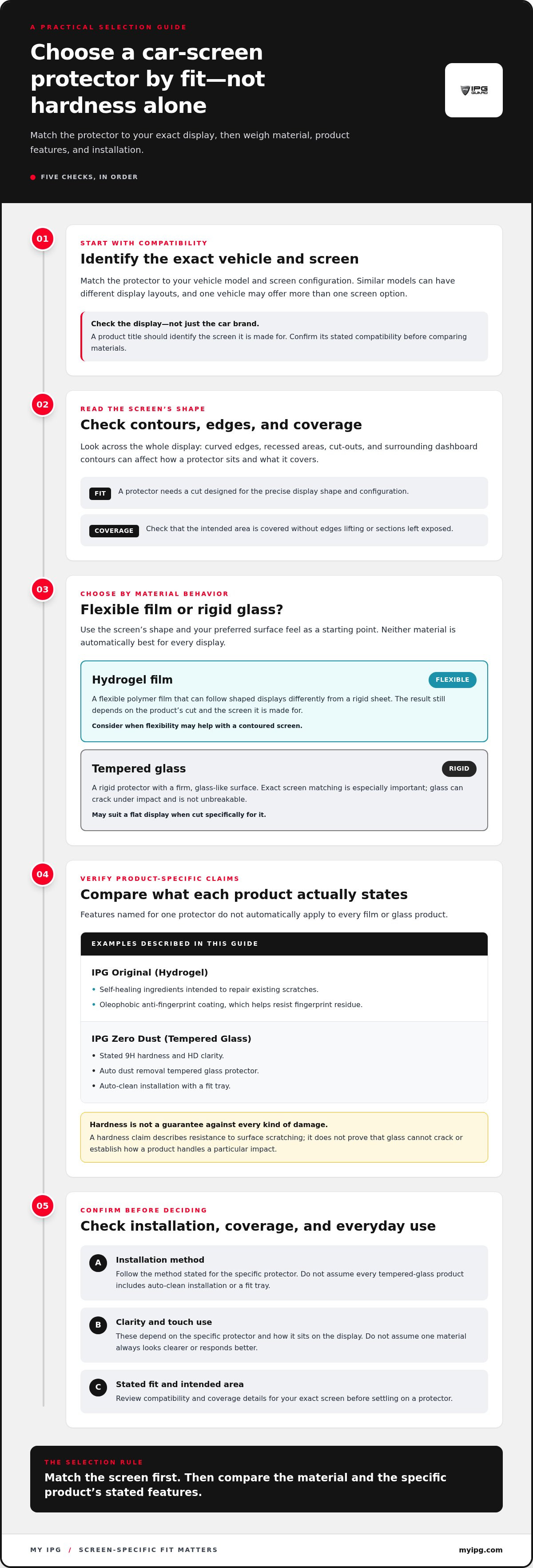
Match the exact model and display before choosing a material: a protector can only protect the screen it’s designed to fit. Use this checklist to compare hydrogel and tempered glass. It helps you avoid choosing by car brand or material name alone.
- Identify the vehicle. Note the make, model, and model year. Similar vehicles can have different interiors and display options.
- Identify the screen. Confirm which display you want to protect, such as the navigation screen or a center console display. Compare its size and layout with the product details.
- Check the shape. Look at the screen’s edges, curves, cut-outs, and surrounding contours. These details affect coverage and alignment.
- Match the protector fit. Read the product title and compatibility information for the precise vehicle and screen configuration. A matching brand name alone isn’t enough.
- Review installation. Follow the method specified for that protector. Application instructions differ by product, so don’t assume them from the material alone.
Match the vehicle and display before comparing materials
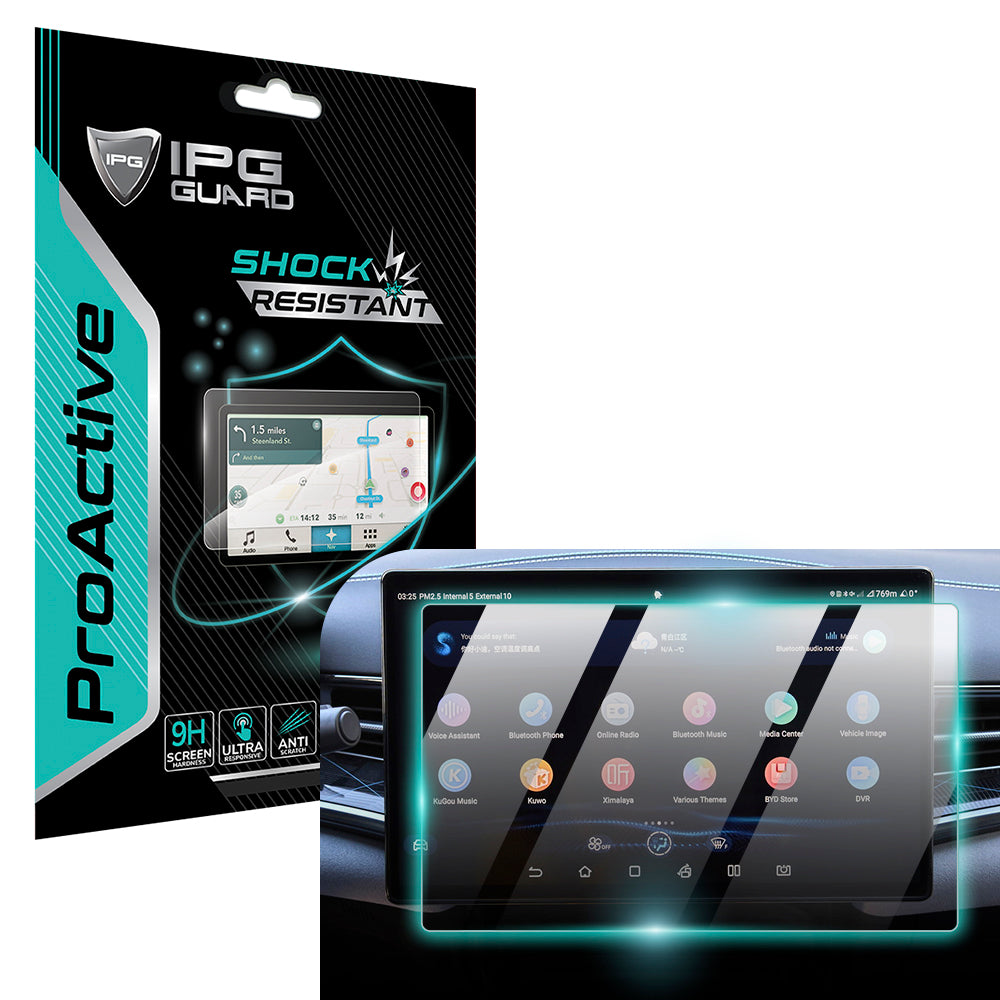
My IPG’s car-display options include the IPG ProActive protector for the 2022-2025 BYD SEAL 15.6-inch navigation display and a Porsche Macan center console protector set for 2022-2024 models. These are specific applications, not a claim of universal fit across every trim or screen configuration. Compare the product title with your vehicle and display before making a selection. For broader context on material differences, see the hydrogel and tempered-glass material guide.
This keeps the hydrogel vs tempered glass car choice grounded in compatibility. Once you’ve found a product designed for your display, consider its stated material, features, and installation method. Don’t assume a protector for one model year or screen layout fits another just because the vehicle name is similar.
Plan for installation and everyday care
Installation instructions are product-specific. IPG ProActive films require dry application. IPG Zero Dust uses auto-clean installation with a fit tray. Keep those methods distinct: the Zero Dust tray process doesn’t apply to ProActive, and dry application shouldn’t be assumed for every protector.
Before starting, identify the product you have and follow its instructions in order. IPG TV installation videos provide visual guidance. Don’t substitute a method shown for another product or add steps that aren’t in the instructions.
Ready to narrow your choice by vehicle and display? Explore My IPG’s screen protector options and use the product details to find a screen-specific match.
Protect your car display with a screen-specific My IPG option
A useful comparison ends with a product that matches your vehicle’s display. My IPG offers car-display protection options with vehicle-specific details, so use the product name and fit information as part of your selection, not just the material category. Choose a protector suited to the screen you rely on, and follow the installation guidance for that product.
What My IPG’s confirmed car-display examples cover
For BYD, My IPG lists the IPG ProActive for BYD 2022-2025 SEAL Navigation Display Screen Protector for the 15.6-inch display. My IPG also offers a Porsche Macan center console protector set for 2022-2024 models. These are specific applications, not a claim that either option fits every BYD or Porsche model, trim, or screen configuration.
That precision matters in the hydrogel vs tempered glass car decision. First match your vehicle and display to the product details. Then consider the stated material and features. Don’t infer that the BYD or Porsche option is hydrogel or tempered glass based only on this comparison. A model-specific name helps narrow the selection, but the screen details still matter.
Keep your vehicle information close while reviewing options. Compare the model year and display description, and make sure you’re looking at the intended screen rather than a different console or panel. A product associated with a particular car brand isn’t automatically compatible with every screen from that brand.
Support that helps protect what you value
Installation is part of choosing a protector. IPG ProActive films require dry application, while IPG Zero Dust uses auto-clean installation with a fit tray. These are different product methods, so follow the instructions for your specific protector rather than transferring steps from one type to another. IPG TV installation videos provide visual installation guidance.
My IPG also offers a 30-day money-back guarantee and a Lifetime Replacement Guarantee after warranty registration. The lifetime replacement guarantee requires registration, and replacement requests incur a USD 4.99 processing fee. Review the terms that apply to your purchase, including the registration requirement and processing fee.
Protect your display with a product matched to its vehicle and screen details, then follow its installation guidance. If you’re ready to compare screen-specific options, explore My IPG screen protection.
Make your next screen-protection choice with confidence
Your car’s display is part of the space you use every day. Give its protection the same considered attention you’d give any frequently used surface. To make your hydrogel vs tempered glass car decision, compare the product details with your vehicle information and decide which stated features matter most for your routine. That helps you choose based on fit and product features rather than a material label alone.
My IPG has more than 15 years in screen protection and serves over 2 million customers worldwide. Its car-display options include specific BYD and Porsche applications, alongside a 30-day money-back guarantee and a lifetime replacement guarantee after warranty registration. Review the product terms and compatibility details as you explore.
Explore My IPG screen protection for car displays and compare options for your vehicle and screen. Choose thoughtfully, and enjoy greater confidence every time you use your display.
Frequently Asked Questions
Is hydrogel or tempered glass better for a car screen?
Neither material is automatically better for every car screen. Hydrogel may suit a contoured display, while tempered glass may suit a flat screen if the protector is made for it. In the hydrogel vs tempered glass car decision, prioritize the exact screen match, then compare the product’s stated features and installation instructions. This helps you avoid choosing based on a hardness claim alone.
Can hydrogel screen protectors fit curved car displays?
Yes, a hydrogel protector designed for a curved display can be a suitable option. Its flexible construction can follow contours differently from rigid glass, but flexibility alone doesn’t confirm that a particular protector will fit. Compare the product details with your screen’s shape, edges, and configuration. If the display has a pronounced curve or unusual outline, pay close attention to the stated coverage and compatible vehicle information.
Does tempered glass affect a car screen’s touch sensitivity?
Touch response can depend on the specific protector, its fit, and the display, so there isn’t a universal answer for every glass product. Look for product-specific information about touch use rather than assuming tempered glass will always preserve or reduce sensitivity. After installation, try the controls you use most, such as tapping a menu and dragging a map. If response changes, follow the protector’s instructions.
Which car screen protector is easier to install, hydrogel or tempered glass?
Installation ease depends on the individual product and its application system, not just whether it’s film or glass. For example, IPG Zero Dust uses auto-clean installation with a fit tray, while IPG ProActive films require dry application. Those methods are different. Read the instructions for the exact protector before starting, and use the matching installation guidance rather than applying steps from another product.
Can a screen protector protect a car infotainment display from scratches?
A screen protector adds a layer over the display that can take some routine surface contact, helping keep everyday marks off the screen itself. It can’t prevent every scratch or protect against all forms of damage. Avoid wiping grit across the display, since particles can scratch the protector’s surface too. Follow the product’s instructions if it becomes visibly damaged or interferes with viewing.
How do I find a screen protector that fits my exact car display?
Check the product title and compatibility details against your vehicle’s model year and the specific display you want to cover. A BYD, for example, may have different screens or configurations, so a listing that names only the brand doesn’t establish a match. Compare the display description, size where provided, and screen location. This helps distinguish a navigation-display protector from one intended for another panel.
Does My IPG make screen protectors for BYD and Porsche displays?
Yes. My IPG lists an IPG ProActive protector for the 2022-2025 BYD SEAL 15.6-inch navigation display and a protector set for the 2022-2024 Porsche Macan center console. These are named vehicle applications, not a statement of fit for every BYD or Porsche display. Match your model year and screen configuration to the product details before choosing.